© Copyright 2025. All Rights Reserved by Presto Stantest Pvt. Ltd.
21-Oct-2026
Presto Enviro
Anyone who has seen a phone battery percentage go down fast in a place has noticed a temperature effect directly. The reason is chemical: when it is cold, the reactions inside a battery get slower. When it is hot, a battery might get bigger. Its plastic or metal cover might get soft or even melt.
The same idea is true for all things that are made. Plastics become hard. Break when it is cold and get soft when it is hot. Electronic parts change how they work electrically. Pieces made from materials grow and shrink at different speeds, which puts pressure on connections and seals. Temperature chambers are there so these effects can be studied in a lab instead of outside in real life.
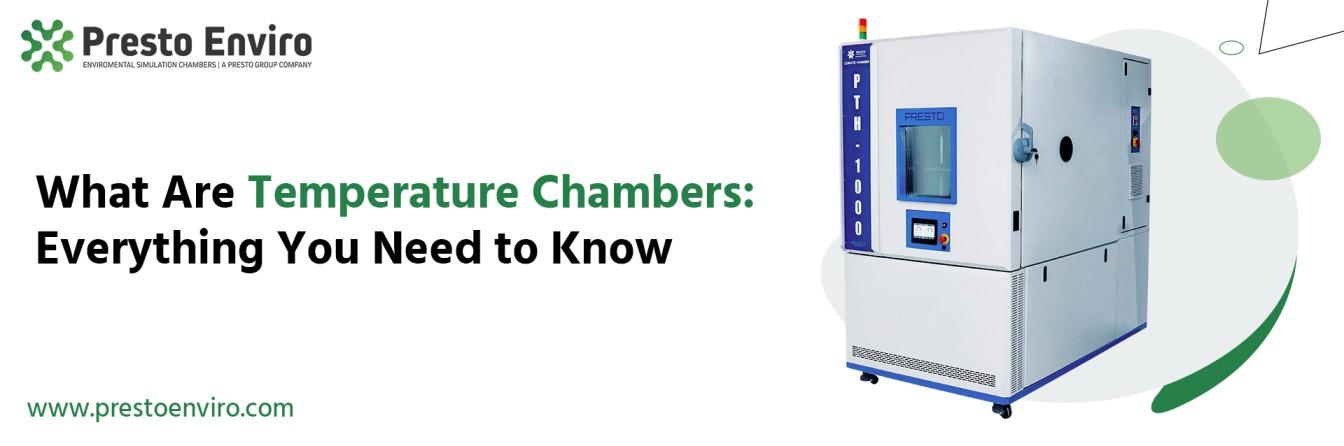
A temperature chamber is a box that keeps the air around a test sample at a controlled temperature. It can stay at one fixed temperature for a while, which is called a soak. It can follow a set pattern that changes the temperature over time with ramps, up and down, and periods of staying at certain levels. You might also hear it called a temperature test chamber, a cold chamber, or a thermal chamber. When humidity control is added, it becomes a temperature and humidity chamber, also known as a chamber.
Presto Enviro is a manufacturer and supplier of environmental test chambers in India. Its range covers chambers that simulate temperature, humidity, vibration, altitude, and thermal shock conditions, used in the automotive, electronics, aerospace, pharmaceutical, research, and renewable energy sectors. For temperature testing, it supplies walk-in chambers and the HCC Series Hot and Cold Chamber, its dedicated model for heat and cold exposure. The HCC Series supports tests under IEC, JIS, ASTM, ISO, and DIN standards, depending on the test method being followed, and can be configured in size, range, and controls to suit the customer's requirements.
The chamber can handle temperatures from -40°C up to +180°C. The control accuracy of the sensor is between ±0.1°C and ±1.2°C, and the display shows temperature in 0.1°C increments. How evenly the temperature spreads inside depends on the size of the chamber. For volumes up to 1000 liters, the uniformity is no more than 1.5°C. Between 1000 and 2000 liters, it’s up to 2.0°C. Above 2000 liters, the difference can be up to 2.5°C. The ramp rate is about 5°C per minute when going from +155°C down to -20°C. When moving linearly from +120°C to -20°C, the rate is 3°C per minute. All these values are measured in a chamber following the IEC 60068-3-5 standard.
Construction uses 1.2 mm stainless steel for the interior and 1.2 mm powder-coated cold-rolled steel for the exterior. Heating is provided by Inconel-sheathed or bare nichrome air heaters, while cooling uses an air-cooled condenser with R449A refrigerant. Operating noise stays below 75 dBA at a distance of 1 meter.
A temperature chamber operates using a closed-loop system. This system includes sensing, control, heating, cooling, and air movement. A temperature sensor, a PT100 platinum resistance sensor, checks the air temperature inside the chamber. The PID controller takes this measurement. Compares it to the setpoint. Based on the difference, it decides if heating or cooling is needed. Electric air heaters, such as those with nichrome or Inconel-sheathed elements, are used to heat the air. A refrigeration system removes heat by using a compressor, a condenser, and an evaporator. When low temperatures are needed, a cascade cooling method can be applied. This method uses two circuits that work in stages. A fan pushes the conditioned air over the specimen to keep the temperature steady. Thick insulation, like glass wool, helps prevent heat from getting into the chamber from the outside or escaping outwards.
By size and format
By function
|
Specification |
What it means |
|
Temperature range |
Lowest and highest achievable air temperature in the workspace. |
|
Ramp rate |
How fast the chamber heats or cools. Usually quoted for an empty chamber, so a loaded chamber is slower. |
|
Uniformity |
The maximum temperature difference across the workspace at steady state. |
|
Fluctuation |
How much temperature varies over time at one point. |
|
Accuracy/resolution |
Closeness of control to the setpoint and the smallest displayed step. |
|
Volume and payload |
Usable internal space and the weight it supports. |
|
Heat load |
Heat is given off by powered samples, which reduces cooling performance. |
IEC 60068-3-5 gives a method for confirming a temperature chamber's performance, and Presto Enviro states its ramp rates under it.
|
Standard |
Scope |
|
IEC 60068-2-1 (Test A) |
Cold |
|
IEC 60068-2-2 (Test B) |
Dry heat |
|
IEC 60068-2-14 (Test N) |
Change of temperature |
|
IEC 60068-3-5 |
Confirming performance of temperature chambers. |
|
MIL-STD-810, Methods 501 and 502 |
High and low temperatures for military equipment. |
|
ISO 16750-4 |
Climatic loads on automotive electrical and electronic equipment. |
Presto Enviro says that its hot and cold chamber can be used for tests that follow IEC, JIS, ASTM, ISO, and DIN standards depending on the test method. Before you qualify a product, confirm the edition of any standard and make sure that the hot and cold chamber meets the required IEC, JIS, ASTM, ISO, and DIN standards.
Built-in protections on the Presto Enviro HCC Series include:
Operating practice:
Send Presto Enviro your temperature range, ramp rate, sample size, heat load, and test standard. The team will recommend a configuration and prepare a specification-based quotation.
Temperature chambers help you see how a product reacts to heat and cold well before customers ever get their hands on it. Getting results depends on having a clear test plan, careful placement of items inside the chamber, and a chamber that matches your needs in terms of temperature range, how fast it heats or cools, and how evenly it distributes temperature. Presto Enviro. Supplies temperature chambers in India. Their HCC Series covers temperatures from -40°C up to +180°C. Can be customized to fit your specific requirements.
1. What are temperature chambers?
They are insulated enclosures that keep a specimen at a temperature or follow a set heating and cooling schedule. This allows the specimen’s performance to be tested under conditions that stay the same every time.
2. How do temperature chambers work?
A temperature sensor measures the air temperature. A PID controller turns heaters and a refrigeration system on or off to reach the setpoint. A fan moves the air around to make sure the temperature is the same.
3. What is the difference between a temperature chamber and a climatic chamber?
A temperature chamber controls temperature only. A climatic chamber controls temperature and humidity.
4. What is the difference between a temperature chamber and a thermal shock chamber?
A temperature chamber changes the temperature slowly and steadily inside one space. It uses a controlled ramp rate to do this. A thermal shock chamber works differently. It moves the specimen quickly from a zone to a cold zone. This lets it switch between temperatures faster than a regular temperature chamber.
5. Why is the ramp rate quoted for an empty chamber?
Standard performance checks such as IEC 60068-3-5 use an empty chamber. A load adds thermal mass and heat, so a loaded chamber ramps more slowly.
6. What safety features should a temperature chamber have?
Independent high and low temperature protection, heater over-temperature protection, refrigeration pressure protection, compressor protection, power protection, and an emergency stop or door interlock.
7. Can Presto Enviro customize a temperature chamber?
Yes. Chamber size, range, and controls can be configured to the test requirements and applicable standards.
Elevate your quality assurance process to new heights
Related Blogs
15-Oct-2026
Presto Enviro
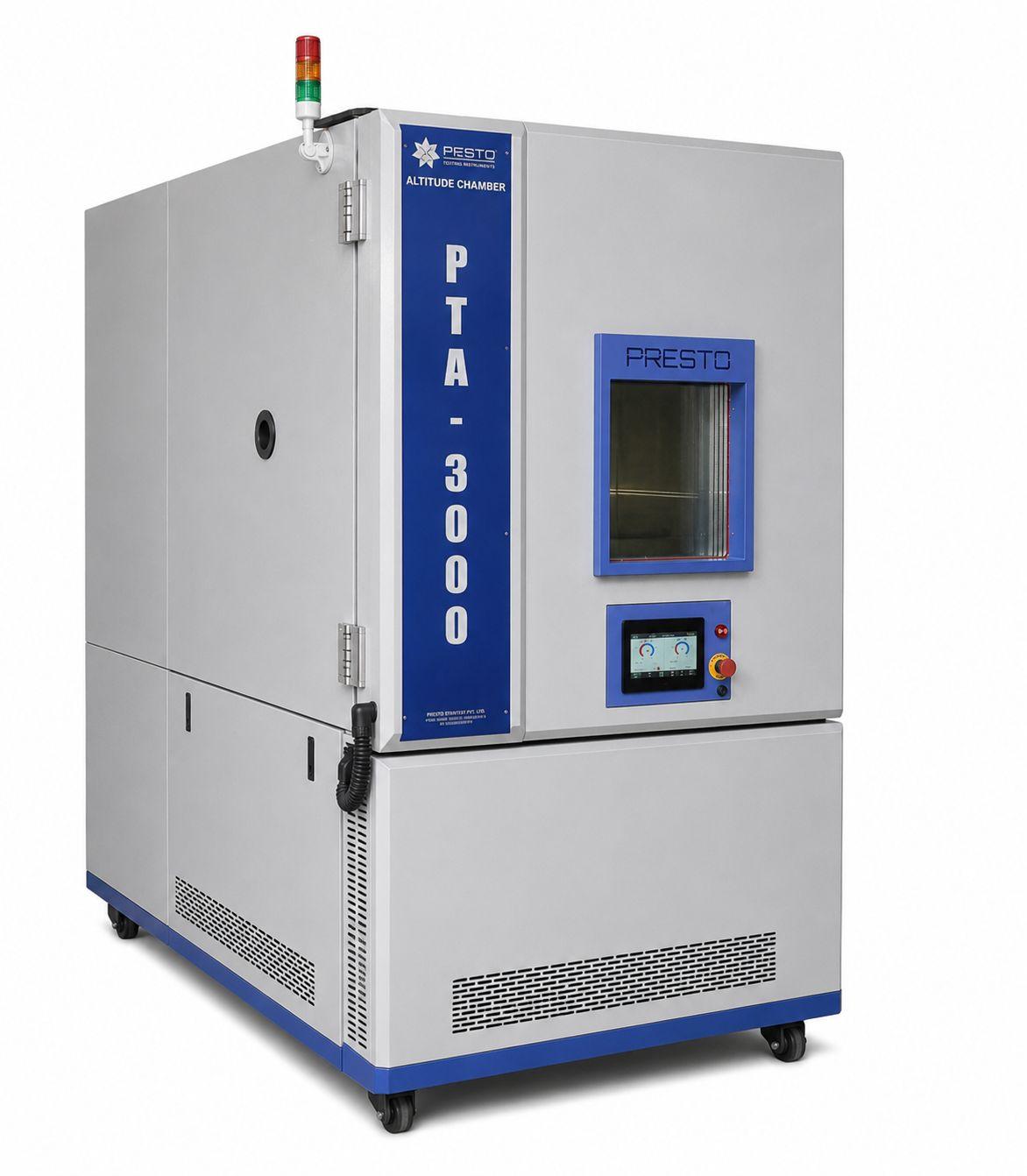
In environmental testing, vacuum chambers are also called altitude test chambers or low-pressure chambers. They lower air pressure inside a sealed chamber to simulate high altitude while controlling temperature and, in some configurations, humidity.
13-Oct-2026
Presto Enviro
An in-house lab can deliver results, give better control over product testing, and reduce testing costs in the long run. To make it work well, the lab space, equipment, utilities, and testing methods must be planned according to your needs.