© Copyright 2025. All Rights Reserved by Presto Stantest Pvt. Ltd.
15-Oct-2026
Presto Enviro
A vacuum chamber is a sealed container that a vacuum pump uses to remove air. This makes the pressure inside lower than the ambient pressure. In work related to product reliability, the term often refers to a low-pressure chamber or an altitude test chamber. It simulates the air pressure that a product experiences during air travel, flying, or when used at high elevations.
An altitude test chamber usually combines three systems:
Some laboratory chambers lower pressure while staying at normal room temperature. A combined altitude-temperature chamber, also known as a temperature-altitude chamber, includes temperature changes as well. This is because actual high-altitude environments are not just low pressure but also very cold. So these chambers test how equipment handles both conditions at the same time.
Air pressure decreases consistently as you go higher. Using the International Standard Atmosphere model:
|
Altitude (m) |
Approx. absolute pressure (kPa) |
|
0 (sea level) |
101.3 |
|
2,000 |
79.5 |
|
5,000 |
54.0 |
|
8,000 |
35.6 |
|
10,000 |
26.5 |
|
12,000 |
19.4 |
|
15,000 |
12.0 |
|
20,000 |
5.5 |
Reduced pressure affects products in several ways:
Presto Enviro is a company based in India that makes and supplies test chambers. These test chambers are designed to create environmental conditions. They can control temperature, humidity, vibration, altitude, and thermal shock. The chambers are used across industries. They are used in the electronics field, in aerospace, and by companies. Research organizations also rely on them. Renewable energy projects use these chambers too. Presto Enviro provides solutions for testing under controlled conditions. Their products help ensure quality and performance in applications.
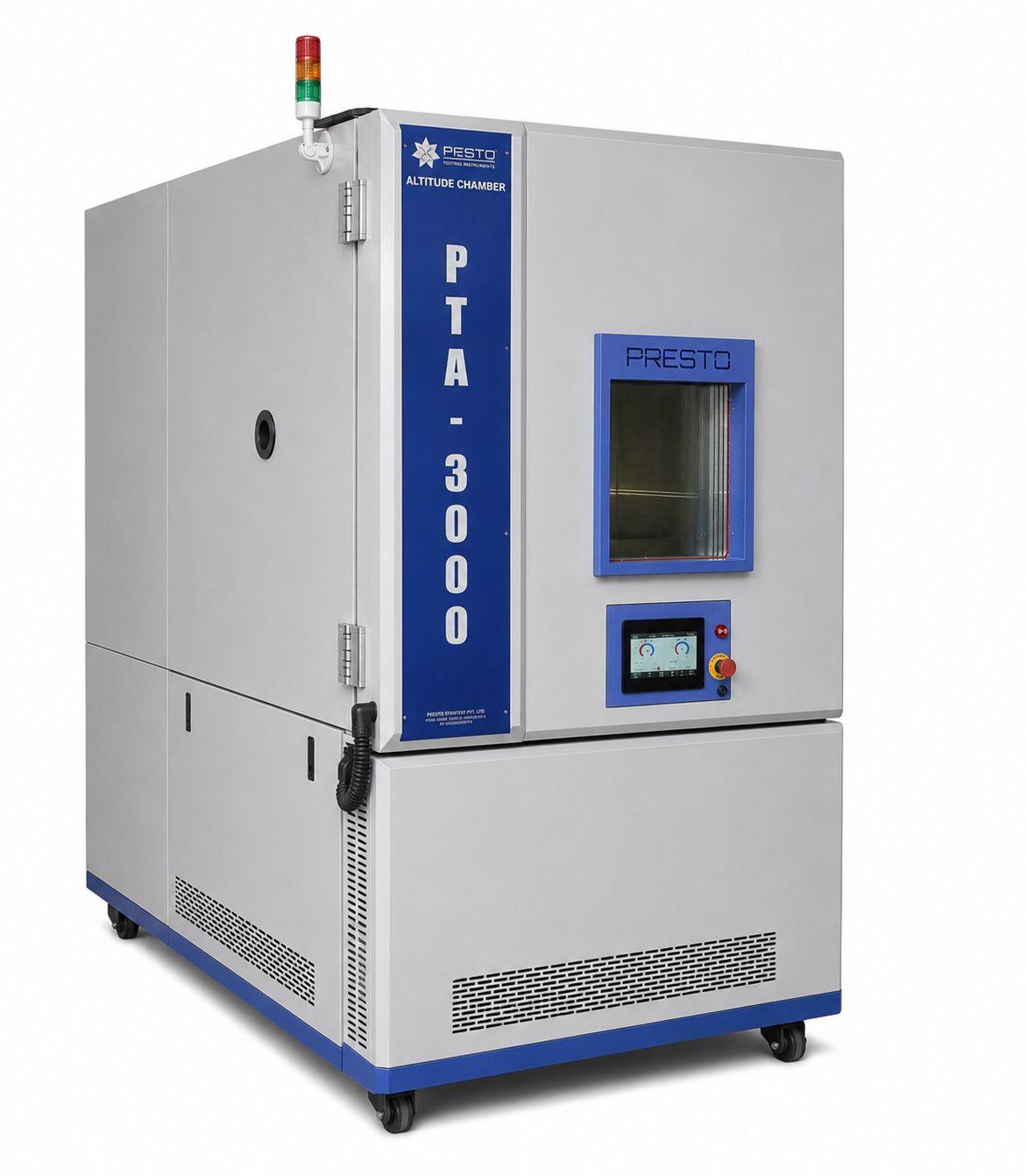
For vacuum and low-pressure testing, Presto Enviro supplies the Altitude Test Chamber in 300 L, 600 L, and 1000 L capacities. Chamber dimensions and controls can be configured to suit the test requirements and the applicable standard.
The exact profile depends on the governing standard and the product. A typical procedure runs as follows.
Step 1: Define the test requirements. List the test requirements clearly. Include the standard or specification that applies. Note the target pressure or equivalent altitude. Write down the temperature conditions. State the rate at which the pressure changes. Specify the dwell time. Indicate the number of cycles to complete. Finally, confirm whether the sample is tested while powered on (operating) or powered off (non-operating).
Step 2: Prepare the sample.
Step 3: Load and seal. Put the sample in place so air can move around it. Make sure the sample does not touch the walls, fans, or heaters. Then close the door. Lock it securely.
Step 4: Program the profile. Type in the step profile into the controller. Include pressure setpoints, temperature setpoints, ramp rates, and dwell times. Double-check the safety limits before beginning the process.
Step 5: Pump down. The vacuum pump lowers the pressure in a controlled manner. Look at the pressure number, the temperature, and any real-time information from the sample. Pick the speed at which the pressure goes down carefully because a quick drop in pressure can damage sealed samples.
Step 6: Dwell at the test condition. Keep the target pressure and temperature steady for the time that has been specified while the sample is being tested. While the equipment is running, perform and observe all functional checks.
Step 7: Return to ambient pressure. Vent through the air vent or the valve on the chamber at a slow pace. Do not try to open the door until the pressure inside and outside the chamber are the same.
Step 8: Recovery, inspection, and reporting. Allow the sample to return to room temperature. This helps stop moisture from forming on the areas when the door is opened. Do the test again to check for any leaks, cracks, breaks, or changes in color. Write down the pressure and temperature numbers in the report.
The applicable standard depends on the industry and product. Commonly referenced examples include:
|
Standard |
Scope |
|
IEC 60068-2-13 (Test M) |
Low air pressure test for electrotechnical products. |
|
IEC 60068-2-1 (Test A) and IEC 60068-2-2 (Test B) |
Cold and dry-heat tests, often combined with low pressure. |
|
GB/T 2423.21 (Test M) |
Chinese low-pressure test standard, listed on Presto's altitude-temperature chamber page alongside GB/T 2423.1 and 2423.2. |
|
MIL-STD-810 (Method 500, low pressure/altitude) |
US defense environmental test methods |
|
RTCA DO-160 (Section 4, temperature and altitude) |
Airborne equipment |
|
UN 38.3 (Test T1, altitude simulation) |
Lithium cells and batteries in transport: at least 6 hours at 11.6 kPa or lower, at ambient temperature (about 20 ± 5°C) |
|
ASTM D6653 |
Effect of high altitude on packaging systems by the vacuum method. |
Confirm the current edition of any standard and that your chamber configuration meets its requirements before qualifying a product.
The Presto Enviro Altitude Test Chamber lists these protection features:
Vacuum chambers that simulate altitude are used in different industries to create low-pressure environments. These environments help check how products work when they are at altitude. In the aviation and aerospace industries, these chambers are used to test parts and equipment under pressure and cold temperatures. The defense industry uses them to make sure equipment works in various settings, especially at high altitudes. In the industry, they help test electronics and parts that need to work in places like mountains. Electronics can be tested for how they cool down, how well they are insulated, and how they behave electrically when there is pressure. Medical devices can be tested to see if they work properly and if their packaging stays intact during air travel. For batteries, altitude simulation is part of the transport testing, including the UN 38.3 T1 test. Packaging companies can also use these chambers to see how seals and containers handle pressure changes during air shipping.
Product link: Altitude Test Chamber, Presto Enviro
Presto Enviro manufactures the Altitude Test Chamber. It is offered in three sizes:
|
Parameter |
PA300-40h-5K |
PA600-40H-5K |
PA1000-40h-5K |
|
Volume |
300 L |
600 L |
1000 L |
|
Test space (W×D×H, mm) |
650×600×800 |
800×850×900 |
1000×1000×1000 |
|
Temperature range |
-40°C to 180°C |
-40°C to 180°C |
-40°C to 180°C |
|
Ramp rate |
5°C/min average |
5°C/min average |
5°C/min average |
|
Pressure range |
Atmospheric to 1 kPa (10 mbar abs.). |
Atmospheric to 1 kPa (10 mbar abs.). |
Atmospheric to 1 kPa (10 mbar abs.). |
|
Pressure accuracy |
±0.5–1 kPa |
±0.5–1 kPa |
±0.5–1 kPa |
|
Humidity range |
10–98% RH (10–95°C) |
10–98% RH (10–95°C) |
10–98% RH (10–95°C) |
|
Tray capacity |
40 kg |
60 kg |
80 kg |
Whichever manufacturer you evaluate, check these points:
Send Presto Enviro your required pressure or altitude, temperature range, humidity range, sample dimensions, and test standard. The engineering team will recommend a configuration and prepare a specification-based quotation.
Vacuum chambers, also called altitude chambers or low-pressure chambers, help manufacturers see how products behave when pressure drops and temperatures fall. To carry out this kind of testing properly, you must prepare samples carefully, control pressure changes precisely, keep records, and perform safety checks on a regular basis. Presto Enviro provides altitude test chambers in three sizes: 300 L, 600 L, and 1000 L. These chambers can achieve pressures as low as 1 kPa and can manage temperatures from –40°C all the way up to 180°C.
1. What is a vacuum chamber in environmental testing?
The sealed chamber is a room where a pump lowers the air pressure. The sealed chamber is used in reliability testing. It is usually called an altitude test chamber or low-pressure chamber. The sealed chamber mimics high‑altitude conditions.
2. What is the difference between a vacuum chamber and an altitude test chamber?
"Vacuum chamber" is the term for any chamber that has been evacuated using a pump. An altitude test chamber is a type of vacuum chamber designed to mimic altitudes. It controls pressure, temperature, and sometimes humidity to create high-altitude conditions.
3. What are the steps of a vacuum chamber test?
Define the test, prepare the sample, and set up the instrumentation. Load the sample into the chamber. Seal it properly. Program the test profile as required. Pump down the chamber at a controlled rate. Hold the system at the test condition for the specified time. Repressurize the chamber slowly and carefully. Allow the system to recover to conditions. Inspect the sample and the chamber for any changes or damage. Prepare a report on the test results.
4. What is the UN 38.3 altitude simulation test?
This is Test T1 from UN 38.3 for lithium cells and batteries. The samples are kept for a minimum of six hours at a pressure of 11.6 kPa or lower at room temperature (about 20 ± 5°C).
5. What are the main safety risks?
The breaking of windows or containers, the popping of sealed or pressurized samples, batteries releasing gas, the exhaust from pumps, and the handling of oil, electrical problems, and exposure to very hot or very cold surfaces.
6. What safety features does Presto Enviro's chamber include?
Over-temperature protection, compressor overload protection, a refrigeration pressure safety switch, sensor failure indication, an emergency stop provision, leakage current protection, a door limit switch provision, MCB and MPCB protection, SPP protection, and an EMI filter are all the protection features planned to be included.
7. Which industries use vacuum (altitude) chambers?
Aviation, aerospace, defense, automotive, electronics, medical devices, batteries, and packaging.
Elevate your quality assurance process to new heights
Related Blogs
13-Oct-2026
Presto Enviro
An in-house lab can deliver results, give better control over product testing, and reduce testing costs in the long run. To make it work well, the lab space, equipment, utilities, and testing methods must be planned according to your needs.