12-Oct-2026
Presto Enviro
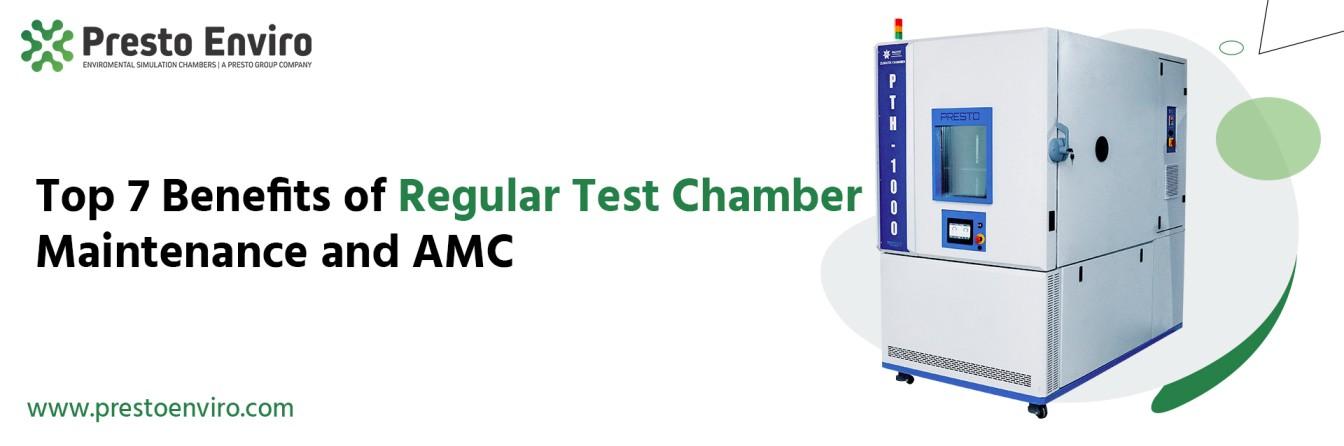
Regular test chamber maintenance and an Annual Maintenance Contract (AMC) keep an environmental test chamber accurate, available, and audit-ready. The top 7 benefits are:
A room that moves by a few degrees or a few percent of humidity can let a product that should not pass go through or make a product that should pass fail. Both situations cost a lot of money. Regular maintenance, checking the accuracy, and having a service agreement cost less than a broken testing process, a ruined batch, or something found during an inspection.
Presto Enviro is a test chamber manufacturer in India. Its after-sales services include visiting the site for maintenance, checking accuracy, providing replacement parts, helping from a distance, yearly service agreements, teaching people how to use the equipment, and helping to make sure everything works properly.
+91 977 366 6011 | response@prestoenviro.com | www.prestoenviro.com
An environmental test chamber is both a measuring instrument and a piece of machinery. Every decision you make about a product’s reliability depends on one belief: that the chamber delivered exactly what you programmed. That belief only stays true when all parts of the chamber the sensors, the refrigeration, the heating, the humidification, and the airflow- are working. Are working just as they should.
These chambers don’t fail suddenly. They wear down slowly. Sensors drift over time. Gaskets get hard and lose their seal. Condensers build up debris. Clog. The refrigerant charge drops. Humidifiers accumulate mineral scale. Fan bearings start to wear out. None of these issues set off an alarm. Each small change shifts your test conditions a little further from the target. That means your results begin to drift without you noticing.
That’s why structured maintenance matters. Catching these changes early keeps your test conditions accurate. It stops problems from becoming big ones. Without checks, even the most precise test can give misleading results.
Maintenance comes in three layers.
An AMC, or Annual Maintenance Contract, puts all these together into one agreement. It includes scheduled visits, defined response times, and a clear scope. It usually covers visits, calibration, help with breakdowns, and sometimes even parts—depending on the type of contract.
Presto Enviro's environmental test chambers are built to mimic real-world conditions so that product durability can be checked. These chambers test for temperature, humidity, and climatic conditions. Presto Enviro also offers help with setting up, starting up, calibrating, and keeping the chambers in working order.
Explore Environmental Test Chambers
The technical reason is that a chamber's control loop relies on a temperature sensor and a humidity sensor. A platinum RTD sensor, called a Pt100 sensor, can drift over time because of age, repeated temperature changes, and dirt. A capacitive humidity sensor is easily affected by dirt, condensation, and aging, so a capacitive humidity sensor often drifts more than a temperature sensor. If a temperature sensor shows a temperature that's one degree Celsius lower than it should, the chamber will run one degree Celsius higher than it should, and no warning will appear.
Regular maintenance protects data quality in several ways:
What you get: Results that stay the same every time—no matter the run, the chamber, or the lab. That consistency matters when test data is used to approve a design release or support a customer request. Meet certification requirements.
Most environmental test standards, such as IEC 60068, MIL-STD-810, ASTM, ISO, and automotive standards like AEC‑Q100, all state that test conditions must remain within defined tolerances. Labs that follow ISO/IEC 17025 and customers who audit their suppliers will ask for proof. They want to see documented evidence that the test conditions were actually controlled properly.
An AMC generates this paper trail as a by-product. A missing calibration certificate or an overdue service record is one of the common audit findings. These missing calibration certificates or overdue service records can put the test data that was generated before into doubt.
Environmental tests often take days or even weeks to complete. Humidity tests such as heat can last for hundreds of hours. Thermal cycling programs that check how reliable a product is can go on for thousands of cycles. A compressor failure on day 9 of a 10-day test ruins the test and pushes back the project.
Preventive checks catch typical failures and precursors:
|
Component |
Early warning sign |
Failure if ignored |
|
Condenser |
Dust build-up, high discharge pressure |
Compressor overheating, cooling loss |
|
Refrigerant circuit |
Slow pull-down, frosting, oil traces |
Loss of low-temperature capability |
|
Humidifier/steam generator |
Scale, slow humidity rise |
Failed humidity control, heater burnout |
|
Door gaskets |
Hardening, cracks, gaps |
Leakage, drift, frost, energy loss |
|
Circulation fan |
Noise, vibration |
Poor uniformity, motor failure |
|
Contactors and relays |
Pitting, heat marks |
Intermittent faults, stuck heaters |
|
Controller and sensors |
Erratic readings |
Wrong conditions, unsafe over-temperature |
What you gain: Problems fixed on your schedule, not in the middle of a critical test.
An environmental chamber is a capital investment. Component wear in a chamber is influenced by operating conditions. High ambient temperature, poor ventilation, hard water in the humidifier, and dust in the condenser all shorten the life of components in a chamber.
Simple habits extend it:
Maintenance costs money. Not taking care of things can cost way more. A dirty condenser, an evaporator, or a leaking door can make the compressor and the heaters work harder. When they work harder, they use energy. Small issues can grow into problems. For example, a clogged filter is simple to fix. If the compressor gets damaged, it can lead to expensive repairs. What starts small can end up costing a lot. Not taking care of the system can also cause maintenance that leads to test runs failing and needing to be done again, which adds time for the technician and more costs for samples. Emergency repairs can add more money and cause delays. In the end, regular maintenance helps lower the cost of owning something, not just the cost of the service.
Test chambers bring together power, extreme high and low temperatures, pressurized refrigerant, steam, and occasionally dangerous items such as batteries. Maintenance checks the safety layer to make sure everything is secure.
Safety systems that are never tested can fail silently. A periodic functional check confirms they will act when needed.
An AMC turns unpredictable repair expenses into a planned annual cost. It also improves service quality:
Follow your manufacturer's manual first. The table below is a practical guide.
|
Frequency |
Tasks |
|
Daily / before each test |
Visual check, door seal, drain, water level, alarm test, clear the working space. |
|
Weekly |
Clean interior, inspect humidifier and wet-bulb wick (if fitted), check condensate drain. |
|
Monthly |
Clean condenser fins and filters, inspect gaskets, check for unusual noise or vibration, check water quality. |
|
Quarterly |
Inspect electrical terminals, check contactors, verify safety cut-outs, check fans, inspect refrigerant lines. |
|
Annually (AMC visit) |
Full service, sensor calibration, temperature and humidity verification, uniformity mapping (as required), refrigerant circuit check, controller backup, service report. |
|
As per standard or customer |
Re-qualification (IQ/OQ/PQ) after relocation or major repair. |
A meaningful calibration is more than checking one point.
|
Point to check |
Why it matters |
|
Comprehensive vs. non-comprehensive |
Comprehensive contracts generally include parts, while non-comprehensive ones cover labour and visits. Check exactly what is excluded, such as compressors and sensors. |
|
Number of preventive visits |
More critical or heavily used chambers may need more than one visit a year. |
|
Response time |
Look for defined response commitments. |
|
Calibration scope |
Confirm parameters, points, certificate type, and traceability. |
|
Spare parts |
Availability and lead time for genuine parts. |
|
Remote support |
Can basic faults be handled quickly without a visit? |
|
Training |
Is operator training included? |
|
Documentation |
Service reports, calibration certificates, and audit-ready records. |
Looking for an environmental test chamber that makes test chamber maintenance simple?
Presto Enviro is a manufacturer and supplier of test chambers in India. Please tell us about your testing standards. Let us know the temperature range you need and the humidity range you require. Also share the size of the specimen you plan to test. Our team will recommend the chamber and send you a quote.
Call: +91 977 366 6011
Email: response@prestoenviro.com
Visit: www.prestoenviro.com
See the product: Environmental Test Chambers.
Test chamber maintenance is not a task; test chamber maintenance is the foundation of test results. The seven key benefits—data, audit readiness, less downtime, longer life, lower costs, safer operation, and predictable budgets—are all born from one approach. That approach is to inspect early, calibrate regularly, document everything, and involve the people who truly understand the equipment. Test chamber maintenance keeps the work running and saves money.
Whether you manage a chamber or a full lab, having a clear maintenance plan supported by an AMC delivers one of the highest returns on your chamber investment. It’s not about keeping things running. It’s about making sure they run right.
1. What is test chamber maintenance?
Test chamber maintenance means checking, cleaning, fixing, adjusting, and repairing a test chamber on a regular basis. It makes sure the temperature and humidity are correct. It also makes sure the equipment works properly and is safe to use. Test chamber maintenance is important because it keeps temperature and humidity correct. It keeps the equipment working and ensures it is safe to use.
2. What is an AMC for an environmental test chamber?
An Annual Maintenance Contract is a service agreement that happens once a year. It includes check-ups to keep things working well. It also covers checking the accuracy of measurements and fixing any problems that happen. Some contracts might have parts available if needed.
3. How often should a test chamber be calibrated?
Annually is common. The right interval depends on the quality system, standards, customer requirements, and how the chamber has performed in previous calibrations. It is suggested you ask your quality team or auditor for your requirements.
4. What is the difference between preventive and corrective maintenance?
Preventive maintenance is planned work done to stop failures from happening. Corrective maintenance is fixing something after it has already broken. Keeping the test chamber well maintained helps keep maintenance to a minimum.
5. Is comprehensive or non-comprehensive AMC better?
Comprehensive AMC usually includes parts, so the costs are more predictable, and it is good for critical or older chambers. Non-comprehensive AMC covers visits and labor, and parts are charged separately. Make sure to check the exclusions before making a choice.
6. Does Presto Enviro offer test chamber maintenance and AMC in India?
Yes. Presto Enviro's after-sales services include on-site maintenance and calibration, genuine spare parts, remote troubleshooting, annual service contracts, operator training, and performance validation support. Contact the team on +91 977 366 6011 to confirm the scope for your chamber.
7. Can Presto Enviro service chambers from other manufacturers?
Coverage for other makes depends on the model and condition. Share your chamber details with Presto Enviro, and the team will advise.
Elevate your quality assurance process to new heights
Related Blogs
© Copyright 2026. All Rights Reserved by Presto Enviro Pvt. Ltd.