© Copyright 2025. All Rights Reserved by Presto Stantest Pvt. Ltd.
10-Oct-2026
Presto Enviro
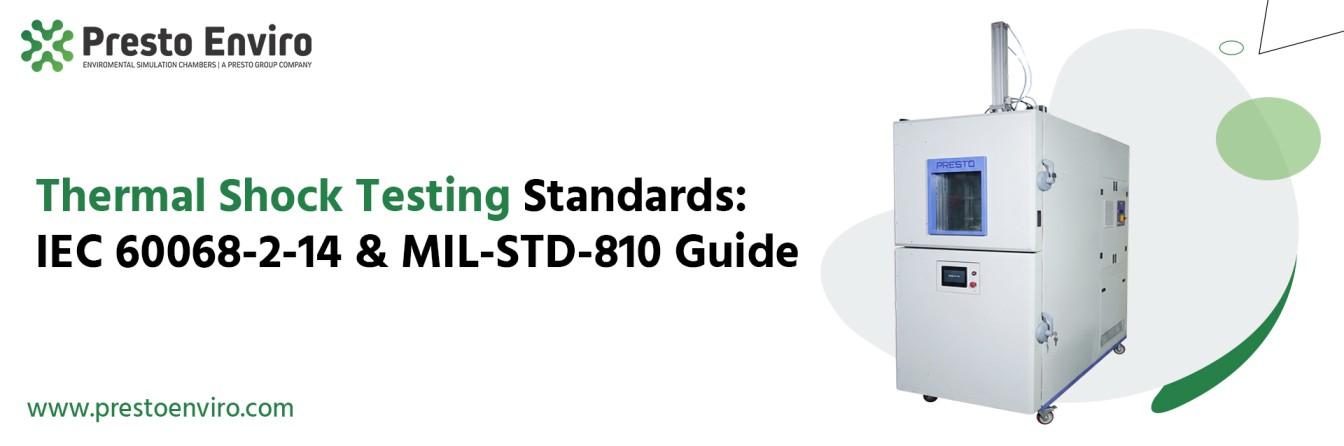
Thermal shock testing puts a product through changes from hot to cold and from cold to hot. This testing helps find cracks, delamination, solder-joint fatigue, and seal failures. Two standards are common.
IEC 60068-2-14 (Test N) is the standard that is used for commercial purposes. It has three types: Na (an air-to-air change with a set time), Nb (a change that happens at a set and controlled speed), and Nc (a shock between two liquid baths).
MIL-STD-810 Method 503 (Temperature Shock) is the US defence standard. It is based on customization. You choose the temperatures based on the real environment where the product will be used. The change between extremes must happen quickly, usually in one minute or less.
IEC 60068-2-14 standard is used when you need electronics, automotive, or industrial testing. MIL-STD-810 is the standard to use for defence, aerospace, and tough equipment. Either way, you need a chamber that has transfer times, good temperature recovery, and a setup that is calibrated and documented. Presto Enviro, a Thermal shock test chamber manufacturer in India, makes chambers that are built to IEC 60068, MIL-STD-810G, ASTM, JSS 55555, and DIN 40046.
Explore Presto Enviro’s Thermal shock test chamber ahead.
+91 977 366 6011 | response@prestoenviro.com
Materials behave differently when the temperature goes up or down. A product built using materials like silicon, copper, solder, ceramic, polymer, glass, and aluminium may contract. Contract at different rates because each material reacts to temperature changes in its own way.
When temperature changes happen fast, the materials might not adjust at the same speed. This causes stress where different materials are attached to each other. This problem is called a CTE mismatch, which stands for coefficient of thermal expansion mismatch.
Over time, repeated stress from temperature shifts can lead to cracks, layers coming apart, or other kinds of damage. These problems can slowly hurt the product's performance and its reliability. That’s why thermal shock testing is used by manufacturers. It helps them see how a product reacts to sudden temperature changes and find spots early—before the product fails in real use.
A product that can handle a temperature increase in a climatic chamber might still fail during just a few thermal shock cycles. In life, this happens often. For example, an automotive ECU can go from a cold start to a hot engine bay quickly, causing stress. An aircraft avionics unit could face sudden changes when descending from high altitude. Another case is a telecom unit that gets soaked by monsoon rain after a hot afternoon. Even if it works fine in tests, sudden shifts in temperature or moisture can break it.
Thermal shock vs. thermal cycling: Thermal shock and thermal cycling are two different methods. Thermal cycling involves changes in temperature, usually a few degrees Celsius per minute. Thermal shock involves changes where the item is moved between areas that have already been prepared. Thermal shock is harder on the material. Shows different ways things can fail. Thermal cycling is usually done in a chamber that controls both temperature and humidity. Thermal shock requires a chamber designed for that purpose.
Presto Enviro's thermal shock test chamber is a specialised testing machine that evaluates products against rapid, extreme temperature changes. It can also run cyclic tests and simulated climatic conditions. It is designed to perform tests to ASTM, ISO, JIS, and DIN standards and suits aviation, automotive, home appliance, and research applications.
Explore the Presto Thermal Shock Test Chamber
IEC 60068-2-14 is part of the IEC 60068 environmental testing series (its national equivalents include IS 9000 Part 14 in India and EN 60068-2-14 in Europe). It covers Test N, with three variants:
|
Variant |
Name |
Method |
Typical use |
|
Na |
Rapid change, specified transition time |
Air-to-air, two-zone or three-zone chamber |
Electronics, automotive, general components |
|
Nb |
Change at specified rate |
Single chamber with controlled ramp (commonly 1, 3 or 5 K/min, averaged over a short window) |
Gradual-stress simulation, thermal cycling |
|
Nc |
Rapid change, two-fluid baths |
Specimen moved between hot and cold liquid baths (non-air) |
Hermetically sealed components, severe shock |
Pre-conditioning → Initial functional check → Cycle 1..n
(cold soak t1 → transfer t2 → hot soak t1 → transfer t2)
→ Recovery at lab conditions → Final functional check → Visual inspection → Report
MIL-STD-810 is a US Department of Defense test method standard, widely adopted for defence, aerospace, and rugged commercial equipment. Its central idea is tailoring: you design tests to reflect the actual lifecycle environment, not a fixed recipe. Temperature shock is Method 503 (numbered 503.5 in MIL-STD-810G and 503.6 in MIL-STD-810H).
Method 503 checks whether equipment survives a sudden temperature change without physical damage or performance loss. The standard treats a change of roughly 10 °C or more within one minute as a temperature shock condition. It is intended for equipment that will see such transitions in use, such as an aircraft landing in a hot climate after high-altitude cold exposure, equipment moved from a heated shelter to a freezing outdoor environment, or airborne stores.
|
Aspect |
IEC 60068-2-14 (Test N) |
MIL-STD-810 Method 503 |
|
Origin |
International (IEC), commercial/industrial |
US DoD, defence/aerospace |
|
Approach |
Prescriptive variants (Na, Nb, Nc) |
Tailoring from lifecycle profile |
|
Transition |
Specified transition time (Na); specified rate (Nb) |
Fast transfer (about 1 min or less) |
|
Temperature extremes |
Selected from standard values or product spec |
Derived from service environment |
|
Exposure |
Fixed durations (10 min to 3 h) |
Until the specimen is stabilised |
|
Liquid shock |
Yes (Nc) |
Not the core method |
|
Typical users |
Electronics, automotive, appliances, telecom |
Defence, avionics, rugged devices |
|
Documentation |
Relevant specification defines the profile |
Test plan and tailoring rationale |
Most systems use one of three architectures:
Two-zone (basket transfer): A hot chamber and a cold chamber sit one above the other or side by side. A specimen basket is moved between them by a lift or shuttle. This is compact and economical. The specimen moves, which suits small parts.
Three-zone (damper / static specimen): A hot zone, a cold zone, and a central test zone. The specimen stays put while dampers direct hot or cold air through the test zone. This is the better fit for heavy, fragile, or powered specimens because there is no mechanical movement and monitoring cables can stay connected.
Liquid-to-liquid (Nc): Baskets move between two thermally controlled fluid baths. It offers the severest shock but is used for sealed components.
Before you request a quote, define these:
|
Observed defect |
Likely root cause |
Corrective direction |
|
Solder cracks after 100s of cycles |
CTE mismatch, large package |
Underfill, package change, pad design |
|
Sealed enclosure fogs |
Seal or gasket failure |
Material change, gasket compression |
|
PCB delamination |
Moisture or resin issue |
Bake-out, laminate selection |
|
Ceramic capacitor cracks |
Board flex plus shock |
Layout, soft termination parts |
|
Intermittent electrical faults |
Connector fretting |
Plating, strain relief |
When comparing manufacturers, ask each one for these in writing:
Presto Enviro supports customisation of chamber size, temperature range, ramp performance and automation to match what you are actually testing.
Need a thermal shock chamber built around IEC 60068-2-14 or MIL-STD-810?
Send us your test standard, temperature range, specimen size, and load. Our engineers will recommend the right configuration and share GA drawings and a 3D layout with your quote.
Call: +91 977 366 6011
Visit: www.prestoenviro.com
See the product: Thermal Shock Test Chamber.
IEC 60068-2-14 and MIL-STD-810 Method 503 are not competing standards. They work in different areas. IEC 60068-2-14 offers structured, repeatable test conditions for commercial product qualification. MIL-STD-810 Method 503 lets you customize the test based on actual service life needs. Even though they approach things differently, both rely on the core elements. You need extreme conditions, fast transitions that repeat enough times reliably for the specimen to stabilize, and a chamber that has proven recovery time and temperature uniformity.
Get those right and thermal shock testing becomes one of the most cost-effective ways to catch latent defects before your customers do.
1. What is IEC 60068-2-14?
The standard for change‑of‑temperature testing is called Test N. Test N describes three tests. The first test is Test Na, where Test Na involves a change of temperature and has a specified transition time. The second test is Test Nb, where temperature changes at a rate. The third test is Test Nc, which uses two baths to create a rapid change of temperature.
2. What is the difference between Test Na, Nb, and Nc?
Na moves the specimen between two air environments quickly. Na moves the specimen swiftly from one air space to another, making the change fast. Nb changes temperature at a controlled rate in one chamber. Nb carefully adjusts the temperature inside a chamber to keep it steady. Nc moves the specimen between two baths for the most severe shock. Nc places the specimen into a bath and then into a hot bath, creating the toughest shock.
3. What is the difference between thermal shock and thermal cycling?
Thermal cycling uses step-by-step temperature changes. Thermal shock uses quick, sudden jumps between very hot and very cold temperatures. Thermal shock is harsher. It can reveal problems that thermal cycling might miss. It’s like testing how something handles stress instead of slow wear.
4. How many cycles should a thermal shock test run?
The number of cycles depends on the specification. Five cycles are common in IEC‑based tests, while MIL‑STD‑810 test plans typically use at least three cycles. Reliability programs may run hundreds or even thousands of cycles.
5. Why does recovery time matter?
The sample starts only after the chamber is stable. A slow recovery while under load can ruin a test or make the cycle take longer. Always request recovery information from the manufacturer for your specific load mass.
6. Two-zone or three-zone chamber?
Two-zone chambers move the specimen and suit small parts. Three-zone chambers keep the specimen still, which suits heavy, fragile, or powered specimens with connected cables.
Elevate your quality assurance process to new heights
Related Blogs
23-Sep-2026
Presto Enviro
Products are expected to work reliably for months or years, but manufacturers cannot always wait that long to find out how they will perform. Accelerated aging testing solves this problem by exposing products to controlled environmental conditions that speed up certain aging effects.
20-Sep-2026
Presto Enviro
Battery safety is not something manufacturers can check only after a battery is ready for use. Temperature, charging conditions and repeated use can change the way a battery behaves. In some cases, excessive heat can cause permanent damage or create serious safety risks.