© Copyright 2025. All Rights Reserved by Presto Stantest Pvt. Ltd.
19-Oct-2026
Presto Enviro
A test chamber, also called an environmental chamber, is an enclosed system that maintains controlled conditions around a test specimen. Depending on its configuration, it can control:
Manufacturers use test chambers to reproduce conditions a product may meet during transport, storage, or use. This shows whether it keeps working within its required limits and helps qualify it against a standard.
Presto Enviro is a manufacturer and supplier of test chambers in India. The company provides chambers that are built to mimic conditions like temperature changes, humidity, vibration, altitude, and thermal shock. These systems are used for testing in areas like electronics, aerospace, pharmaceuticals, research, and renewable energy. The company offers chamber sizes, temperature ranges, and control features. These can be chosen based on the test being done and the standards that apply.
The temperature chambers take samples. Expose them to controlled heat or cold, or a specific temperature range. The moving fans inside the chamber help to circulate the air so that the temperature can change quickly and be uniform. These chambers are often used to test electronics, plastics, rubber, oils, and parts when they are in different temperature situations.
Humidity chambers manage both temperature and relative humidity together. This allows manufacturers to watch how materials and products behave when they are around moisture. These chambers are frequently used to treat fabrics, paper, and packaging materials. They also play a role in checking how well electronic and electrical parts handle moisture. When dealing with textiles, humidity conditioning can be carried out according to the ASTM D1776 standard.
Climatic chambers, also known as climate test chambers, are machines that allow us to set temperatures and humidity for product testing. Climatic chambers are very useful because they let us observe how products and materials behave when climatic chambers expose them to weather conditions for periods. Climatic chambers are often used for electronics, automotive parts, packaging, plastics, and batteries.
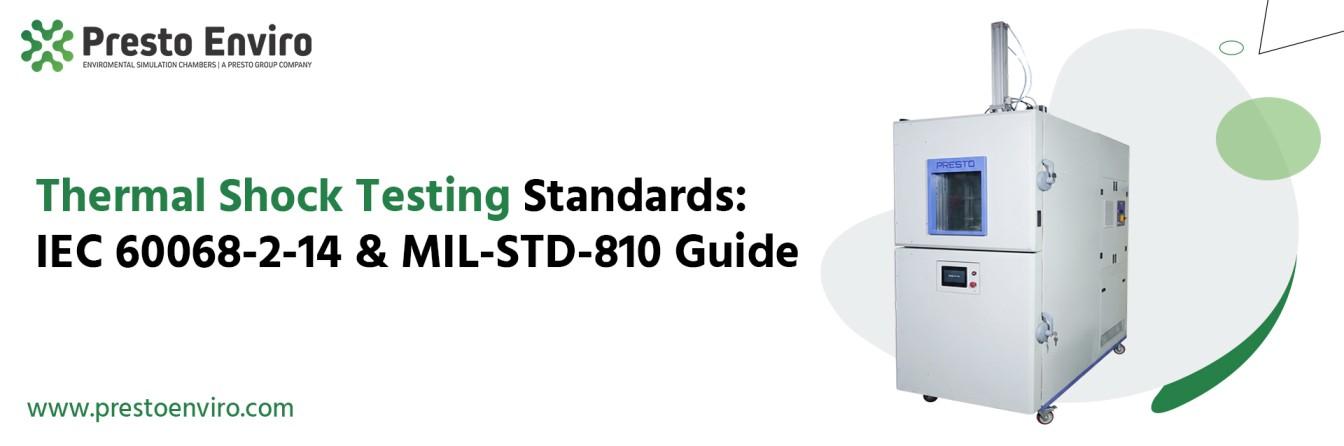
Thermal shock and rapid temperature change chambers put samples through repeated shifts between hot and cold. Thermal shock systems usually move the sample back and forth between two zones—one hot and one cold. Rapid-change chambers achieve the effect inside just one chamber. These tests are important because they show how materials react under stress from heating and cooling. They can reveal problems in solder joints, seals, coatings, and other parts that may fail due to expansion or contraction. The standard IEC 60068-2-14 (Test N) provides guidelines for testing how things respond to changes in temperature.
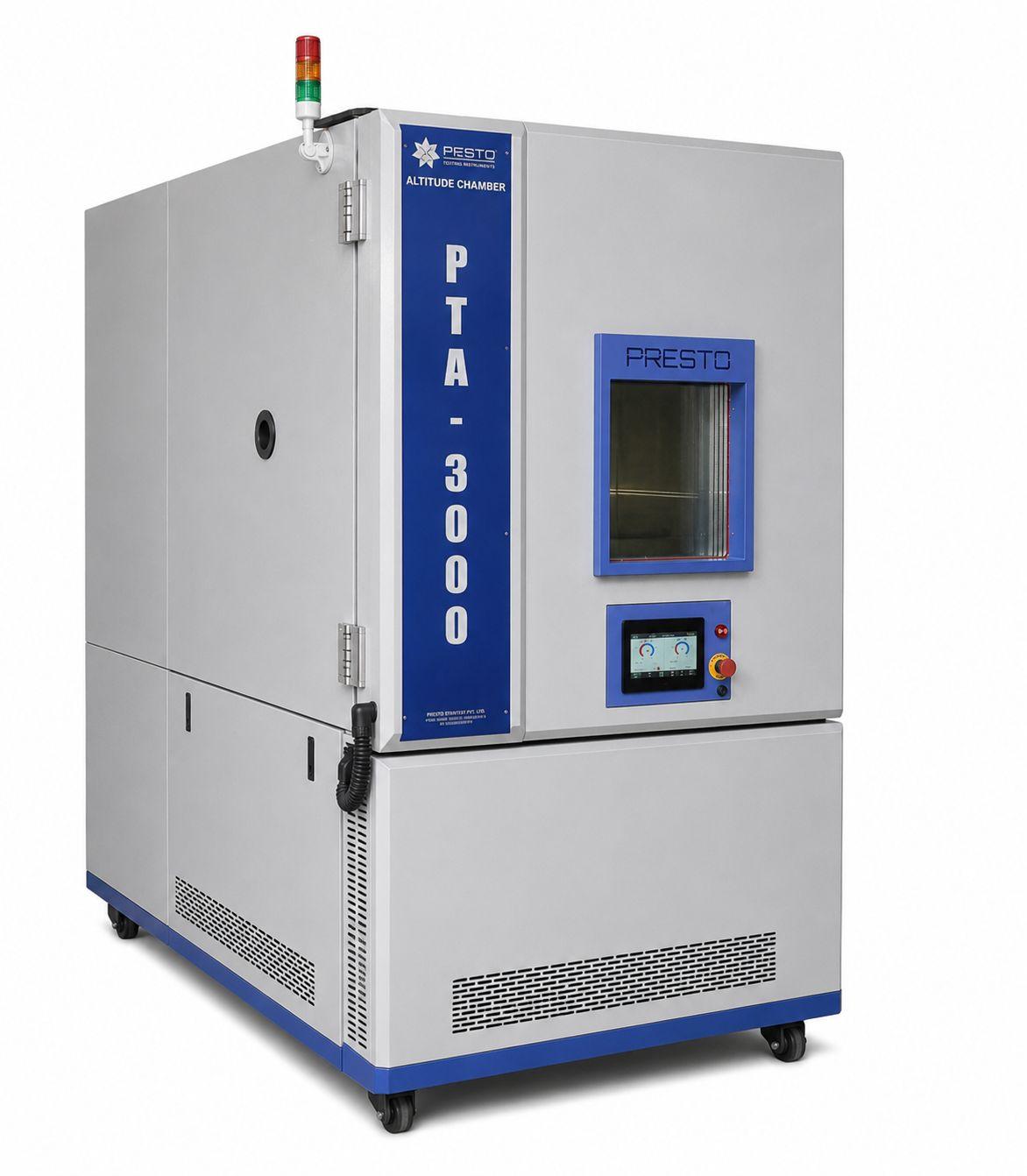
Altitude chambers lower the air pressure to mimic the conditions found at altitudes. They can also manage temperature. Depending on how the chamber is set up, controlling humidity might be possible too. These chambers are also known as vacuum chambers. They are used for testing in fields like aviation, aerospace, defense, automotive, electronics, medical devices, and batteries. Some important standards are IEC 60068-2-13, MIL-STD-810, and UN 38.3, for testing lithium batteries during transport.
Stability chambers keep temperature and humidity steady for periods of time so we can see how products change as time goes on. Stability chambers are a tool for stability studies with pharmaceuticals, cosmetics, chemicals, and packaging. Pharmaceutical stability testing follows ICH guidelines, especially ICH Q1A. ICH Q1A tells us the long‑term and accelerated storage conditions that should be used, such as 25°C and 60% RH or 40°C and 75% RH.
Weathering chambers are used to look at how materials react to sunlight, temperature, moisture, and rain as time goes by. Xenon arc chambers use lamps that are made to copy the light from the sun. UV fluorescent chambers use ultraviolet lamps. Also have cycles like condensation to simulate certain weathering situations. These chambers are often used for paints and coatings, plastics, polymers, textiles, and car parts to check for changes like fading, breaking, and getting worse. Some standards that go along with this are ASTM G154, ASTM G155, and ISO 4892.
Salt spray chambers expose test samples to a controlled salt fog environment. This helps in checking how well materials resist corrosion. Cyclic corrosion chambers go a step further. They combine salt fog, drying, and humidity cycles. This creates a realistic and varied corrosive setting. These chambers are often used for metals, coated surfaces, and parts in industry. ASTM B117 is a test method. It uses a 5% sodium chloride solution at a temperature of 35°C. This test is called neutral salt spray testing. It is widely accepted for evaluating corrosion resistance.
Water ingress test chambers use controlled water sprays or jets to check how well an enclosure keeps out water. The tests help measure protection against water entry. The IP code system, which stands for Ingress Protection, is set by IEC 60529. These tests are often used on enclosures, lighting products, automotive parts, and consumer electronics. They show how well the products resist water damage.
Walk-in and drive-in chambers offer a big area where you can test large parts. These chambers are perfect for testing items, full systems, many samples, or even cars. The inside space, how the door opens, how hot or cold it can get, and the way it works can all be changed to fit the test you need. They are useful when regular lab chambers are too small for what you need to test.
|
Chamber type |
Main stress |
Typical applications |
Common standards |
|
Hot and cold |
Temperature |
Electronics, plastics, components |
IEC 60068-2-1, 2-2 |
|
Humidity |
Temperature and moisture |
Textiles, packaging, electronics |
IEC 60068-2-78, ASTM D1776 |
|
Climatic |
Temperature and humidity, wide range |
Product qualification, durability |
IEC 60068, MIL-STD-810 |
|
Thermal shock / rapid change |
Fast temperature swings |
Solder joints, seals, coatings |
IEC 60068-2-14 |
|
Altitude |
Low pressure |
Aerospace, batteries, packaging |
IEC 60068-2-13, UN 38.3 |
|
Stability |
Long-term temperature and humidity |
Pharma, cosmetics, chemicals |
ICH Q1A |
|
Weathering |
UV, light, moisture |
Paints, plastics, textiles |
ASTM G154, G155, ISO 4892 |
|
Water ingress |
Water spray and jets |
Enclosures, lighting |
IEC 60529 |
Product link: Climatic Test Chamber, Presto Enviro
|
Parameter |
Specification |
|
Temperature range |
-70°C to +180°C (±0.5°C) |
|
Humidity range |
20% to 98% RH (±2.5% RH) |
|
Control |
PLC with touchscreen, programmable cycles, and dwell times. |
|
Air circulation |
Centrifugal baffles for uniform distribution. |
|
Refrigeration |
Cascade cooling with eco-friendly refrigerants |
|
Construction |
SUS 304 stainless steel, interior and exterior |
|
Internal size (W × H × D) |
1000 × 1000 × 1000 mm |
Send Presto Enviro your test type, temperature and humidity range, sample dimensions, and governing standard. The team will recommend a configuration and prepare a specification-based quotation.
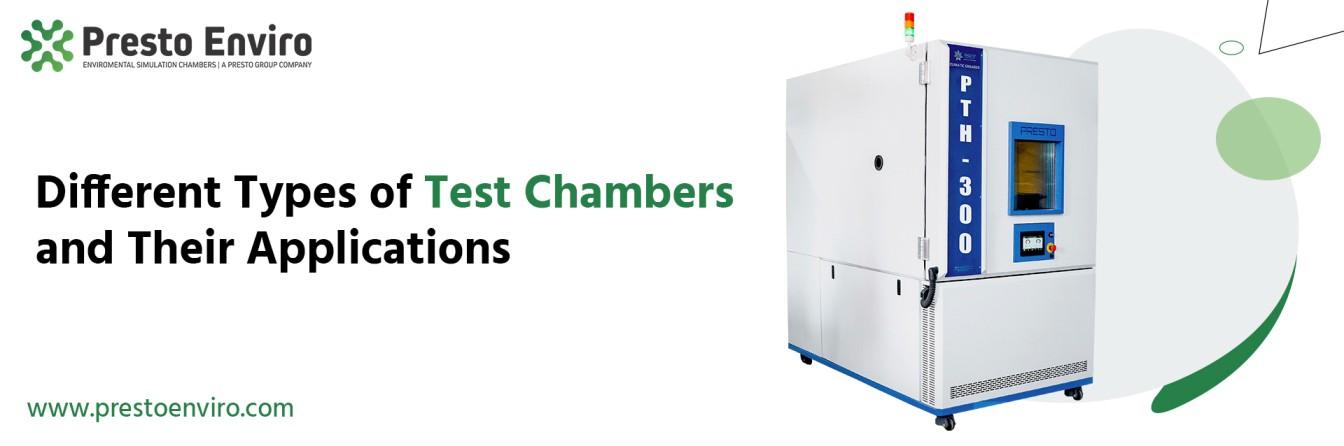
The kinds of test chambers are different because of the stress they create: heat, wetness, pressure, light, rust, or water. Chambers that are hot and cold, humid, climatic, thermal shock, altitude, stable, weathering, salt spray, and water entry each solve a question about how reliable something is. Big products can be tested with walk-in or drive-in versions of these chambers. Picking the right one starts with the rules that are in place, how many samples there are, and what range is needed. Presto Enviro. Provides these kinds of chambers in India and sets them up according to what the customer needs for testing.
1. What is the difference between a humidity chamber and a climatic chamber?
A humidity chamber controls temperature and humidity over a defined range. A climatic chamber usually offers a wider range and more programmable cycling. The exact capability depends on the configuration.
2. What is a thermal shock chamber used for?
That test exposes products to repeated temperature extremes. That test shows how temperature extremes can cause failures due to expansion rates, such as cracked solder joints, seals, and coatings.
3. What is an altitude test chamber?
It lowers the air pressure to create altitude while keeping the temperature steady. In some settings, it can also manage humidity. Many people call this device a low‑pressure or vacuum environmental chamber.
4. What is a stability chamber used for?
It keeps the temperature and humidity the same for a period of time so that we can study how products stay stable. This is mostly used for medicines, beauty products, chemicals, and boxes that hold things. ICH Q1A talks about how medicines should be stored.
5. What does a salt spray chamber test?
It tests the corrosion resistance of metals and coatings. ASTM B117 uses a 5% sodium chloride solution at 35°C. Cyclic chambers add drying and humidity phases.
6. What is the difference between UV and xenon weathering chambers?
UV chambers use UV lamps and include cycles that create condensation. Xenon arc chambers use lamps that produce a spectrum very similar to natural sunlight.
7. What are walk-in and drive-in chambers?
Walk-in chambers are big enough for an operator to go inside. They are used for assemblies or many samples at once. Drive-in chambers are even larger. They can fit vehicles and big equipment.
8. How do I choose a test chamber?
Define the stress and the governing standard. Measure the sample and confirm the range of the controls and the total cost. Specify any combined tests, such as altitude and temperature, at the start.
Elevate your quality assurance process to new heights
Related Blogs
21-Oct-2026
Presto Enviro
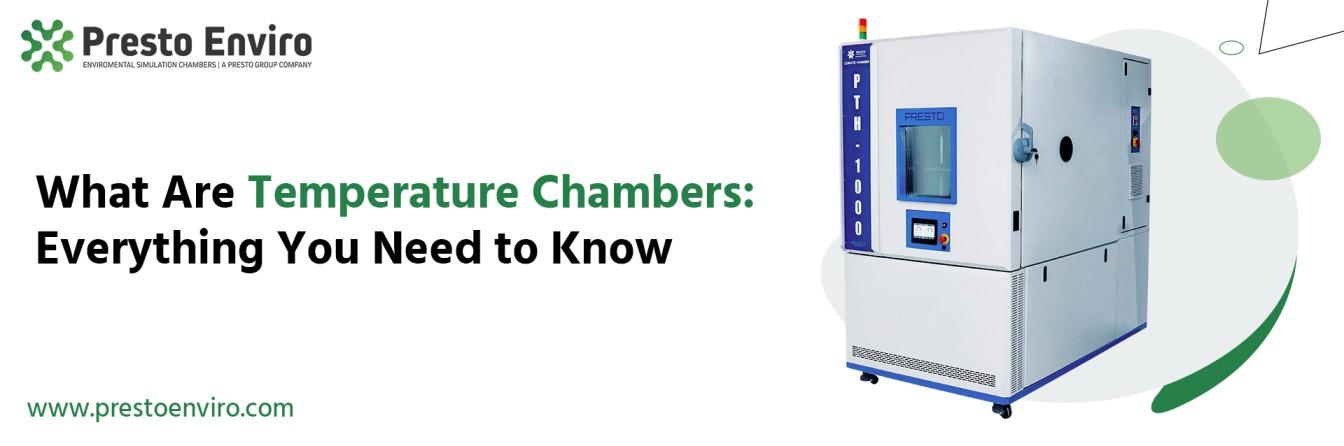
Temperature chambers are insulated boxes. They keep a product at a specific temperature. They can move it through different temperature levels in a set pattern. This lets people test how the product behaves when it's hot or cold.
15-Oct-2026
Presto Enviro
In environmental testing, vacuum chambers are also called altitude test chambers or low-pressure chambers. They lower air pressure inside a sealed chamber to simulate high altitude while controlling temperature and, in some configurations, humidity.
13-Oct-2026
Presto Enviro
An in-house lab can deliver results, give better control over product testing, and reduce testing costs in the long run. To make it work well, the lab space, equipment, utilities, and testing methods must be planned according to your needs.