© Copyright 2025. All Rights Reserved by Presto Stantest Pvt. Ltd.
23-Oct-2026
Presto Enviro
A standard reach-in chamber has shelves where samples are placed. This setup works well for things like a circuit board or a battery cell. It doesn't work for larger items such as a full instrument panel, an engine assembly, a telecom rack, a pallet of packaged goods, or an entire vehicle. Testing these items in parts can miss failures that only show up when the whole product is exposed together.
Large climatic chambers solve this problem by having enough space to fit the full item inside. They control temperature and humidity across a room-sized area. The same basic controls used in chambers are applied here—sensing, heating, refrigeration, humidification, and air circulation—all working together to create a stable environment.
A climatic test chamber controls both temperature and relative humidity. It follows a programmed profile of ramps and dwells to reproduce conditions such as heat, cold, damp heat, and humidity cycling. The term is used for chambers of any size, from benchtop to vehicle scale.
A walk-in chamber is large enough for a person to enter when the chamber is not running a test. Its interior height is typically that of a room, so operators can load and unload products, mount them on racks or fixtures, connect instrumentation, and inspect the article without lifting it into a shelf.
Presto Enviro's WIC Series has an interior height of 2100 mm across the range. Walk-in chambers suit large products and many samples in a single run.
A drive-in chamber is built to take vehicles or heavy equipment. The floor is reinforced to carry the load, and the doors are wide, sometimes with extra headroom, to admit the article. It may be a walk-in chamber scaled up, with the floor and door design changed for vehicle access.
Presto Enviro describes its walk-in and drive-in chambers as engineered for large products or numerous specimens at once and configures the size, range, and controls to the test requirement.
The choice usually follows the test article.
If the article is a large component, an assembled unit, a rack of equipment, or a quantity of packaged goods, a walk-in chamber is the right size. If the article is a whole vehicle or too heavy or too large to move by hand or trolley, a drive-in chamber is needed.
Then check the same points as for any chamber: the temperature and humidity range in your test standard, ramp rates, the heat load the sample gives off, and the volume needed for airflow around the article.
|
Parameter |
Walk-In Chamber |
Drive-In Chamber |
|
Test article |
Components, assemblies, racks, packaged goods |
Complete vehicles, heavy equipment |
|
Access |
Standard or wide door, loaded by hand, trolley, or pallet truck |
Wide or full-width door, vehicle driven or rolled in |
|
Floor |
Standard floor, rated for racks and trolleys |
Reinforced floor rated for vehicle or equipment weight |
|
Interior height |
Room height (WIC Series: 2100 mm) |
Extra headroom, depending on vehicle |
|
Typical volume |
8 to 40 m³ (WIC Series) |
Larger, configured per vehicle |
|
Ventilation |
Standard |
Exhaust extraction if the engine runs inside. |
|
Typical industries |
Electronics, telecom, pharma, packaging, automotive components |
Automotive, defense, heavy equipment |
|
Presto Enviro offer |
WIC Series |
Custom configuration on request. |
The sequence follows any climatic test. The test plan defines the standard, temperature, and humidity levels, ramps, and dwells. The article is inspected and given a baseline functional test, then placed in the chamber and instrumented with sensors and leads through the cable ports.
The profile is programmed with safety limits, and the chamber and article are monitored during the run. Dwell time normally starts once the article itself, not only the air, has stabilized. At the end, the article goes back to environmental conditions slowly to stop moisture from forming; then it is tested again and checked carefully.
Larger articles take longer to reach a temperature because they hold more heat. This means the time spent staying at a temperature and the time it takes to change temperature depend on the article itself. It's not about the room. The article's size and material play a role. You have to think about how much heat it can store. That affects how fast it warms up or cools down. So the article matters as much as the environment.
|
Standard |
Scope |
|
IEC 60068-2-1 (Test A) |
Cold |
|
IEC 60068-2-2 (Test B) |
Dry heat |
|
IEC 60068-2-78 |
Damp heat, steady state |
|
IEC 60068-2-30 |
Damp heat, cyclic |
|
IEC 60068-2-14 (Test N) |
Change of temperature |
|
MIL-STD-810 |
Military environmental methods |
|
ISO 16750-4 |
Climatic loads on automotive electrical and electronic equipment. |
Presto Enviro states that its temperature test chambers support testing under IEC, JIS, ASTM, ISO, and DIN standards, depending on the test method. Confirm the current edition of a standard before qualifying a product.
Walk‑in and drive‑in chambers are found in sectors such as automotive, electronics, aerospace, defense, pharmaceutical, telecommunications, and packaging. Walk‑in and drive‑in chambers are often used for tasks such as:
Because people can enter these chambers, safety covers more than the equipment. Personnel should enter only when the chamber is not running a test and has returned to a safe temperature. Chambers reaching low temperatures or very high humidity are hazardous to enter mid-test.
The WIC Series includes a seven-point alarm function, overshoot temperature alarm, test completion alarm, low water level indication, remote monitoring alarms, manual and automatic emergency shutdown, and a safety door and leakage circuit breaker protection. Where a vehicle engine runs inside a drive-in chamber, exhaust gas must be extracted to keep the air safe.
Product link: Walk-In Temperature Humidity Test Chamber, Presto Enviro
Presto Enviro is a manufacturer and supplier of environmental test chambers in India. Its range covers chambers that simulate temperature, humidity, vibration, altitude, and thermal shock conditions, used in the automotive, electronics, aerospace, pharmaceutical, research, and renewable energy sectors. The WIC Series walk-in chamber is built for large products and many specimens at once, and the Presto Enviro configures size, range, and controls to the customer's requirements.
The WIC Series controls temperature from -65°C to 80°C. You can choose from four range options. The lower limit can be set at 0°C, -20°C, -40°C, or -65°C. This depends on the test standard you are following. Temperature fluctuation is kept within ±0.5°C. Temperature uniformity is ±2.0°C between -40°C and 80°C. Between -65°C and -40°C, the uniformity is ±2.5°C. For humidity, the chamber controls levels from 20% to 95% RH. Humidity fluctuation is ±1.5% RH. Uniformity for humidity is ±3.0% RH.
Interior volumes range from 8 m³ (1970 × 2100 × 1970 mm) up to 40 m³. The chamber comes in six sizes. The interior is made of SUS304 steel. The exterior is built with powder-coated rolled steel. Insulation includes 100 mm of polyurethane and 10 mm of mineral wool. For refrigeration, semi-hermetic Bock or Bitzer compressors are used. The system has a water-cooled condenser and uses R404A, R23, and R508 refrigerants. Humidity is created using a steam humidifier. A centrifugal blower moves the air around the chamber.
The chamber is controlled by a Presto-programmed touchscreen, with run-time graphs, data recording, USB export, password-protected settings, pass/fail reports, fault history, email notification, and remote monitoring.
Send Presto Enviro your test article dimensions and weight, temperature and humidity range, ramp rates, heat load, and test standard. The team will recommend a configuration and prepare a specification-based quotation.
The difference between walk-in and drive-in climatic chambers comes down to what you need to test. Walk-in chambers hold large components and many samples, with operator access for loading and set-up. Drive-in chambers take whole vehicles, with reinforced floors and wide entries. Presto Enviro manufactures and supplies walk-in chambers in India, with the WIC Series covering -65°C to 80°C, and configures larger chambers to the customer's test article.
1. What is a walk-in climatic test chamber?
It is a room-sized chamber that controls temperature and humidity and is large enough for an operator to enter, load, and instrument large products or many samples.
2. What is a drive-in test chamber?
It is a larger chamber with a strong floor and wide doors. This allows vehicles or heavy machines to be driven or rolled inside for testing.
3. What is the main difference between walk-in and drive-in chambers?
The test article and the access. Walk-in chambers suit components, racks, and assemblies, while drive-in chambers are built for whole vehicles and heavy equipment, with reinforced floors and wider entries.
4. Do drive-in chambers need special ventilation?
If a vehicle engine runs inside during the test, exhaust gas must be extracted to keep the chamber air safe.
5. Is it safe to enter a walk-in chamber during a test?
No. Enter only when the chamber is not running a test and has returned to a safe temperature.
6. What safety features does the WIC Series include?
A seven-point alarm function, overshoot temperature alarm, test completion alarm, low water level indication, remote monitoring alarms, manual and automatic emergency shutdown, and a safety door and leakage circuit breaker protection.
Elevate your quality assurance process to new heights
Related Blogs
21-Oct-2026
Presto Enviro
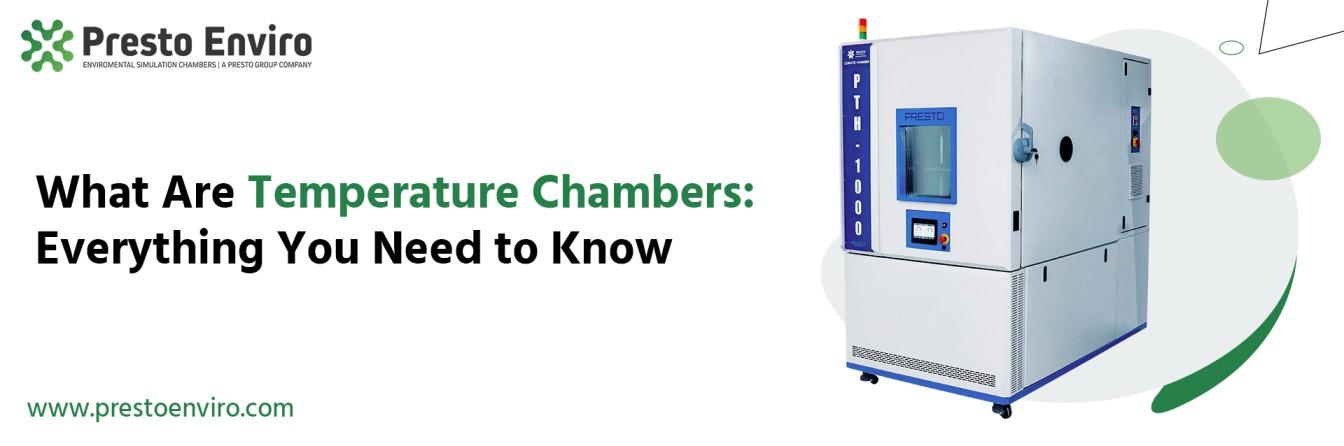
Temperature chambers are insulated boxes. They keep a product at a specific temperature. They can move it through different temperature levels in a set pattern. This lets people test how the product behaves when it's hot or cold.
15-Oct-2026
Presto Enviro
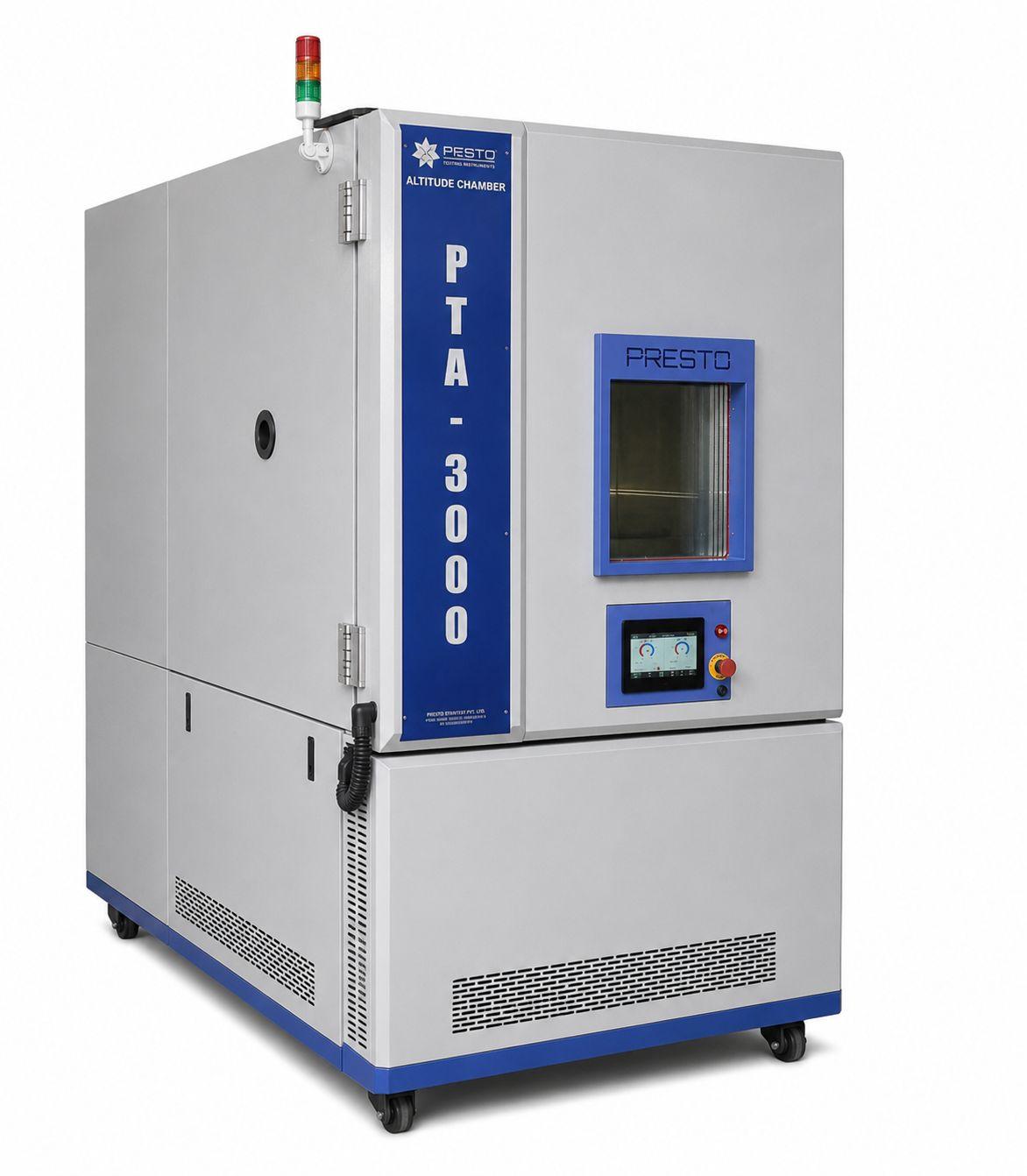
In environmental testing, vacuum chambers are also called altitude test chambers or low-pressure chambers. They lower air pressure inside a sealed chamber to simulate high altitude while controlling temperature and, in some configurations, humidity.
13-Oct-2026
Presto Enviro
An in-house lab can deliver results, give better control over product testing, and reduce testing costs in the long run. To make it work well, the lab space, equipment, utilities, and testing methods must be planned according to your needs.