18-Nov-2026
Presto Enviro
A car bracket that rusts within one monsoon period, a fastener that shows pitting during service at an offshore platform, and an electrical enclosure that corrodes within one year in coastal regions—the financial impact of corrosion runs into billions yearly. That is why any decent manufacturer has corrosion resistance testing as a mandatory part of their product development.
In this article, we discuss the procedure manufacturers use to test products for corrosion resistance, the standards, and the reason the salt spray chamber is the most popular tool for the job.
The gradual decay of a metal by virtue of a chemical process taking place on the metal in its surrounding environment is termed corrosion.
Testing for corrosion resistance helps manufacturers to:
Corrosion in reality may take years to occur. The laboratory test reduces this time frame to hours, days, or weeks.
There is no single test that suits every product. Manufacturers typically choose from these approaches.
The most frequently adopted method. Here, the samples are sprayed continuously with a fine mist of the salt solution within an enclosed container. It is fast, predictable, and well-understood; hence its application in the areas of specification and quality control.
The salt is made acidic using acetic acid, increasing its corrosive nature. The salt can normally be used for the creation of decorative surfaces, for example, copper-nickel-chrome deposits.
The copper chloride solution is introduced, and after that, the temperature is increased so that the test becomes quite difficult. In general, the CASS test is recommended for testing anodized aluminum and decorated materials.
In cyclic testing, there is cycling between salt spray, dry, and humidity environments. Cyclic testing better reflects the actual environment because of its similarity to real-life situations. It is used mainly by automakers.
The parts are subjected to high humidity and elevated temperatures to observe their performance in a moist environment.
The corrosion rates can be evaluated using the potentiodynamic polarization and electrochemical impedance spectroscopy approaches. These are good options for lab experiments, but they must be used in addition to the chamber testing approach.
The samples are put in racks in marine, industrial, or tropical settings, where they remain for several months or years. It gives the most accurate results but is a lengthy process and, therefore, is only used to confirm laboratory results.
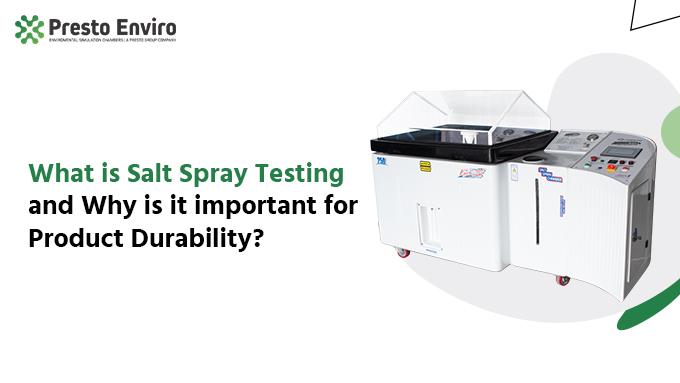
Salt Spray Chamber (salt fog chamber/salt mist chamber) creates a corrosive atmosphere to test any kind of product in a controlled environment. This chamber has gained much popularity for the following reasons:
Make sure to always know which standard and what test period is needed.
Step 1: Samples should be prepared. Test specimens should be cleaned to remove any oil, dust, and fingerprint marks except as noted in the specification. If corrosion creep is to be evaluated using a defective surface, the surface may be marked or scribed.
Step 2: The salt solution is prepared. In case of a neutralization test, the solution can be prepared by using pure salt dissolved in distilled or deionized water to make a 5% solution of sodium chloride.
Step 3: Chamber environment setup. The temperature inside the chamber during the NSS test is kept at about 35 degrees Celsius. The liquid is converted to fog using air pressure, and the fog deposition rate is measured using collection cylinders.
Step 4: Arrange the specimens. The specimens will be placed at an angle set by the standard, which is usually tilted, in such a way that the mist is distributed evenly and the liquid does not flow to other specimens.
Step 5: Perform the test. The test is performed for a certain period of time, ranging from 24 hours to more than 1,000 hours, according to the item or specification being tested.
Step 6: Inspection/Evaluation. Once the specimens are exposed to the environment, the specimens are then cleaned and inspected for any occurrences of white rust, red rust, blistering, pitting, and creep in the scribed areas.
Step 7: Document the results. Results can be traced and compared since photographs, measurements, and evaluations are documented in the test report.
Pass or fail criteria depend on the product and customer requirements. Evaluators commonly check:
Standards such as ASTM D1654, D610, and D714 are often used to rate scribe creep, rusting, and blistering.
Although the salt spray test is one of the best tests for comparison and consistency of coatings, this particular test poses some limitations. The constant spraying of salt fog does not replicate the real-life situation of the material, including wet and dry cycles, ultraviolet rays, and pollution.
Manufacturers can get the best out of this type of test by combining it with cyclic testing and field testing when necessary.
When selecting equipment for your corrosion resistance test, consider the following:
The corrosion resistance testing that gives you reliable results ensures safety for your product, your clients, and your reputation. Whether you opt for neutral salt spray testing or cyclic corrosion testing, the correct technique will ensure that you are able to identify potential flaws before it's too late.
Here at Presto Enviro, we assist manufacturers, laboratories, and R&D departments in choosing the appropriate environmental testing equipment.
Ready to upgrade your corrosion testing? Talk to the Presto Enviro team today.
Call: +91 977 3666 011
Email: response@prestoenviro.com
Request a quote for a salt spray chamber and get expert guidance on the right setup for your products.
This is done by subjecting the material to an artificial environment that causes corrosion, such as a salt fog environment, humidity, and variations in temperature. This test determines whether the material can withstand rusting or decaying.
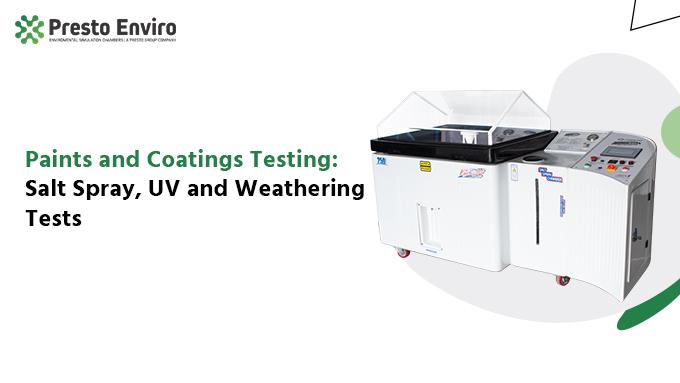
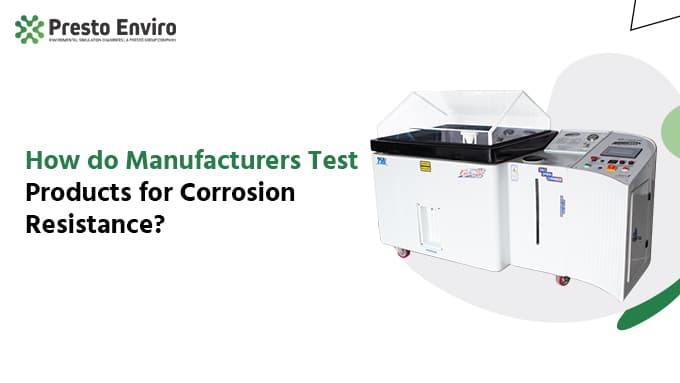
The salt spray chamber is used to develop an artificial environment for corrosion of items inside it. The salt spray chamber can be used in several tests, such as for paints, coatings, and plating metals.
Among these, the two most commonly followed standards are ASTM B117 and ISO 9227. Other popular ones include IEC 60068-2-11 and JIS Z 2371, depending on the industrial and geographical location of your choice.
It all depends on the product and specification. Typical times vary from 24 hours to over 1,000 hours. Finishes used for decoration would require less time, whereas those applied for protection would require more time.
Salt spray subjects test specimens to fog throughout. In cyclic corrosion testing, exposure is done by changing from fog with salt to humidity; hence, it is more natural compared to real-life scenarios.
The labs perform testing of the fog collection rate, pH, and temperature on a regular basis, either weekly or at the start of each test, while calibration is performed once a year or as required by the quality system.
Absolutely. Paints, platings, and coatings are often subjected to corrosion tests. Although plastics don’t undergo corrosion, the coating or any metals inserted within them can be tested for corrosion.
Think about your specifications, including sample size, batch volume, temperature control, construction quality, and after-sales support. Our Presto Enviro can assist you in making the correct choice of configuration. Call +91 977 3666 011 or email response@prestoenviro.com.
Elevate your quality assurance process to new heights
Related Blogs
© Copyright 2026. All Rights Reserved by Presto Enviro Pvt. Ltd.