© Copyright 2025. All Rights Reserved by Presto Stantest Pvt. Ltd.
12-Nov-2026
Presto Enviro
A solar module is sold on a promise: 25 years or more of reliable power output. But a rooftop in Rajasthan or a solar farm in Gujarat can swing from freezing nights to scorching afternoons, day after day, for decades. Modules that haven’t been tested against this stress can fail early through cracked cells, broken interconnects, or delaminated layers.
This is why solar panel testing is a core part of module qualification and why thermal cycling is one of the most important tests in the IEC 61215 standard.
IEC 61215 is the international standard for design qualification and type approval of crystalline silicon terrestrial photovoltaic (PV) modules. A companion standard, IEC 61646, covers thin-film modules. IEC 61215 exposes sample modules to a series of accelerated stress tests that simulate years of field exposure in a short time. These include:
If a module passes through the above cycles, then it proves to be capable of enduring the rigors of outdoor conditions. From the point of view of the producer, obtaining the IEC 61215 certificate may become a requirement for tenders and export.
Solar modules consist of laminated layers of glass, an encapsulant, solar cells, solder ribbons, a back sheet or rear glass, a frame, and a junction box. The materials all have their own expansion and contraction rates depending on the temperature variation.
On a daily basis, a module experiences heating due to the sun’s rays during the daytime and cooling during the nighttime. This process happens thousands of times, and each cycle causes mechanical fatigue. A thermal cycling test aims to identify:
Most of these flaws don’t become evident on day one but manifest themselves within months or years of use in the field. Thermal cycling uncovers them within weeks in a lab environment.
The temperature cycling test (MQT 11 in the standard) exposes the solar power generation module to fluctuating temperatures between two extremes in the climatic chamber. The important variables for this test include
The pre-test and post-test examination of the module includes visual inspection, determination of maximum power, insulation resistance testing, and wet leakage current testing. The module can be considered to meet the requirements if there are no severe visual defects, no open circuit is found, no insulation defect is detected, and there is no power degradation beyond that specified in the standard (generally 5%).
Always check with the current version of the standard, since changes were made in both test procedure and tolerances.
The accuracy of the test result depends solely on the quality of the equipment used for it. Poorly managed chambers may give wrong data about temperature distribution, failed audits, or excessive/insufficient loadings of modules. This affects both the results of the certification process and the operation of your product.
A dedicated solar panel test chamber should provide:
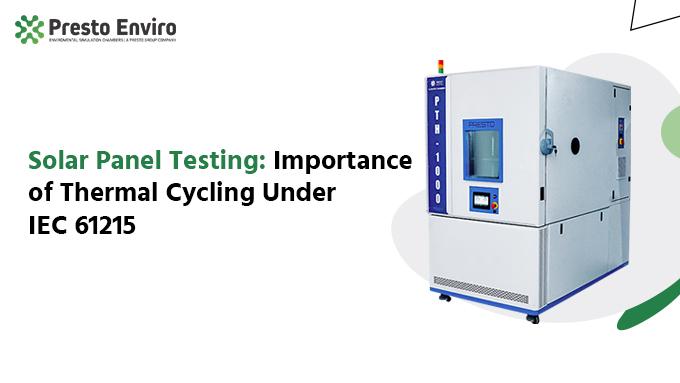
Presto Enviro is a manufacturer of environmental testing chambers from India, with a specialized series of solar panel test chambers and solar testing instruments. This series comprises thermal cycling test chambers, damp heat test chambers, and humidity freeze test chambers, encompassing all major environmental cycles mentioned in IEC 61215.
Chambers offered by Presto Enviro are highly accurate, reliable, and have an extended lifespan. Chambers can be customized according to various dimensions and demands of the tests, and the company offers after-sales support to its clients.
Looking for a solar panel test chamber that meets IEC 61215 requirements? Talk to the Presto Enviro team for a recommendation and quotation.
Thermal cycling is among the most enlightening tests in the solar panel testing process since it determines whether the materials and the bonding in the panels can withstand the cycles of temperatures they will be subjected to throughout their useful lifespan. The equipment used is fundamental to generating trusted IEC 61215 test results.
If you wish to design your test equipment or improve on existing ones, go for a chamber that is well suited for PV testing.
What is thermal cycling in the testing of solar panels?
Thermal cycling is a test in which a solar panel is exposed to alternating heating and cooling cycles at extreme temperatures within a climatic chamber. This test helps identify the limitations of a solar panel, such as solder fatigue, cell cracking, interconnect failure, and delamination.
What makes the need for thermal cycling in IEC 61215 tests necessary?
IEC 61215 standards are used for qualification testing of crystalline silicon PV modules. The test is incorporated due to the fact that temperature-stress is one of the most common modes of failure of the modules.
How many cycles are there in the solar panel test?
The complete test requires 200 cycles (TC200). However, a 50-cycle test (TC50) is carried out in another test sequence, which is combined with UV preconditioning and humidity freeze.
What are the conditions to qualify for the thermal cycling?
The module must not have any apparent visual faults, any open circuits, or any insulation failures. The power loss during thermal cycling shall not exceed the specified limit, which is usually not more than 5% per cycle.
Is it possible for Presto Enviro to tailor their chamber based on my module size?
Yes. There is a range of chamber options available at Presto Enviro that come in various sizes, which can be customized based on your needs.
Elevate your quality assurance process to new heights
Related Blogs