16-Nov-2026
Presto Enviro
With batteries being used in all types of devices from smartphones and e-bikes to electric vehicles and grid storage, a battery that overheats, expands, or catches fire poses significant dangers. This is why battery testing is an essential part of the process before any battery cell, module, or pack is released on the market.
In this guide, we will find out how the thermal stability testing of batteries is done, what standards are employed in this testing, and how a battery testing chamber makes this possible.
It must be noted that lithium-ion batteries are vulnerable to changes in temperature. Elevated temperatures accelerate chemical reactions inside the battery; however, if the heat is not released, a phenomenon called “thermal runaway” takes place. The temperature quickly increases, gases start to build up, and the cell will vent, burn, or even explode at worst.
Colder temperatures also cause problems for lithium-ion batteries because during charging processes, lithium plating takes place.
Battery testing helps manufacturers to:
A complete test program usually combines environmental, electrical, and mechanical tests. Here are the most common ones.
Temperature extremes are tested on batteries either by storage or by running them in order to evaluate any capacity degradation, leakage, swelling, or drifting. This is among the most common applications of the battery testing chamber.
Samples are subjected to repeated cycling in temperature extremes between hot and cold. This helps to identify the weak points in seals, welds, electrodes, and casing due to expansion and contraction.
Exposure to high moisture levels and temperatures is done on batteries to determine the effects of moisture on their terminals, casings, insulation, and electronics. This is significant for goods that operate in tropical or coastal conditions.
The battery will be heated to a particular temperature and held for a period of time in order to verify that there won’t be an incidence of burning or explosion. Standards provide for the particular temperature and duration required, depending on the type of cell and standard.
The battery is charged to an amount more or less than its rated capacity so that it can be subjected to electrical endurance testing.
The terminal connections are short-circuited under controlled conditions and sometimes even at high temperatures in order to examine the cell reaction to the high current flow.
Some of these tests involve crush, impact, dropping, nailing, vibration, and shock. These tests simulate an accident situation, harsh treatment, and transport and are carried out in order to evaluate any internal short circuit or failure of structure.
The batteries are subjected to low-pressure conditions to mimic air travel to verify that there is no leakage, venting, or rupture.
In the case of modules, packs, and energy storage systems, thermal runaway is induced in one cell and then monitored for any chain reaction that propagates to adjacent cells. This is an important aspect of the design of safe EVs and stationary energy storage systems.
Tools that study the production of heat in materials and cells, such as Accelerated Rate Calorimetry (ARC) and Differential Scanning Calorimetry (DSC), help scientists find the starting point of exothermic reactions.
The exact tests and limits depend on the battery type and the market. Commonly referenced standards include:
Prior to testing, always refer to the latest copy of the standard, as well as the requirements set out by your client or certification agency.
Step 1: First, design a proper testing process. The choice of the test process should come before any action taken towards putting anything into the oven, such as the standard test process that will be used, the temperature levels, and how long the batteries should stay at each.
Step 2: Prepare your samples. Record the initial values of the voltages, weights, sizes, and impedances of the batteries. Then charge or discharge them to the required state of charge according to the experiment’s requirements.
Step 3: Battery instrumentation. Connect thermocouples to the exterior of the battery and use the voltage and current cables to monitor the activity from the access hole in the chamber.
Step 4: Load the chamber properly. The batteries need to be arranged in such a way that air is allowed to flow freely all around them.
Step 5: Temperature profile implementation. The furnace is heated up to a particular temperature and maintained at that temperature for the requisite amount of time, depending on the temperature profile created in Step 1.
Step 6: Pay attention to safety problems. Watch out for venting, smoking, bulging, leaking, fire, or unusual rise in temperature. Make sure that the safety interlocks are installed to automatically shut down the experiment in case of any problem.
Step 7: Re-inspect and measure. After the testing procedure is completed, allow the batteries to return to normal room temperature before conducting a voltage, capacity, and weight measurement, as well as an inspection of the batteries' physical characteristics.
Step 8: Everything must be documented. Document the test conditions, observations made, data log, and final pass/fail determination. This document is traceable in nature and often necessary for certification purposes.
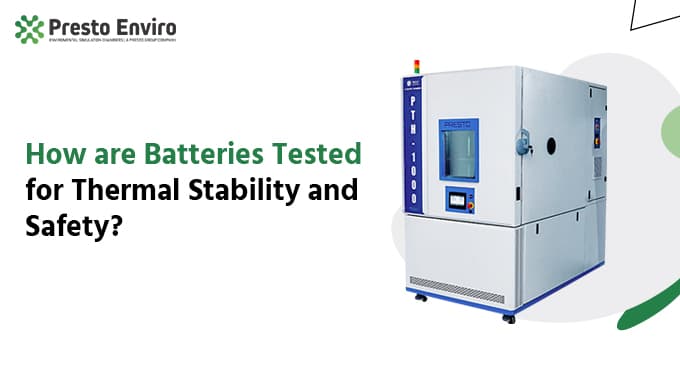
This is what a battery test chamber is—a chamber where temperature and even humidity are controlled. It ensures that testing is accurate, reproducible, and comparable. In contrast to improvised testing chambers like an oven or a room, a special test chamber ensures the following:
Batteries may fail unexpectedly during testing, so it is as crucial to test safety as performance. Seek out:
Battery testing forms the basis of safety and reliability in energy storage. The use of temperature cycling, thermal abuse, electrical stress, and mechanical testing will enable the manufacturer to know how the battery will react in real and extreme environments and design the battery accordingly.
The design of the battery testing chamber ensures that the testing process is accurate, repeatable, and, more importantly, safer for your team.
Presto Enviro helps battery manufacturers, EV manufacturers, labs, and R&D teams locate environmental testing equipment.
Ready to strengthen your battery testing setup? Talk to the Presto Enviro team today.
Call: +91 977 3666 011
Email: response@prestoenviro.com
Request a quote for a battery test chamber and get expert guidance on the right configuration for your testing needs.
The test process that is used in assessing the performance and safety of the battery through different electrical, thermal, and mechanical stressors is called battery testing. This is done in order to ensure that the battery performs and works properly even under adverse conditions.
Battery thermal runaway occurs spontaneously when there are self-powered and self-sustained temperature increases in batteries. There is an increase in reactions that generate heat, causing venting, fires, and explosions.
A battery testing chamber is a facility that provides controlled conditions of temperature and sometimes humidity and is used for testing the behavior of batteries at high temperatures, low temperatures, cycling, and humidity.
Requirements that can be included are UN 38.3 for transportation requirements, IEC 62133-2 for Portable Sealed Secondary Batteries and Cells, IEC 62619 for Industrial Batteries, UL 1642 & UL 2054 for Cells and Batteries, UL 2580 for Electric Vehicle (EV) Batteries, and UL 9540A for Energy Storage Systems. The requirements in India include IS 16046 & AIS-156.
It all depends on your standard and applications. Battery tests require temperature conditions ranging from sub-zero to high temperatures, so ensure that the chamber has the ability to operate within your required range of temperatures with a little buffer.
Not always. The reason is that environmental chambers are only used for environmental conditioning, not to create any abnormal conditions like fire, venting, and explosion. A proper enclosure that is designed for overcharge, short circuit, and thermal runaway tests is required.
A thermal cycling test changes temperature gradually from hot to cold and vice versa, while a thermal shock test changes temperature very rapidly. Nonetheless, both kinds of tests will highlight any weaknesses in materials and mechanisms.
UN 38.3 is a requirement for transportation by air, water, or road of lithium cells or batteries. Passing the UN 38.3 test ensures that the battery will withstand various conditions, including variations in altitude, extreme temperatures, vibration, shock, and electrical failure.
The calibration frequency varies from lab to lab, but most will do it at least once per year, or as required by their quality system or certification body.
Consider the tests you run, temperature and humidity range, chamber size, ramp rate, safety features, software, and after-sales support. Presto Enviro can help you select the right setup. Call +91 977 3666 011 or email response@prestoenviro.com.
Elevate your quality assurance process to new heights
Related Blogs
© Copyright 2026. All Rights Reserved by Presto Enviro Pvt. Ltd.