© Copyright 2025. All Rights Reserved by Presto Stantest Pvt. Ltd.
03-Mar-2025
Presto Enviro
Several industries, such as pharmaceutical, food, and electrical, ensure very important product stability. Surrounding conditions such as climatic conditions, humidity levels, and illumination can cause materials to break down, impacting their security and performance. Product stability testing is essential to comply with standards.
To solve this issue, stability chambers maintain a controlled environment that recreates practical storage conditions. Stability chambers regulate temperature and humidity with precision, ensuring consistent and reliable results that help industries establish ideal storage conditions and product shelf life.
This article will explore the fundamental principles of stability chambers, their types, and their applications across various industries. We will also look at the challenges in stability testing and how modern technology makes these chambers more efficient and reliable.

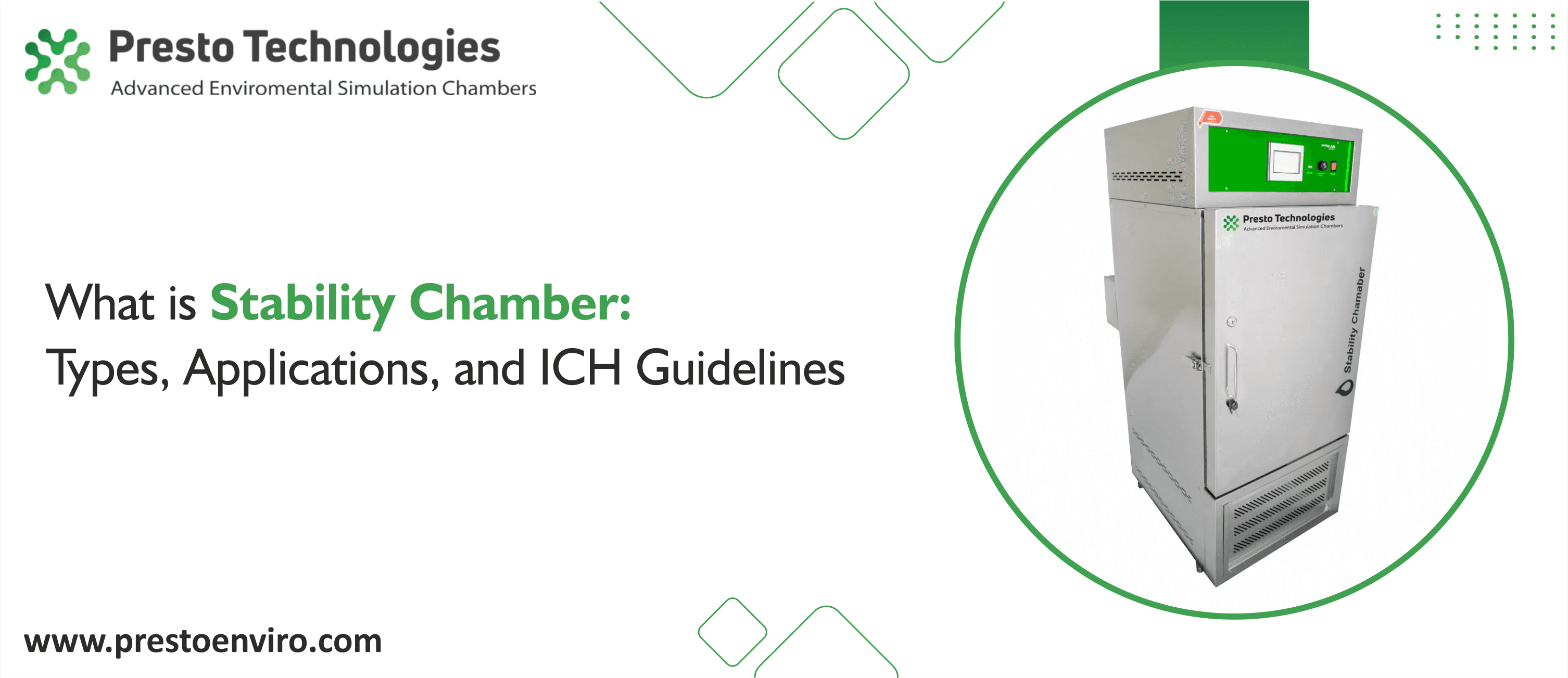
Stability chambers are special machines that copy the storage conditions found in places like warehouses, pharmacies, and stores. It is a specialized device used for testing the stability of products by reproducing different climatic conditions such as temperature, humidity, and light. This helps check how long the product lasts and if it stays effective over time.
A stability chamber particularly consists of the following components a Temperature and Humidity control system, an insulated chamber, an Air circulation system, a data recording system, and some safety features.
Temperature and Humidity control system: Maintains exact storage conditions.
Insulated chamber: Keeps inside conditions stable by reducing outside effects.
Air circulation system: Distributes air evenly to prevent fluctuations.
Data recording system: Records conditions for tracking and compliance.
Safety features: It consists of alarms and safety features to protect samples.
A stability chamber works by creating a controlled environment to test how products react to temperature, humidity, and other conditions over time. It maintains a stable temperature which also keeps relative humidity consistent. “Relative humidity” refers to the ratio of the amount of moisture in the air to the maximum amount the air can hold”.
As the temperature goes up, the air can hold moisture, which reduces moisture level. This process allows temperature and humidity to adjust together automatically. This helps industries determine product shelf life, quality, and safety under different storage conditions.
A stability chamber operates on the principle that maintaining a constant temperature will also stabilize air moisture levels. As the temperature goes up, the air can hold more water, which lowers the relative humidity. This process allows temperature and humidity to adjust automatically at the same time.
The working principle of stability chambers consists of various factors such as thermal equilibrium, humidity regulation, airflow management, and data logging.
There are several types of stability chambers, including Reach-In Stability Chambers, Walk-In Stability Chambers, Photostability Chambers, Humidity Chambers, Thermal Shock Chambers, and Vacuum Chambers. Each type is designed for specific environmental testing needs across various industries.
Reach-In chambers are small and convenient, perfect for testing limited samples and handling slight condition changes. It maintains temperature and humidity to test product stability in limited spaces.
Advantages:
Disadvantages:
Walk-in chambers are better for storing many samples and keeping stable conditions for a long time because of their larger size. They keep temperature and humidity stable, making them used for long-term stability testing in different industries.
Advantages:
Disadvantages:
Humidity chambers are designed to regulate moisture levels and test products in a controlled environment. Humidity chambers are made to match the client’s specific environmental needs.
Advantages:
Disadvantages:
This testing is very tough and challenging. It exposes a sample to fast environmental shifts and temperature changes of 30 Degrees Celsius or more per minute. It is used for products that must handle extreme levels of pressure.
Advantages:
Disadvantages:
A vacuum chamber lowers air pressure by removing gases from a sealed space. This test checks how a product works in a vacuum, especially for aerospace and defense applications.
Advantages:
Disadvantages:
Stability chambers are used in a variety of industries such as Electronics, Pharmaceutical, Military, and plastic industries and many more. The following are the major industries where stability chambers are used frequently –
Stability chambers test how well electronic parts work in different conditions. They control temperature, humidity, and pressure to ensure reliability, prevent damage, and extend product life. This is important for circuit boards, semiconductors, and other electric devices.
Stability chambers help the military by testing weapons, equipment, and materials in extreme conditions. They create harsh climates like high humidity, extreme heat, and pressure changes to ensure reliability. This improves the lifespan, performance, and safety of military gear in real-world situations.
Stability chambers test plastic materials by exposing them to controlled temperature, humidity, and UV Lights. This helps check color fading, and strength, ensuring products meet quality standards, and perform well in real conditions.
The pharmaceutical industry focuses on developing, studying, and marketing medicines to support medical research. Since people worldwide need these drugs, proper production is a top priority. Poorly made medicines can cause harmful side effects.
Image 3 (Add an image of a pharmaceutical workplace that display working with stability chamber)
Stability testing in the pharmaceutical industry is essential to ensure drugs remain safe under different conditions. Stability chambers help by testing medicines under various temperatures, humidity levels, pH, radiation, and more. In the pharmaceutical industry stability chambers are essential for:
The International Council for Harmonization of Technical Requirements establishes the guidelines for stability testing that are adhered to by global entities, including the Food and Drug Administration, the European Commission, and Health Canada.
For industrial purposes, these guidelines are explained in six ICH documents, from Q1A to Q1F. According to these standards, stability chambers must keep humidity within 5%, and temperature changes within 2-3 Degrees Celsius. They must track minimal changes over extended timeframes.
The ICH guidelines for stability chambers include temperature, humidity, light, and other conditions. These guidelines help ensure that pharmaceutical products are safe and effective over time.
Under stability chamber guidelines, storage conditions include, but are not limited to:
Our pharmaceutical stability chambers can also control custom ICH conditions such as 30/75, 30/35, 25/40, 40/25, 5°C, and -20°C
The International Council for Harmonisation (ICH) provides guidelines for stability testing under the following documents:
When selecting a stability chamber many considerations should be kept in mind such as capacity and size, temperature and humidity range, meeting with industry standards, accuracy and maintenance, etc.
Capacity and size: Make sure it matches the needed testing capacity
Temperature and humidity range: Confirm adherence to regulatory standards
Data Logging and Monitoring: Always choose current tracking features
Compliance Industry standards: Assures it meets the guidelines such as FDA, and ICH guidelines.
Accuracy and maintenance: Select a chamber with a durable build and minimal maintenance.
It can be concluded that stability chambers play a crucial role in maintaining controlled environments that are vital for testing the stability of pharmaceutical products, ensuring they remain effective and safe over time. By adhering to industry guidelines, stability chambers help organizations achieve reliability and consistency in their testing processes, ultimately supporting product quality and consumer safety.
Elevate your quality assurance process to new heights
Related Blogs
15-Oct-2026
Presto Enviro
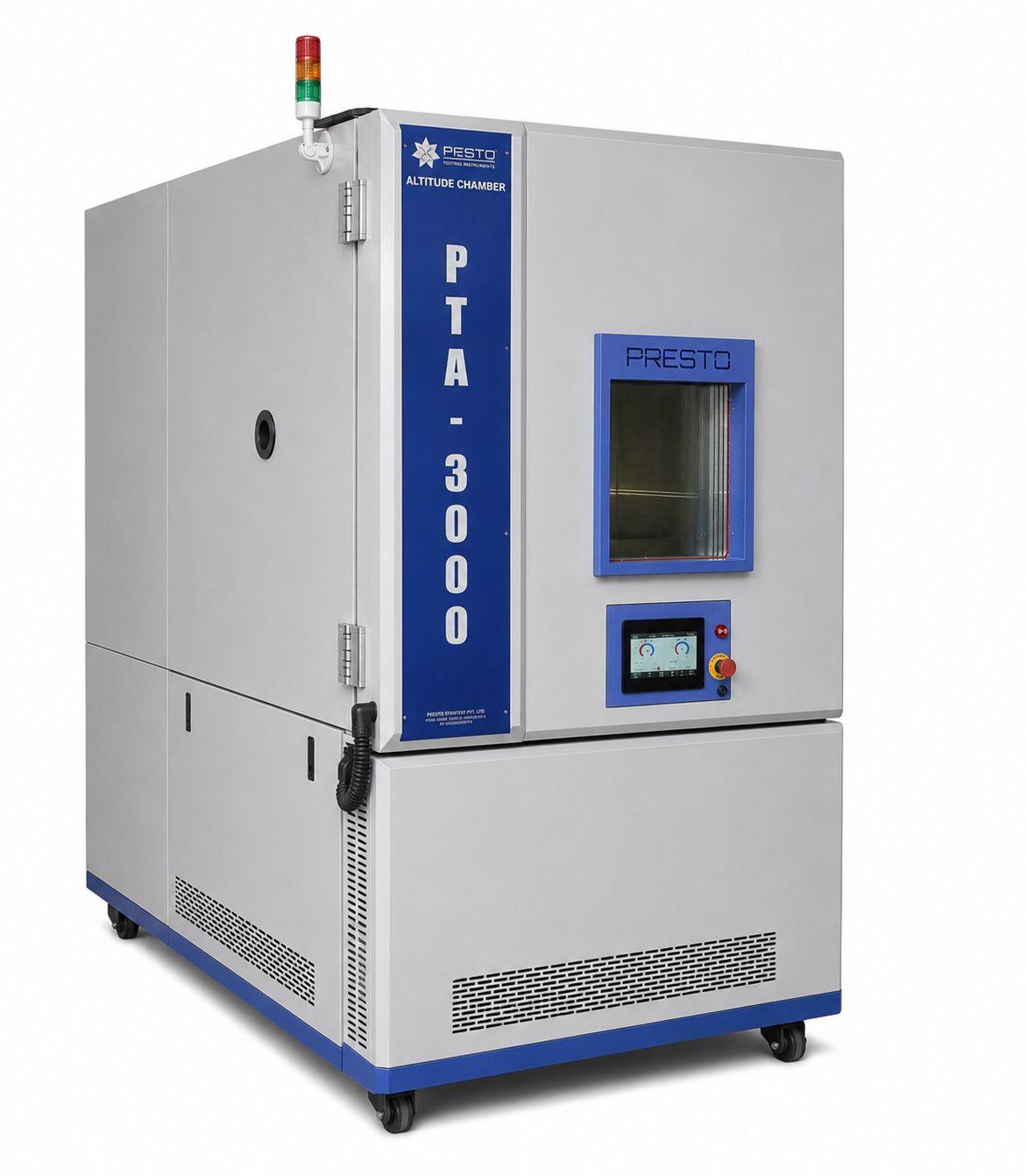
In environmental testing, vacuum chambers are also called altitude test chambers or low-pressure chambers. They lower air pressure inside a sealed chamber to simulate high altitude while controlling temperature and, in some configurations, humidity.
13-Oct-2026
Presto Enviro
An in-house lab can deliver results, give better control over product testing, and reduce testing costs in the long run. To make it work well, the lab space, equipment, utilities, and testing methods must be planned according to your needs.