© Copyright 2025. All Rights Reserved by Presto Stantest Pvt. Ltd.
12-May-2026
Presto Enviro
Manufacturers and lab operators spend a lot of time deciding whether a walk-in chamber or a benchtop chamber is suitable for their processes. Both test environmental conditions. Both control temperature and humidity. But using the wrong one for your application is a problem that can deteriorate products faster.
The real issue is that most people approach the choice of the right chamber based on budget or available space alone. Those things matter but they are not the whole picture. You must understand the other requirements also like the type of product you are testing, the volume of samples and how your lab workflow is structured.
This article looks at what each chamber actually is, how they work differently, and what factors should drive your final decision.
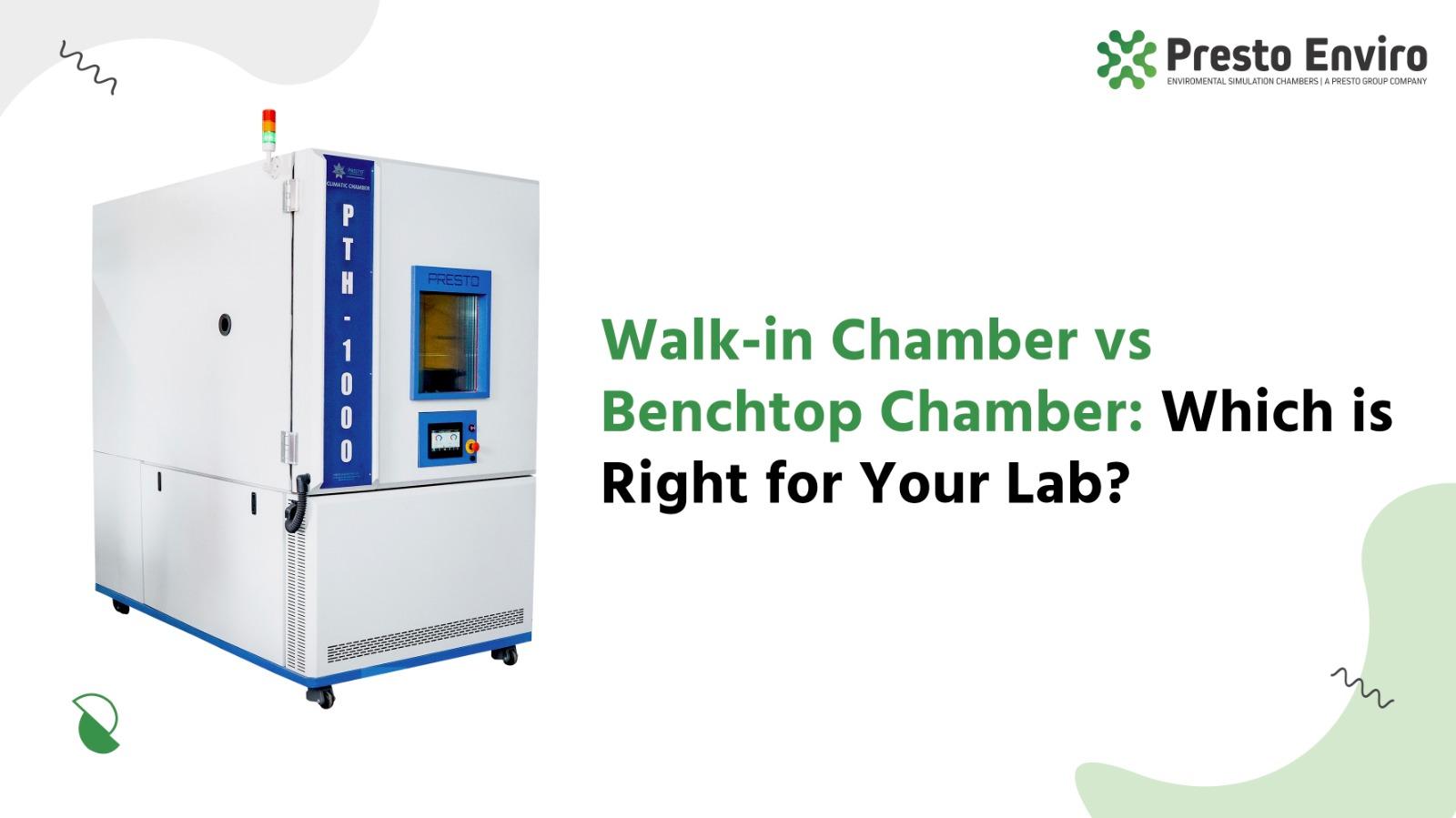
A Walk-in Chamber is an environmental testing chamber large enough for a person to physically walk into. These chambers are built to test big products, full assemblies, or a large number of samples at the same time under controlled temperature and humidity.
These chambers are majorly used in automotive testing facilities, aerospace labs and large electronics manufacturing setups. If the product being tested is too big to fit on a bench or if you need to run simultaneous tests on fifty units under identical conditions, a walk-in chamber is the right option to go for. They are not standard lab furnishings. They require dedicated floor space, site preparation and proper installation before they are ready to use.
A walk-in chamber works by controlling the internal environment using industrial-grade heating, cooling, and humidity systems. In this system, the refrigeration unit handles the low-temperature range, electric heaters take care of the upper end and evaporation-based systems manage moisture levels inside.
Maintaining uniform conditions throughout the space is a real engineering challenge due to the large internal area. Powerful air circulation systems push conditioned air across the entire interior. It helps to maintain the temperature at the back wall similar to the temperature near the door. Sensors at multiple points continuously feed data to the controller. If the door seal wears out or does not close properly, the system struggles to hold its setpoints.
A benchtop chamber is a compact unit designed to sit on a lab table or workbench. It tests smaller samples and components under controlled environmental conditions without needing dedicated floor space or special installation.
Depending on the model, the amount of space that can be used for an interior volume or design will be either less than or greater than what is available. Most laboratories performing basic component tests, stability assessments and material characterizations will have a benchtop chamber that satisfies their requirements completely.
It is more affordable, easier to install, and gets to target conditions faster than a walk-in unit. Small footprint, practical performance and relatively straightforward operation make it the default choice across industries like electronics and pharmaceuticals.
A benchtop chamber uses a compressor-based refrigeration system for cooling and electric resistance heaters for warming. Humidity is generated through a small internal water reservoir and heating element, and dehumidification is handled by routing air through a cooling coil to condense moisture out.
Due to smaller internal volume, the chamber reaches its setpoint temperature much faster than a walk-in unit does. A PID controller reads the sensor data and makes continuous adjustments to keep conditions stable. Most modern benchtop chambers support programmable test profiles. It helps in setting up a full cycle of temperature and humidity changes.
Presto Enviro builds benchtop environmental chambers with tight control tolerances and reliable PID systems. These are particularly useful when manufacturers run long stability tests where small drifts in temperature or humidity can quietly compromise the test results.
Difference between Walk-in chamber and Benchtop chamber: Walk-in chambers are for large products and high-volume testing. Benchtop chambers are for smaller samples and everyday lab work.
|
Factor |
Walk-in Chamber |
Benchtop Chamber |
|
Interior Volume |
Several cubic meters to room-sized |
Few liters to around 1000 liters |
|
Sample Size |
Large assemblies, full-sized products |
Small components, specimens, devices |
|
Simultaneous Samples |
High volume at once |
Limited by interior volume |
|
Temperature Range |
Typically -40°C to +100°C or beyond |
Typically -70°C to +180°C depending on model |
|
Humidity Control |
Yes, industrial-grade |
Yes, standard on most models |
|
Time to Reach Setpoint |
Slower due to large volume |
Faster due to compact size |
|
Space Required |
Dedicated room or large floor area |
Lab bench or table |
|
Cost |
High, often needs custom installation |
More affordable, minimal setup |
|
Best For |
Automotive, aerospace, large assemblies |
R&D, QC, pharma, small parts testing |
|
Installation |
Requires site preparation |
Plug and use in most cases |
If your samples are small, go with a benchtop chamber. If your products are large or you need to test many units at once, you need a walk-in chamber. That is really the core of it.
The size of what you are testing makes this decision for you in most cases. A benchtop chamber works perfectly for components, small assemblies, and lab specimens. It is faster to set up, easier to operate, and fits into a standard lab without any special arrangements. For routine quality control, R&D testing, and stability studies, it covers everything.
It is important to note that many larger facilities run both. The benchtop chamber handles routine daily testing while the walk-in unit is used specifically for full product validation before a product goes to market. That combination works well when both needs genuinely exist at different stages of the process.
Walk-in chambers and benchtop chambers are both excellent at what they do. The difference is in what they are designed for and matching that to your actual testing requirements is what makes the choice straightforward.
Presto Enviro is India's most trusted name in environmental and material testing equipment. Our range of environmental chambers, whether benchtop or walk-in, is built for labs that need reliable performance and accurate results without constant maintenance headaches. If you are deciding which chamber is best for your lab, reach out to us or contact us for a quote.
Elevate your quality assurance process to new heights
Related Blogs

23-Sep-2026
Presto Enviro
Products are expected to work reliably for months or years, but manufacturers cannot always wait that long to find out how they will perform. Accelerated aging testing solves this problem by exposing products to controlled environmental conditions that speed up certain aging effects.
20-Sep-2026
Presto Enviro
Battery safety is not something manufacturers can check only after a battery is ready for use. Temperature, charging conditions and repeated use can change the way a battery behaves. In some cases, excessive heat can cause permanent damage or create serious safety risks.