© Copyright 2025. All Rights Reserved by Presto Stantest Pvt. Ltd.

27-Jan-2026
Presto Enviro
Moisture may seem harmless, but in medicines it can quietly alter everything. Tablets can soften. Capsules may stick. Powders can clump. These changes often appear long after production. That is why Humidity Chambers in Pharmaceutical Industry testing has become a regular part of quality checks. It enables laboratories to investigate how medicines react when exposed to moisture over time, under calm and controlled conditions.
A humidity test chamber is a controlled enclosure used to study how products react to moisture over time. Inside the chamber, humidity levels are set and held steady while samples are observed. Medicines, packaging materials, and raw ingredients are placed inside to study slow changes caused by moisture exposure. In pharmaceutical work, this chamber allows teams to see how products behave in real climate-like conditions without leaving the laboratory.
Constant humidity chambers
These chambers maintain one fixed humidity level for long periods. They are commonly used for stability testing, where medicines stay under the same moisture conditions for weeks or months.
Cyclic humidity chambers
Cyclic chambers change humidity levels at set intervals. This helps simulate day and night moisture changes or movement between different storage zones. Pharmaceutical teams use these chambers to observe how products react to repeated moisture variation.
Temperature and humidity combination chambers
These chambers control both humidity and temperature. They help study how heat and moisture interact. Many pharmaceutical stability studies rely on this type for deeper analysis.
1. Supports accurate drug stability studies
Every medicine faces humidity during storage and transport. A Humidity Test Chamber recreates these real situations inside a laboratory. Scientists observe slow changes such as texture shifts, color variation, or loss of strength. These observations help teams understand how products behave over months rather than days.
2. Improves formulation development
During formulation work, moisture can interact with active ingredients in unexpected ways. Some compounds absorb water easily, while others break down faster. A humidity chamber used in laboratory research allows teams to test different formulations under controlled moisture. This makes it easier to adjust compositions before finalizing them.
3. Helps to determine realistic shelf life
Expiry dates must reflect how a product behaves in environments. Humidity Chambers in the Pharmaceutical Industry testing keep medicines at steady moisture levels for long periods. This demonstrates the onset of degradation and the rate of degradation. The methods of making decisions on shelf life are based on actual observation as opposed to estimation.
4. Facilitates the testing demands of regulations.
The testing of pharmaceuticals is very rigid. Consistent development of the humidity chamber test method facilitates the adequate documentation and replication of studies. The regulated humidity levels generate uniform data sets that are in compliance with regulatory requirements. Inspections and audits are also easy.
5. Assesses the performance of packaging.
The initial moisture resistance is in the packaging. Seals, blister packs, and bottles should be solid. A Humidity Test Chamber is used to test the response of a packaging to humid conditions. Weak points will be identified at an early stage, which enables the team to use superior materials prior to mass utilization.
6. Minimizes the chance of batch rejection.
Failure related to moisture is usually manifested late, even after full-scale production. The laboratory of a humidity test chamber is used to detect these dangers at the initial testing stage. Before mass production, it was possible to make changes, which is time- and resource-saving.
7. Supports sensitive and biological products
Biological medicines react quickly to moisture changes. Even small shifts can affect appearance or potency. Humidity Chambers in the Pharmaceutical Industry allow slow and steady observation under fixed moisture levels. This protects sensitive products and supports patient safety.
8. Creates repeatable laboratory conditions
The natural humidity varies during the day. Weather patterns cannot be relied upon in testing. A Humidity Test Chamber maintains an amount of moisture at a given level during the test. This ensures that comparisons will be just and results will be easier to comprehend.
9. Supports learning and research training
Observation is the most effective way of learning in the lab teams. A humidity chamber in laboratory training enables the new researchers to observe the effects of moisture on medicines in the long term. This builds practical understanding and strengthens testing skills.
10. Strengthens confidence in product quality
Trust matters deeply in pharmaceuticals. Constant practices of testing can be achieved by the use of systems provided by a supplier of humidity test chambers who have been in the business. There is increased confidence in products as they become available in the market, as per their performance in the real-world humidity conditions.
A humidity chamber is a control mechanism that maintains the level of humidity with a balanced mechanism of detectors, water, and flow of air.
Humidity testing plays a powerful role in pharmaceutical quality. This chamber allows careful observation of moisture effects that might otherwise go unnoticed. Presto Enviro helps you to understand the working principles and to select the right chamber type and supplier. Every step supports better product stability. As medicines continue to move across diverse environments, humidity chambers remain a trusted part of pharmaceutical testing practice.
1. How to know the price of a Humidity test chamber?
Customers can contact our team to know the price of the humidity test chamber. Please send us an email to response@prestoenviro.com. You can also call us at +91 9773666011.
2. How does a humidity chamber used in laboratory testing help?
It creates controlled humidity conditions that support accurate observation over time.
3. What is the humidity chamber working principle?
It controls moisture using sensors and regulates water input to keep conditions steady.
4. Why is a humidity chamber test method important?
It supports consistent testing practices aligned with pharmaceutical quality expectations.
5. How should one choose a humidity test chamber supplier?
Look for experience with pharmaceutical testing needs and steady technical support.
Elevate your quality assurance process to new heights
Related Blogs

23-Oct-2026
Presto Enviro
A walk-in climatic test chamber is a room-sized chamber that an operator can enter to load, position, and instrument large products or many samples. A drive-in chamber is a type of chamber. It has a reinforced floor and wide doors. This design lets a vehicle be driven or rolled inside.

21-Oct-2026
Presto Enviro
Temperature chambers are insulated boxes. They keep a product at a specific temperature. They can move it through different temperature levels in a set pattern. This lets people test how the product behaves when it's hot or cold.
15-Oct-2026
Presto Enviro
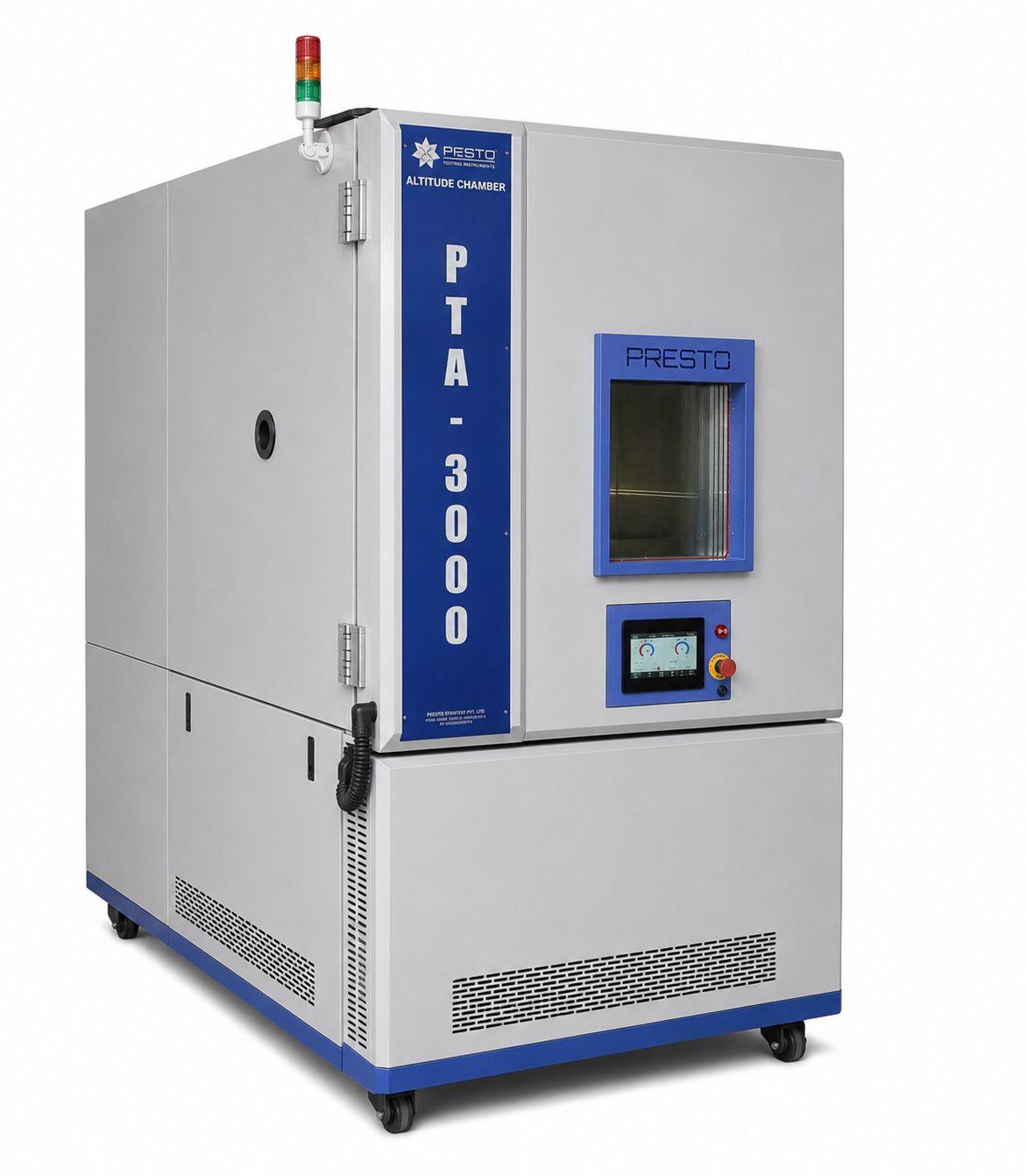
In environmental testing, vacuum chambers are also called altitude test chambers or low-pressure chambers. They lower air pressure inside a sealed chamber to simulate high altitude while controlling temperature and, in some configurations, humidity.