© Copyright 2025. All Rights Reserved by Presto Stantest Pvt. Ltd.
20-Sep-2026
Presto Enviro
Battery safety is not something manufacturers can check only after a battery is ready for use. Temperature, charging conditions and repeated use can change the way a battery behaves. In some cases, excessive heat can cause permanent damage or create serious safety risks.
This is the reason thermal testing is significant for the battery evaluation process. It enables manufacturers to assess the operation of the batteries and the battery packs in controlled conditions prior to employing them in actual products. The article will discuss what battery evaluation means, and why thermal stability is important, and how batteries are evaluated for safety.
Battery testing is the process of checking a battery’s performance, durability and safety under controlled operating conditions. It gives manufacturers practical information about how a battery behaves before it is used in a real application.
There is no single test that tells everything about a battery. A manufacturer may need to check capacity, voltage, charging performance, discharge behavior, cycle life and temperature response depending on the application.
Temperature testing gets special attention because batteries produce heat while they are working. Fast charging or heavy discharge can increase the heat further. If the temperature goes beyond a suitable range, the internal materials may start behaving differently.
A battery can also react differently at low temperatures. Capacity may drop and charging can become less efficient. So, both high and low temperature conditions may be part of a battery testing programme.
Testing can be carried out on a single cell, a battery module or a complete battery pack. Sensors and testing equipment are used to record temperature, voltage, current and other parameters during the test.
The idea is fairly simple. Put the battery through controlled conditions, record what happens and compare the results with the expected performance.
Thermal stability tells us how a battery behaves when exposed to heat and changing temperature conditions. It is important because temperature can affect both battery performance and safety.
All batteries generate some heat during use. In normal situations, this heat is bearable. Problems can occur if heat generation exceeds the capacity of the battery or its cooling system.
There is also the risk of thermal runaway. In layman’s terms, this is when an increase in temperature causes reactions inside the battery that generate even more heat. The temperature can then rise very quickly. It is one of the major safety concerns in rechargeable battery systems.
Low temperature conditions need to be considered too. A battery may lose part of its usable capacity when the temperature falls. Charging at unsuitable temperatures can also cause unwanted internal reactions in certain battery chemistries.
This is why thermal stability cannot be judged from normal room temperature performance alone. A battery that performs well under standard conditions still needs to be checked under the temperatures it may experience during storage, transport and operation.
Battery testing starts with a defined set of conditions and ends with a review of the battery’s response. The exact procedure changes from one battery type to another, but the basic approach remains similar.
The battery is first checked before testing begins. Its physical condition, voltage and other basic details are recorded.
This step may look simple, but it gives the testing team a reference point. If the battery develops swelling, deformation or another change later, there is something to compare it with.
Any visible damage should also be identified before the test. A damaged sample can behave differently and may affect the test result.
Next, the required temperature is selected. The test may involve a fixed high temperature, a low temperature or a sequence of different temperatures.
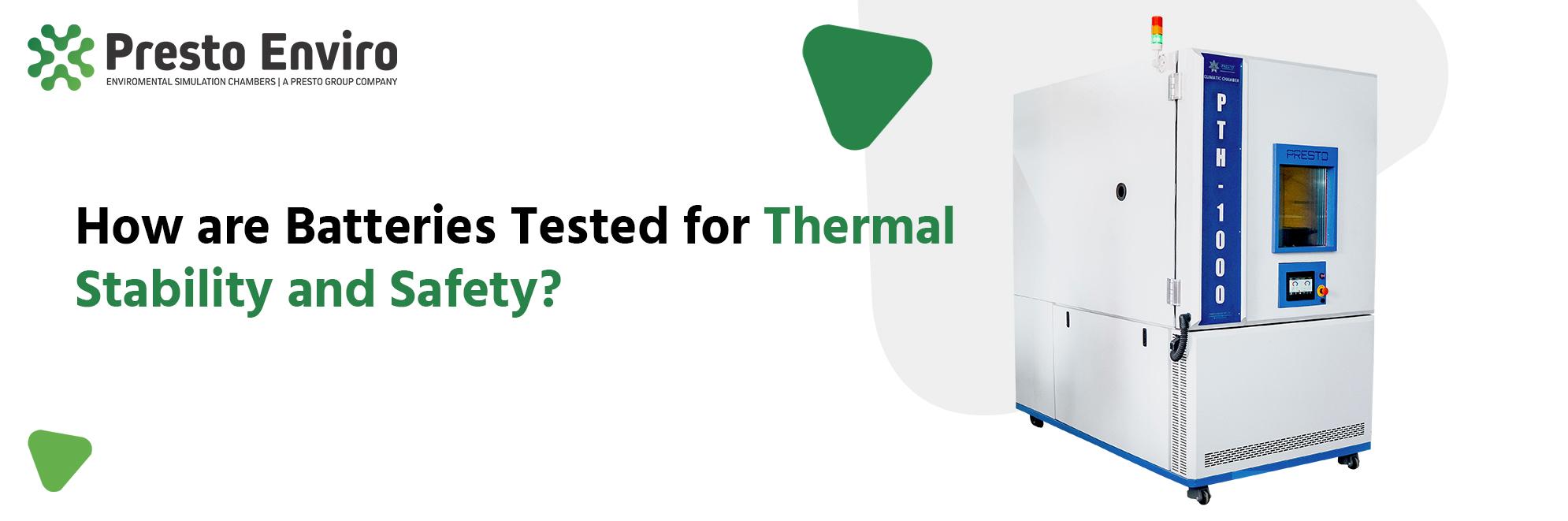
A battery test chamber is commonly used when a controlled temperature environment is required. The chamber can maintain the selected conditions for the required test period instead of relying on the temperature of the surrounding laboratory.
The test duration also matters. Some changes may appear quickly while others only become noticeable after the battery has remained at a particular temperature for some time.
Before thermal exposure, basic electrical readings are taken. These may include voltage, capacity, current and resistance.
The readings are the starting point for the test. After thermal exposure, the same parameters can be checked again to see if the battery has changed.
For example, the temperature condition may affect the battery; a significant change in the capacity or resistance may indicate that.
The battery is placed inside the test chamber and exposed to the selected temperature. Depending on the test, the temperature may remain constant or change according to a programmed cycle.
Temperature sensors are used during this stage. The battery may be monitored at one or several points depending on its size and construction.
The important part here is control. If the test temperature keeps fluctuating without a defined reason, it becomes harder to understand what actually caused a change in battery behavior.
Some tests are performed while the battery is being charged or discharged. This makes the test more representative of actual use.
Charging and discharging both generate heat. The amount can vary with current, battery condition and temperature. Testing these activities under controlled conditions can reveal problems that may not appear during a simple temperature exposure test.
The charging rate and discharge rate are therefore selected carefully according to the test requirement.
The battery is monitored throughout the test for unusual changes. Temperature is one of the main readings but it is not the only one.
A sudden temperature increase, unusual voltage behavior, or physical swelling may indicate a problem. Depending on the test setup, pressure or gas related changes may also be monitored.
Not every unusual reading means the battery has failed. The result needs to be looked at against the test conditions and the expected behavior of that particular battery.
Once the test is complete, the battery is inspected again. Its physical condition and electrical performance are compared with the original readings.
There is obvious swelling, leaking, deformity or damage. The test data is also presented to understand the battery response under the temperature condition. The test data is also presented to understand the battery response to the temperature condition.
If the results show an issue, further testing may be required. Sometimes the findings can also lead to changes in battery design, cooling arrangements or battery management settings.
Battery safety depends on good design, suitable materials and proper testing. Thermal testing gives manufacturers a practical way to check whether a battery remains stable when conditions become more demanding.
One useful piece of equipment for this type of work is a battery test chamber. Presto Enviro battery test chamber for batteries can be used to create controlled temperature conditions for battery testing. It gives testing teams a controlled environment where the response of a battery can be observed at selected temperatures.
There are several things worth considering during battery safety testing.
Temperature needs to stay within the selected test range. Uncontrolled changes can affect the results and make the test difficult to repeat.
A suitable environmental test chamber provides controlled conditions for the required period. This becomes especially useful when several battery samples need to be tested under the same conditions.
Checking the temperature only at the beginning and end is not enough for many thermal tests. A battery can experience a sudden rise while the test is running.
Continuous temperature monitoring makes these changes easier to identify. For larger battery packs, more than one sensor may be required because different areas of the pack can behave differently.
Testing a battery only at room temperature does not tell the full story. Depending on its application, it may need to be checked at high and low temperatures along with charging and discharging conditions.
For an electric vehicle battery, for example, temperature behavior during heavy use can be important. A battery used in a consumer device may have a different set of conditions to consider.
The battery should also be inspected visually during and after testing. Swelling, leakage, cracks and deformation can provide useful clues.
These changes should be considered along with the electrical and temperature readings. A small physical change may not look serious on its own but can become important when other test data shows an abnormal response.
Battery tests should be planned according to the battery chemistry, product application and applicable testing requirements. Using the same defined conditions for repeated samples also makes comparison easier.
A clear procedure reduces unnecessary variation between tests. It also gives the testing team a consistent way to record and review the results.
The equipment should match the battery being tested and the purpose of the test. A small cell and a complete battery pack may need very different testing arrangements.
Presto Enviro offers environmental testing equipment including battery test chambers for controlled temperature testing. Such equipment can be used when batteries need to be evaluated under defined thermal conditions in a laboratory environment.
Thermal stability testing gives manufacturers a clearer idea of how a battery will behave when temperature and operating conditions change. Excess heat can affect performance and pose serious risks, so it’s an important part of battery safety testing.
The testing process normally includes an initial inspection, electrical measurements, controlled temperature exposure, charging or discharging where required and a final assessment. Temperature and battery behavior are monitored throughout the test rather than checked only at the end.
Presto Enviro provides environmental testing equipment including battery test chambers that can support controlled thermal testing of batteries. With suitable equipment and a properly planned test procedure, manufacturers can identify thermal issues earlier and make better decisions about battery design and safety.
Elevate your quality assurance process to new heights
Related Blogs
15-Sep-2026
Presto Enviro
Corrosion is one of those problems that may appear mild at first and later turn costly. A metal part may leave the manufacturing facility appearing undamaged, yet suffer corrosion, stain formation or coating failure as a result of its contact with moisture, salts and changing weather conditions.

11-Sep-2026
Presto Enviro
Metal parts exposed to environmental elements like rain, high humidity and saline air are subjected to quick degradation. Manufacturers don’t have years to wait to see long-term real-world durability with immediate shipping deadlines.