© Copyright 2025. All Rights Reserved by Presto Stantest Pvt. Ltd.
28-Oct-2026
Presto Enviro
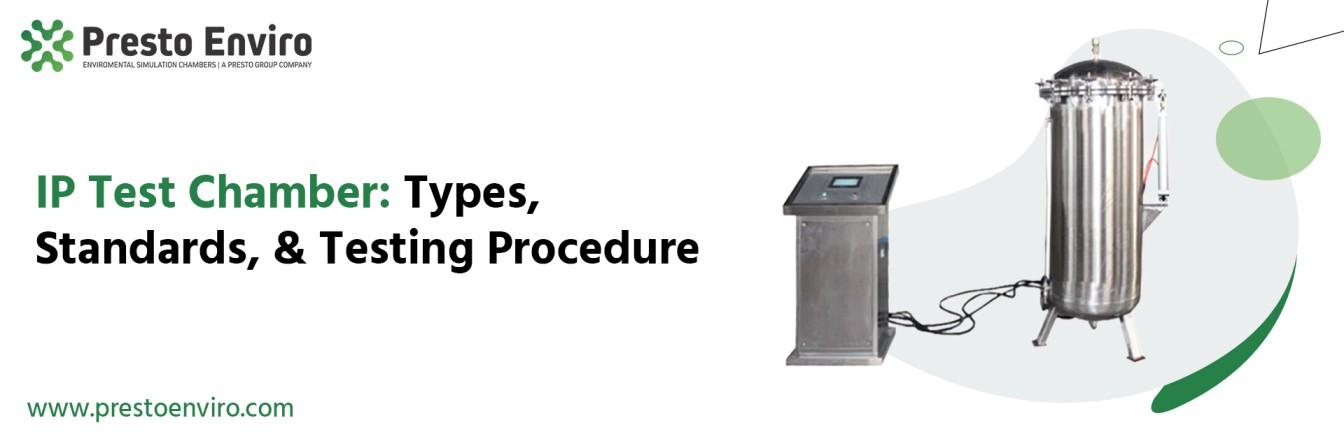
An IP test chamber checks whether an enclosure keeps out solids, dust, and water. The result is an IP (Ingress Protection) code, such as IP54 or IP67, defined by IEC 60529. The first digit covers solids and dust, and the second covers water. A sand and dust test chamber proves the first digit at its highest levels, IP5X (dust-protected) and IP6X (dust-tight).
Presto Enviro's Sand & Dust Test Chamber (PS-DC1000) is built for IP5X and IP6X testing to IEC 60529. For a recommendation, email response@prestoenviro.com or call +91 977 3666 011 with your enclosure size and target IP rating.
Claiming a product is "dust-proof" or "weatherproof" is easy. Proving it is harder, and that is what an IP test does. A product that works perfectly on the bench can start to fail once dust and moisture find their way, and the damage is often slow enough to go unnoticed until the product is already in the field.
Dust is rarely harmless. It collects in connectors. It can raise contact resistance. It wears down gaskets and seals until they no longer close properly. On circuit boards, dust combined with humidity can form paths that cause leakage currents and intermittent faults. In motors and moving parts, it acts as an abrasive and speeds up wear.
IP testing also matters commercially. Tenders, OEM approvals, and export certifications often call for an IP rating. A rating supported by a lab test report carries more weight with buyers and certifying bodies than a design calculation. Finding a seal on a prototype also costs a fraction of what a field recall or redesign would.
The code has two digits. A letter X replaces a digit that was not tested, so IP5X means dust-tested with no water rating.
First digit (solids and dust). Digits 1 to 4 describe protection against progressively smaller objects, from a 50 mm sphere (a hand) down to a 1 mm wire. Digit 5 means dust-protected, and digit 6 means dust-tight.
Second digit (water). Digits 1 to 4 cover dripping, tilted dripping, spray, and splashing. Digits 5 and 6 cover water jets of increasing power. Digits 7 and 8 cover immersion, and 9 covers high-pressure, high-temperature jets.
|
Code |
What it means in practice |
|
IP5X |
Some dust may enter, but not enough to interfere with safe operation. |
|
IP6X |
No dust enters at all. |
|
IP54 |
Dust-protected and splash-resistant (typical outdoor/indoor-use equipment). |
|
IP65 |
Dust-tight and resistant to water jets (outdoor luminaires, control boxes). |
|
IP67 |
Dust-tight and survives temporary immersion (sensors, portable devices). |
Two common misunderstandings are worth clearing up. First, IP6X does not imply any water protection. Second, a higher water digit does not include the lower ones: an IPX7 product is not automatically rated for jets (IPX5/6), and each level is tested separately.
The principle is simple. The enclosure sits in a closed cabinet filled with a suspended cloud of fine talcum powder. If it does not leak, nothing enters. If it does, the powder shows where.
The vacuum is what makes the test meaningful. Real products "breathe." When a device heats up in operation and then cools, the air inside contracts and the internal pressure falls below the outside pressure. This pulls air, and any dust carried in it, through every tiny gap in the seals. The chamber reproduces this effect by drawing air out of the specimen at a controlled rate while the dust cloud surrounds it. Under IEC 60529, this vacuum method applies to enclosures where such pressure differences can occur (Category 1). Enclosures with no pressure difference are tested without the vacuum (Category 2), typically over a longer period.
Typical IEC 60529 conditions for talcum powder are a fine grade passing a 75 µm sieve, around 2 kg per cubic meter of chamber volume, and an under-pressure of up to about 2 kPa (20 mbar). IP5X is typically run for around 2 hours, and IP6X for around 8 hours. Confirm the exact clauses in the edition you are working on.
Product link: Sand & Dust Test Chamber, Presto Enviro
Presto Enviro is an Indian manufacturer of environmental test chambers. The PS-DC1000 is designed to evaluate enclosures, components, and assemblies against airborne dust and sand, and it complies with IEC 60529 for IP5X and IP6X testing.
High-efficiency circulation blowers keep the dust evenly spread out so every time you run the test, you get consistent results. The test area is covered with glass-reinforced plastic (GRP), which can handle rubbing and exposure to chemicals. The sealed design keeps the dust inside the chamber. Helps keep the lab clean. A PLC-controlled HMI and a separate control panel let you adjust the shaking time, vacuum strength, and test length the way your procedure says. An inside heater stops moisture from forming. The dust stays dry and moves easily. Wheels on the base make it easy to move the unit anywhere in the lab.
|
At a glance |
PS-DC1000 |
|
Standard |
IEC 60529 (IP5X, IP6X) |
|
Internal size |
1000 × 1000 × 1000 mm, modifiable on request |
|
Temperature range |
15 °C to 45 °C |
|
Depression sensor |
0 to 50 mbar |
|
Timer |
0 to 9999 hours |
|
Supply |
380 to 440 V AC, 3-phase, 50/60 Hz; 3 to 4 bar compressed air. |
The difference is not just the duration. It is the acceptance criterion. For IP5X, the inspector looks at whether any talc that got in could affect the product's correct operation or safety, for example, by settling on insulation surfaces or creepage paths. For IP6X, even a trace of dust inside is a fail.
That makes IP6X a much stricter design goal. It usually requires continuous, uniformly compressed gaskets, properly sealed cable entries, and careful treatment of vents and breathers. Aiming for IP6X "just in case" can add cost, so decide based on where the product will really operate.
Dust and sand tests sound similar but answer different questions.
An IP dust test asks, "Does fine powder get in?" It is a sealing test, performed in a closed chamber with a stationary specimen.
A blowing sand and dust test, such as those in MIL-STD-810 (Method 510) and IEC 60068-2-68, asks, "Does the product survive and keep working in a sandstorm?" Here, particles are blown at the product at a set velocity and concentration, often at elevated temperature. The concern is as much abrasion, clogged filters, jammed moving parts, and overheating as it is ingress. Defense, aerospace, off-road vehicle, and outdoor infrastructure products are often tested for both.
After testing many different products, certain weak points appear again and again:
Test the product as it will be shipped. Fit every gasket, gland, cap, and cover, and fasten screws to the specified torque. Remove nothing and add nothing. Run a baseline functional test first so you can prove afterward that performance is unchanged. Record the specimen's orientation, because the chamber should hold it in its normal operating position. If the product breathes, connect the vacuum line to a suitable port.
The sequence follows a clear logic. Define the target IP rating and standard, then prepare and baseline the specimen. Mount it in the chamber and set the duration, vacuum level, and agitation interval. Run the test while monitoring under-pressure, airflow, and elapsed time. When the run ends, wait for the dust to settle completely before opening the door. This helps make sure the deposits aren’t moved or disturbed. Take out the specimen carefully. Open it with care. Look closely at where dust has settled. Pay attention to seals, live parts, and insulation areas. After that, repeat the test. Then prepare the report using the format. Include the conditions under which the test was done, your observations, photographs, and the final result.
The location of any dust is useful design feedback. A line of talc along one gasket edge points to a compression problem, and dust around a gland points to the entry.
Standards are revised from time to time, so check the current edition before qualifying a product.
Start with the specimen. The internal working volume must hold the largest product with room for dust to circulate around it. Next, match the chamber to your standards: IP5X and IP6X need controlled vacuum and measured airflow, not just a dust cloud. Look at how the dust is kept uniform, because poor circulation gives unrepeatable results. Check the interior material, since talc and sand are abrasive. Finally, consider the lab: power supply, compressed air, space, and whether you need to move the chamber.
Share your enclosure dimensions, target IP rating, enclosure category, and test standard with Presto Enviro. The team will recommend a configuration and prepare a specification-based quotation.
An IP rating means nothing if the test behind it is not reliable. A sand and dust chamber shows the truth behind the digit of the IP code by creating a steady dust cloud and using a controlled vacuum. This setup exposes spots in seals during testing, not after the product is already in use. Knowing how the IP code works, understanding the difference between IP5X and IP6X, and seeing where enclosures tend to fail can help you build products and pick the right testing equipment. Presto Enviros PS-DC1000 handles both IP5X and IP6X testing in line with IEC 60529 standards. It can be adjusted to fit your specific needs.
1. What is an IP test chamber?
It is test equipment that exposes a product to dust, sand, or water to verify its IP (Ingress Protection) rating under IEC 60529.
2. What does an IP code like IP65 mean?
The first digit (6) means dust-tight. The second digit (5) means resistant to water jets.
3. What is the difference between IP5X and IP6X?
IP5X allows a small amount of dust if it does not affect safe operation. IP6X allows none.
4. Why is a vacuum used in the dust test?
It reproduces the internal pressure drop that occurs when a heated product cools, which draws dust through weak seals.
5. What powder is used in IP dust tests?
Fine talcum powder passing a 75 µm sieve, at about 2 kg per m³ of chamber volume.
6. How long does an IP dust test take?
Typically around 2 hours for IP5X and around 8 hours for IP6X, depending on the enclosure category and the standard's current edition.
7. What is the difference between a dust test and a blowing sand test?
A dust test checks whether fine powder gets in. A blowing sand test checks whether the product survives abrasion, clogging, and heat in a sandstorm.
8. Which standards cover dust and sand testing?
IEC 60529 and ISO 20653 for IP codes, IEC 60068-2-68 for dust and sand, and MIL-STD-810 Method 510 for military equipment.
9. Where do enclosures most often fail?
At gaskets, cable glands, seams, vents, and connector mountings.
10. Does an IP6X rating mean the product is waterproof?
No. The second digit defines water protection and must be tested separately.
Elevate your quality assurance process to new heights
Related Blogs

23-Oct-2026
Presto Enviro
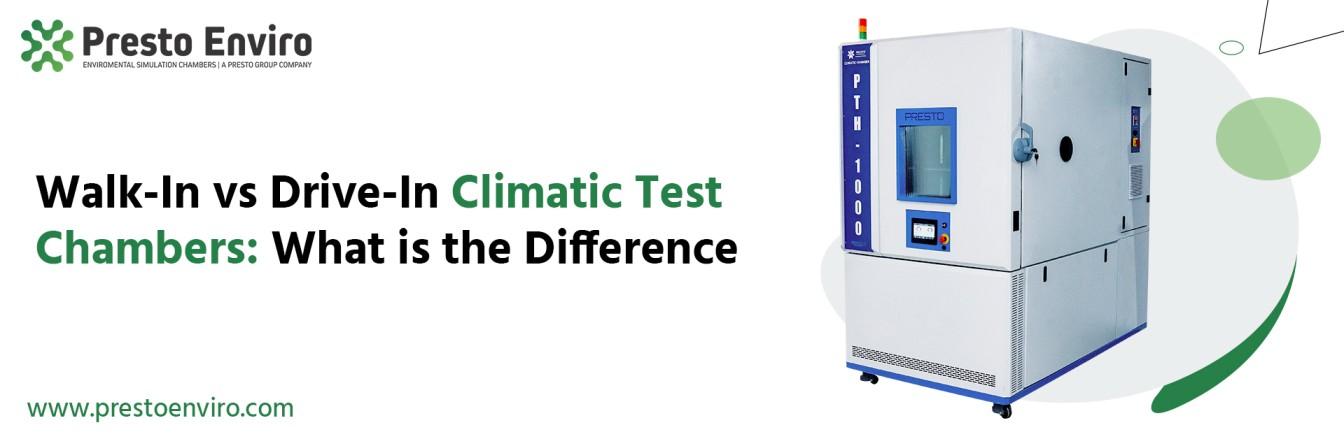
A walk-in climatic test chamber is a room-sized chamber that an operator can enter to load, position, and instrument large products or many samples. A drive-in chamber is a type of chamber. It has a reinforced floor and wide doors. This design lets a vehicle be driven or rolled inside.

21-Oct-2026
Presto Enviro
Temperature chambers are insulated boxes. They keep a product at a specific temperature. They can move it through different temperature levels in a set pattern. This lets people test how the product behaves when it's hot or cold.