© Copyright 2025. All Rights Reserved by Presto Stantest Pvt. Ltd.
30-Apr-2026
Presto Enviro
Corrosion is one of those failure modes that show up slowly but become a serious problem for materials. Metal components, coatings and surface finishes that look perfectly fine during production can start breaking down within months of real world exposure to moisture and salt.
The salt spray test exists to catch that early. It pushes corrosion forward in a controlled environment so manufacturers can see how a coating or material actually can withstand in the real environment and does not break suddenly.
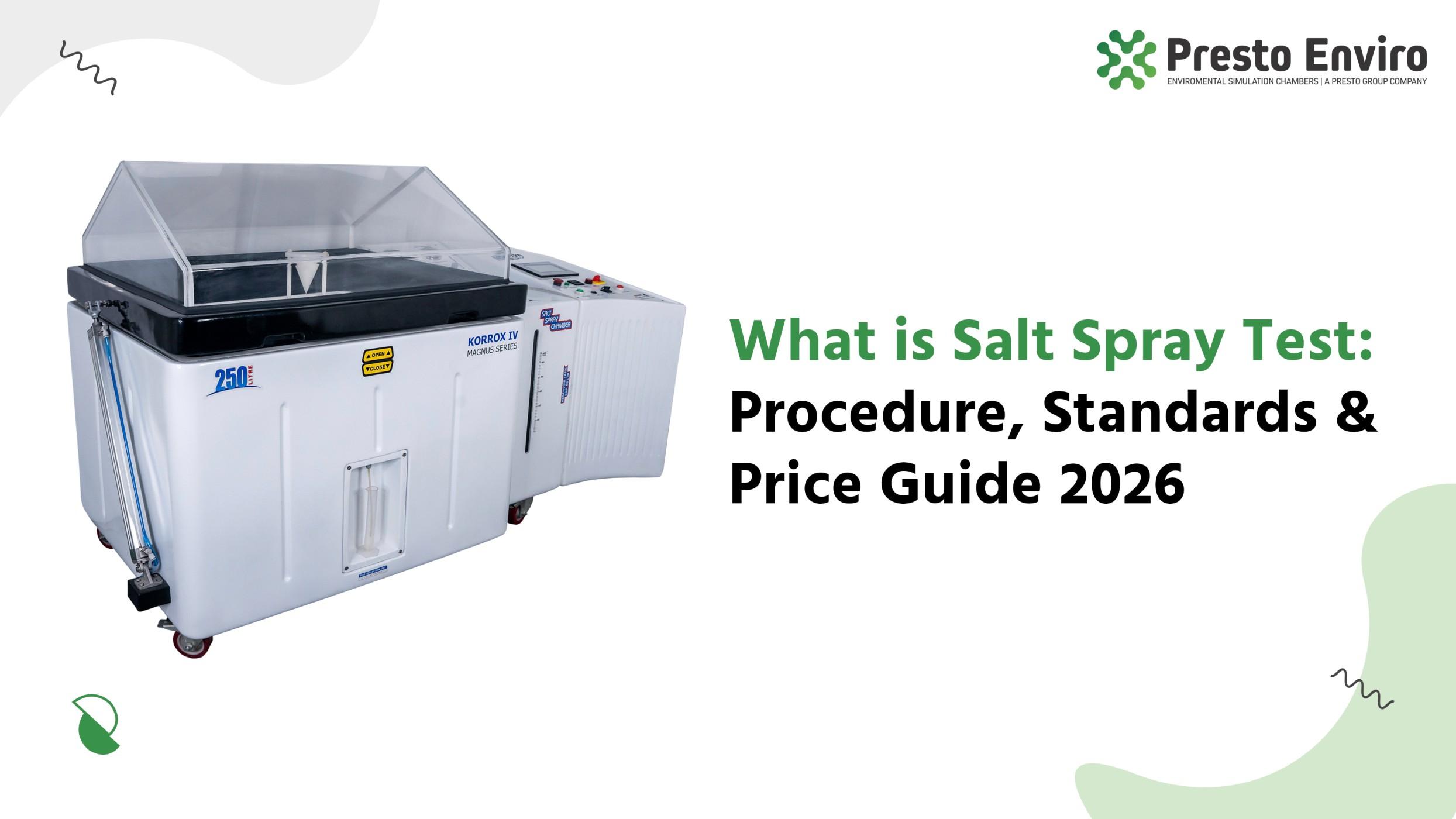
A salt spray test is an accelerated corrosion testing method that exposes materials to a fine mist of salt solution. The test is conducted inside a controlled chamber to evaluate their corrosion resistance.
In simple terms, the chamber, used for salt spray test, creates a harsh, salty, humid environment. Years of real world corrosion exposure get compressed into a fraction of the time. It is used across automotive, aerospace, marine, electronics and coating industries. Any product going into an environment with moisture, salt air or outdoor exposure is a candidate for this test.
A salt spray test works by atomizing a sodium chloride solution into a fine mist inside a sealed chamber while maintaining specific temperature and humidity conditions throughout the test.
The chamber holds a steady temperature of approximately 35 degrees Celsius while a compressed air and saltwater mixture gets converted into a fine fog across the test samples. Salt concentration, temperature and pH of the solution are kept controlled as even small variations can shift results. Samples are placed at a fixed angle inside the chamber which is usually 15 to 30 degrees from vertical. So the fog settles evenly rather than pooling in one spot. The test runs continuously for the required number of hours. After that, samples come out and get inspected for rust, blistering, adhesion loss or any visible sign of corrosion starting to work through the surface.
Samples need to be clean before going into the chamber. Oil, grease, dirt or any surface contamination can change how the coating and material respond to salt exposure and make the results unreliable.
Cleaning is typically done with a solvent that does not affect the coating itself. Once cleaned, samples should not be handled with bare hands. Skin oils create localized contamination on the surface and that is enough to affect how the test plays out.
The standard salt solution is sodium chloride dissolved in distilled or deionized water at five percent concentration by weight. The pH should fall between 6.5 and 7.2 at the test temperature.
This part matters more than it seems. Using tap water or getting the salt concentration slightly wrong produces results that cannot be compared against any standard benchmark. The test becomes less useful the moment the solution is off.
Chamber temperature is set to 35 degrees Celsius for standard neutral salt spray testing. The salt solution reservoir and atomizing nozzle pressure are adjusted to produce the right fog density inside.
Collection rate is worth verifying before the test starts. The fog collecting inside should land at around 1 to 2 milliliters per 80 square centimeters every hour. If it is too high or too low, sort out the nozzle before the test runs. Starting with the wrong collection rate is just going to affect everything after it.
Samples go in at the correct angle and need enough space between them so they are not touching each other or the chamber walls. Salt solution dripping from one sample onto another produces misleading results and ruins the data for both.
The angle keeps fog from pooling on flat surfaces and lets it settle naturally across the full sample area.
Once the chamber is sealed and conditions are stable, the test runs for the required duration without interruption. How long depends on the standard being followed and the product being tested. Some tests run 24 hours. Others go well beyond 1000 hours.
Opening the chamber mid test to check on samples is generally a bad idea. It disrupts the internal environment and affects the consistency of what you get at the end.
After the test, samples are removed carefully and rinsed with clean water to get salt deposits off before inspection. The surface gets evaluated for rust creep from scribed lines, blistering, adhesion loss, or any visible corrosion working through.
Results are documented and compared against the relevant standard to determine pass or fail.
Several internationally recognized standards monitor how salt spray testing is conducted. It is also important to select the right standard based on the industry and it must be chosen before the test starts.
ASTM B117 is probably the most referenced standard globally. It covers the basic neutral salt spray test and sets out chamber conditions, solution requirements, and test parameters clearly. ISO 9227 is the international equivalent and covers neutral, acetic acid, and copper accelerated acetic acid salt spray tests. DIN 50021 shows up commonly in European automotive and industrial applications.
JASO M609 is used in Japanese automotive testing. Each standard has its own requirements around solution concentration, temperature, exposure duration, and acceptance criteria. Knowing which one applies to your product before testing starts is not a step worth skipping.
Salt spray tester prices shift depending on chamber size, build quality, control system, and the standards the equipment is designed to meet.
Entry level salt spray testers start from 1.5 to 3 lakh rupees. Mid range testers with better temperature stability, programmable controllers and ASTM B117 or ISO 9227 compliance typically range from 3 to 6 lakh rupees. High-end testers built for continuous industrial use, larger capacity and multi-standard compliance are priced over 6 lakh rupees.
Presto Enviro is competitively positioned within the mid-to-high-end chamber segment, and securing a direct quote is advisable. Pricing varies quite a bit based on chamber volume and required certifications, and their team is straightforward to deal with when it comes to matching the right chamber to the actual testing requirement. Our salt spray testers are built to comply with relevant international standards, and the build quality holds up well for facilities running frequent or continuous test cycles.
For facilities running corrosion testing regularly, the chamber has to be reliable. Inconsistent internal conditions produce inconsistent results, and inconsistent results do not tell you anything useful.
Presto Enviro is a leading salt spray tester manufacturer, particularly for industries where standard compliance and result accuracy are a priority. Our salt spray chambers hold stable conditions across long test durations, are built for industrial workloads, and have control systems that do not need constant technical attention. If corrosion testing is an important part of your quality process, Presto Enviro is worth contacting directly.
The salt spray test is not complicated to understand but it does demand precision to run properly. Solution concentration, chamber temperature, sample placement, and test duration all feed into whether the results actually mean something.
For any product going into corrosive environments, this testing is not a box-ticking exercise. It is the difference between knowing how a coating performs and just hoping it does. Getting the procedure right and using equipment built to the relevant standards is what makes the data worth acting on.
Elevate your quality assurance process to new heights
Related Blogs

28-Aug-2026
Presto Enviro
Every day, EV batteries face harsh conditions. On the road, a high-voltage pack may deal with sudden freezing slush, extreme heat buildup during 350kW fast-charging stops, and continuous structural pounding from bad pavement.