© Copyright 2025. All Rights Reserved by Presto Stantest Pvt. Ltd.
23-Apr-2026
Presto Enviro
When a product fails in the field, humidity is often the silent culprit. It is not due to poor design or weak materials but the uncontrolled moisture conditions in which it was made, stored or never properly tested against. Every manufacturer has faced it at some point when materials are behaving differently than expected, finished goods are failing quality checks or worse, products are returning from the customers.
The environment inside a production facility is rarely stable and moisture, more than almost any other variable, tends to go unmanaged until it becomes a visible, costly problem. That is where a humidity chamber steps in - not as a luxury addition to a testing lab but as an operational necessity that serious manufacturers rely on every day.
In this guide, we will discuss what is a humidity chamber actually, which manufacturing processes depend on it the most and most importantly, how to use one strategically to optimize your production outcomes from the ground up.
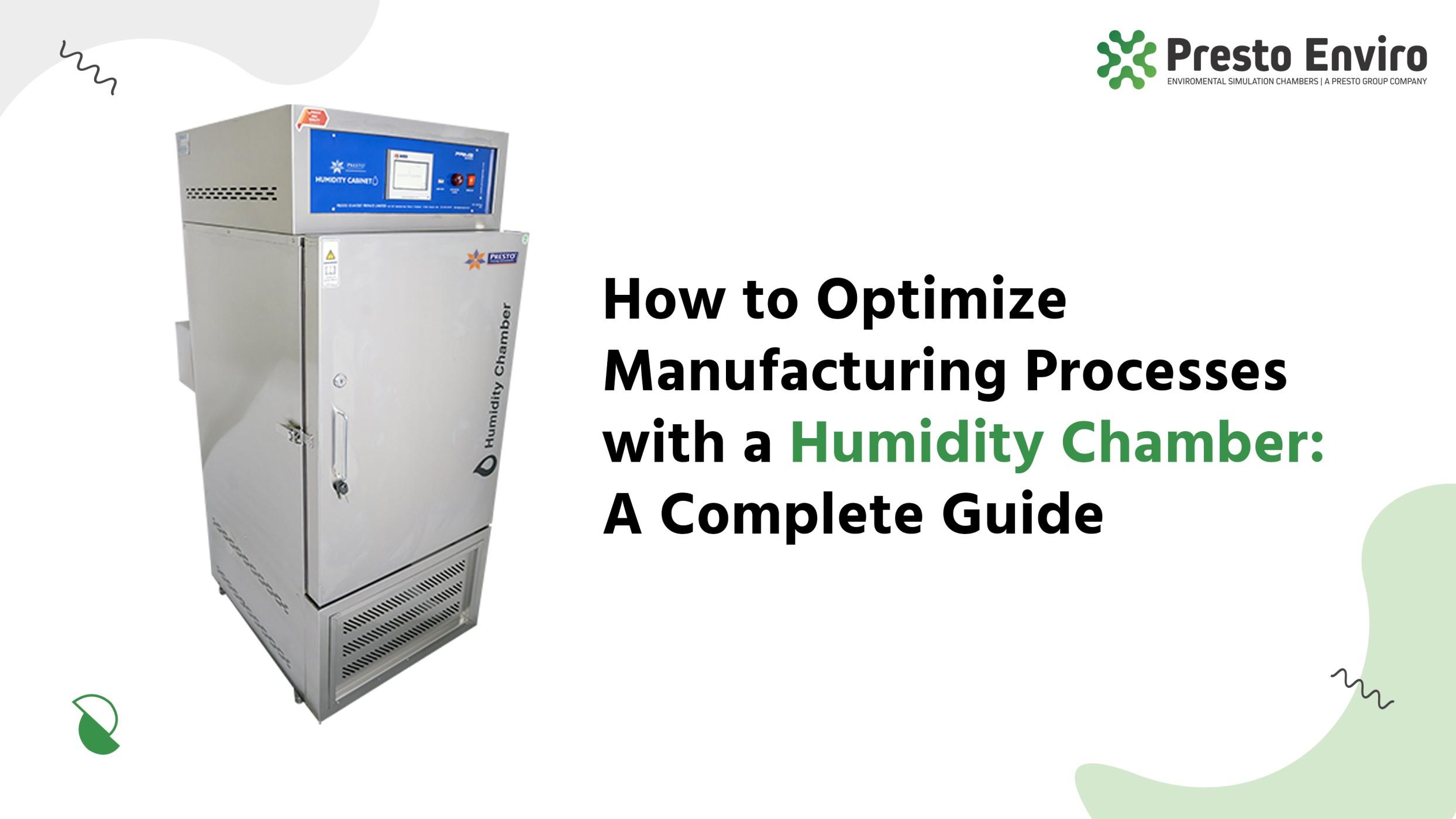
A humidity chamber is a controlled environment unit to precisely regulate both temperature and relative humidity within a sealed enclosure. It works by combining heating elements, refrigeration systems and water reservoirs or ultrasonic humidifiers to maintain stable atmospheric conditions. The typical ranges are from 10% to 98% relative humidity and temperatures from sub-zero up to 150°C or higher.
The chamber monitors and adjusts these conditions continuously using built-in sensors and microprocessor controllers. Combining these materials so that a product or material is exposed to identical environmental conditions ensures accurate simulation of actual environmental storage conditions. It is useful for products, acceleration of the aging process of products and maintaining the moisture content of materials being processed accurately throughout all phases of manufacturing.
Humidity chambers are not limited to a single industry or application. Common moisture-sensitive materials, coatings, adhesives or finished goods benefit directly from controlled humidity management. Here are the key manufacturing areas where they play a critical role:
Owning a humidity chamber is one thing. Using it to genuinely improve your manufacturing outcomes is another. The following sections break down the practical strategies manufacturers can implement to get measurable value from their chamber investment.
Most impactful place to start is pre-conditioning. Materials such as paper, textiles, rubber compound and wood composites release or absorb moisture. When you load raw materials on a production line at varying moisture content, it may experience dimensional errors, adhesion problems and lack of coating uptake.
You can remove that variability by putting the materials in a humidity chamber with the target processing conditions and leaving it long enough before production starts. What comes into your line is predictable, consistent and willing to act in the same manner your process anticipates it to. This is the one step that, by itself, can save a great deal of rework and material waste in most moisture sensitive operations.
Many manufacturing processes have humidity-sensitive steps that include curing a resin, drying a coating, laminating two surfaces or setting an adhesive bond. When these steps are run without humidity control, results vary batch to batch, particularly across seasons when ambient conditions shift. A humidity chamber will allow you to experiment and lock in the conditions under which your process performs best.
The manufacturers that record these humidity sensitivity ranges on each critical process step experience less non-conformances as they no longer guess but rather manage.
When your product remains in wet conditions after leaving your premises, you must be aware of its condition when it arrives. Humidity chambers enable the simulation of months or even years of real-life exposure in a few days with a combination of high temperature and high relative humidity.
It is particularly useful in package integrity testing, seal strength testing, material durability testing and electronic component reliability. Manufacturers obtain this information during the development stage rather than waiting to determine the performance of a product in the field. Thus having the opportunity to make changes to the design or materials before the time to invest in mass production comes. It is among the most cost effective investments that a product development team can make.
Quality control becomes far more reliable when samples are always tested under the same environmental conditions. If a technician is measuring tensile strength, moisture content, adhesion force or coating thickness, fluctuations in ambient humidity between test sessions.
Bringing samples to a standardized humidity level in the chamber before QC testing removes that source of variation entirely. Your test data becomes comparable across days, shifts, seasons and even different facilities.
In most industries, manufacturers are obliged to demonstrate that their products have been tested under certain environmental conditions as a compliance requirement or regulation. Testing procedures may have temperature and humidity requirements that must be observed which are usually given by organizations such as ISO, ASTM and IEC. A properly calibrated humidity chamber gives you the documented and reproducible evidence that those requirements have been met.
This matters not just for audit protection but for market access. Customers in automotive, aerospace, medical devices and defense supply chains increasingly require compliance data as a baseline expectation not as an added value. Having a validated chamber and the records to match puts you in a position to compete for that business confidently.
When it comes to selecting a humidity chamber that genuinely delivers on precision and long-term reliability, Presto Enviro is a name that manufacturers across industries have come to depend on. Presto Enviro humidity chambers are built to meet the demands of real production and testing environments with tight tolerance controls, durable construction and intuitive digital interfaces.
Our chambers are designed to meet international calibration standards and integrate smoothly into existing quality workflows. These chambers are useful for material conditioning, accelerated agin or compliance-driven QC programs. The range spans benchtop units suited for laboratory sampling to larger capacity models capable of conditioning full production batches.
Humidity is one of those production variables that tends to receive serious attention only after it has already caused a problem. The manufacturers who build humidity control into their processes proactively—through structured pre-conditioning, validated parameters, systematic testing and standardized QC environments.
A humidity chamber is not simply a testing instrument. It is a precision control asset that reduces material waste, improves batch-to-batch consistency and shortens the path to compliance. With a trusted partner like Presto Enviro behind your testing infrastructure, that level of control is entirely within reach for your operation.
Get in touch with us today to find the humidity chamber that fits your manufacturing requirements and start building real consistency into every batch you produce.
Elevate your quality assurance process to new heights
Related Blogs

28-Aug-2026
Presto Enviro
Every day, EV batteries face harsh conditions. On the road, a high-voltage pack may deal with sudden freezing slush, extreme heat buildup during 350kW fast-charging stops, and continuous structural pounding from bad pavement.