© Copyright 2025. All Rights Reserved by Presto Stantest Pvt. Ltd.
05-Sep-2025
Presto Enviro
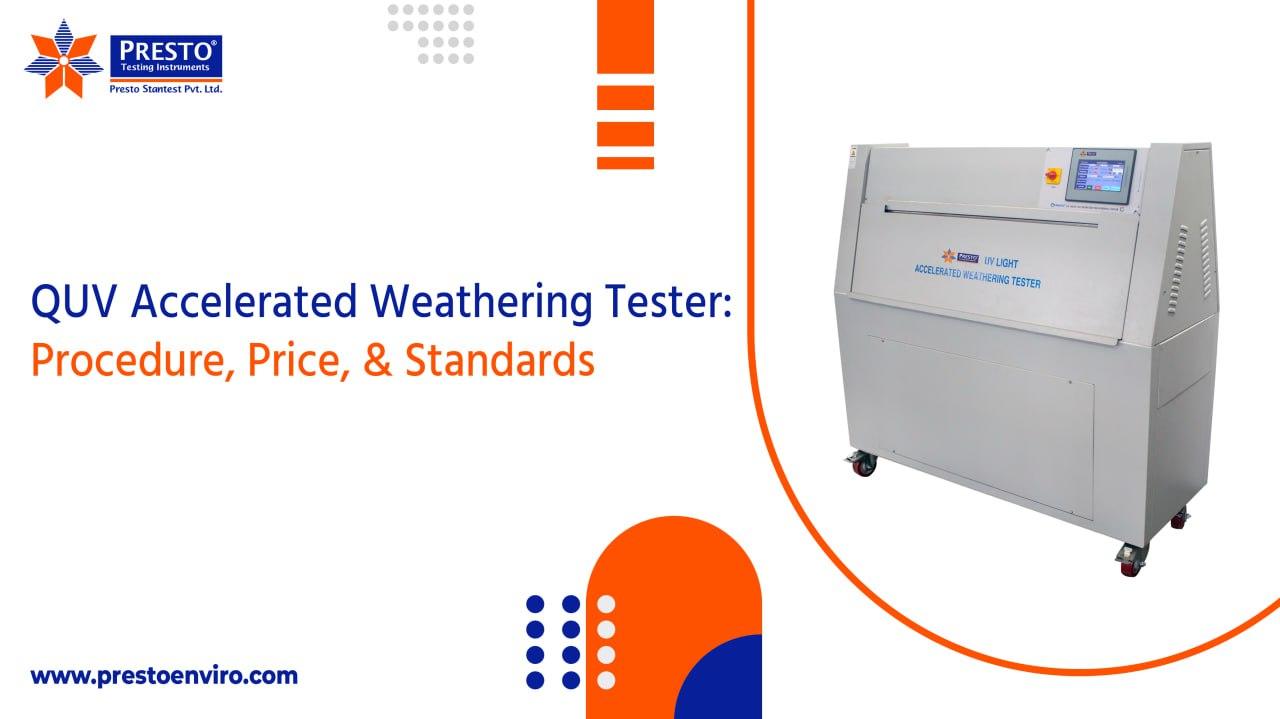
QUV testing is a laboratory procedure used to simulate the damaging effects of sunlight, rain, and dew on materials over an extended period. This accelerated weathering test is commonly used in industries such as automotive, construction, and coatings to evaluate the durability and longevity of materials when exposed to outdoor conditions.
The QUV weathering test chamber replicates these conditions using fluorescent ultraviolet (UV) light, moisture, and temperature control. It allows manufacturers to predict how products will perform and degrade in real-world environments.
QUV Testing Meaning –The meaning of QUV testing lies in its purpose to assess the weathering resistance of materials by exposing them to cycles of UV light and moisture. It helps in quality control, product development, and compliance with industry standards.
QUV Test Full Form – The full form of QUV is "QUV Accelerated Weathering Tester" where "QUV" refers to the use of ultraviolet light in the testing process. The test is designed to replicate outdoor weathering conditions in a controlled laboratory environment.
Also Read :- The Ultimate Guide to UV Weathering Test Chambers
In QUV Accelerated Weathering Testing, the samples are prepared and mounted carefully for even exposure. A UV light source mimics sunlight, and moisture exposure simulates rain or dew. Alternating light and moisture is brought under controlled cycles. Temperature and humidity and maintained precisely. Tests are conducted for fixed durations after which the samples are tested for color change, cracking, or degradation.
Also Read :- What is a UV Weathering Test Chamber and Why Is It Essential?
The QUV accelerated weathering test is commonly employed to expose a material to sunlight, moisture, and heat in a controlled laboratory environment to forecast a material's longevity. Various industries and applications adhere to certain international standards for consistency and comparability of results.
QUV Testing consists of several applications to identify material degradation issues such as fading, cracking, and loss of mechanical strength, allowing for better quality control and product development.
QUV testing determines how well paints, varnishes, and other coatings resist sunlight, rain, and dew. The test looks for damage such as color fading, loss of gloss, blistering, peeling, and chalking, which enables manufacturers to confirm their products will have a durable, quality finish.
This test procedure determines plastic and polymer resistance to UV degradation, heat, and water. It detects breakdowns like yellowing, cracking, embrittlement, and a loss of tensile strength, so that plastic components, from auto parts to packaging, retain their look and integrity over time.
QUV testing is applied to materials such as roofing, siding, sealants, and window parts to forecast their durability outdoors. Through the simulation of weather cycles, it confirms the materials' ability to resist cracking, delamination, and deterioration for long-term exposure to the elements.
For textiles and clothing, QUV testing checks color fastness and tensile strength retention after subjecting the product to sunlight and water. It is crucial for outdoor clothing, upholstery of furniture, and car interiors to avoid fading and weakening caused by UV radiation to enable manufacturers to provide long-lasting products.
QUV testing is used for a wide variety of consumer products, including patio furniture, outdoor lighting fixtures, and packaging. It confirms that products and packaging will continue to function and look good after extended exposure to sunlight and environmental conditions.
QUV Accelerated Weathering Tester price ranges from ₹2,50,000 to ₹10,00,000 in India. The price depends on factors including the size of the chamber, model type, operation mode, type of UV lamps used, and other advanced features. Higher-end models designed for long-term performance and more precise simulation of environmental conditions typically come at a higher cost.
Among the reputed options in the market, Presto Enviro stands out as a reliable provider of QUV testing machines, offering high-quality equipment at the best value. Their machines are equipped with features like accurate UV light simulation, automatic moisture and condensation control, and a user-friendly interface. Designed to meet international standards, our QUV testers are ideal for ensuring consistent and dependable weathering performance testing across various industries.
QUV Accelerated Weathering Testing is a must-have predictor of product performance and long-term reliability. Through adherence to world testing standards and exact replication of environmental conditions, it allows manufacturers to improve product quality, reduce warranty claims, and preserve customer confidence. Spending on a QUV tester or engaging a quality testing service guarantees your products survive the test of time under severe environmental conditions.
Elevate your quality assurance process to new heights
Related Blogs
28-Aug-2026
Presto Enviro
Every day, EV batteries face harsh conditions. On the road, a high-voltage pack may deal with sudden freezing slush, extreme heat buildup during 350kW fast-charging stops, and continuous structural pounding from bad pavement.