© Copyright 2025. All Rights Reserved by Presto Stantest Pvt. Ltd.
20-Aug-2026
Presto Enviro
Electronic parts tend to fail when temperatures and moisture levels shift rapidly. Static lab tests don't capture these conditions because real life is dynamic. A phone moves from an air-conditioned car to a humid street, moisture forms inside, and solder joints slowly crack over time. That is why humidity cycling exists. This article breaks down how humidity cycling tests work, why it matters, and how engineers run these tests in the real world to ensure products can sustain for the long term.
A humidity cycling test subjects a product to repeating patterns of high and low relative humidity combined with temperature changes. This stress testing method speeds up potential atmospheric damage inside a controlled laboratory setup.
Understand this with a real example of outdoor security cameras. In the morning, sunrise heats the housing up fast while dew sits on the outer casing. At night, the temperature drops and moisture is drawn in through the imperfections in the minute seals. Throughout the month, metal components oxidize, circuit paths break down and plastic housing malforms. Cyclic testing simulates those specific environmental changes to give you insight into design flaws before the products leave your factory.
Simply activating the humidity cycling machine is not enough to properly establish a humidity cycle. Correct preparation of the components is essential, as is setting specific ramp rates, as well as determining whether any damage has occurred as a result of the process.
Before testing, each specimen is visually inspected by the technical team to ensure that samples are free from any grease or dust which may interfere with the absorption of moisture. Items need to be placed on the wire racks in the chamber and proper arrangement is necessary, as any touching items can interfere with the process and prevent proper humidity absorption by their surfaces.
You start by letting samples settle at room temperature. This resets any leftover physical stress from manufacturing or shipping before test loops begin.
If a board came straight out of a hot soldering oven or a cold delivery truck, testing it right away gives skewed results. Letting everything sit at ambient room temperature gives you a clean baseline.
Next, the chamber cranks up both heat and relative humidity at controlled rates. This step pushes water vapor deep into tiny gaps and porous materials.
Temperatures usually climb up to 65 degrees Celsius or higher while relative humidity reaches around 85 to 98 percent. Air holds way more moisture when it is hot. High vapor pressure forces steam past gaskets, into wire insulation, and down to the board level.
Once the chamber hits peak temperature and humidity, it holds those settings steady for hours. This gives water enough time to soak completely into internal layers.
This is the silent damage. Moisture will cause plastic housings to swell, adhesives to soften, and untreated copper traces to oxidize.
The chamber drops temperature quickly while keeping humidity high. This temperature crash creates thick dew across every surface.
Cooling air drops its moisture instantly on cold components. Water droplets collect on pins, test points and small components. This stage tests if protective conformal coatings really prevent short circuits, even in a heavy dew.
After running through the scheduled loops, the chamber returns to room temperature. The samples come out for detailed physical and electrical inspection.
Engineers check under magnification for fine cracks, blistering paint, peeling coatings, or rust. After that, the most important test is to plug the device in and check to see if it turns on and functions within the tolerances imposed by the original factory.
Testing standard protocols keep results consistent across different labs. You follow these exact profiles so your test results hold up in any court or client review.
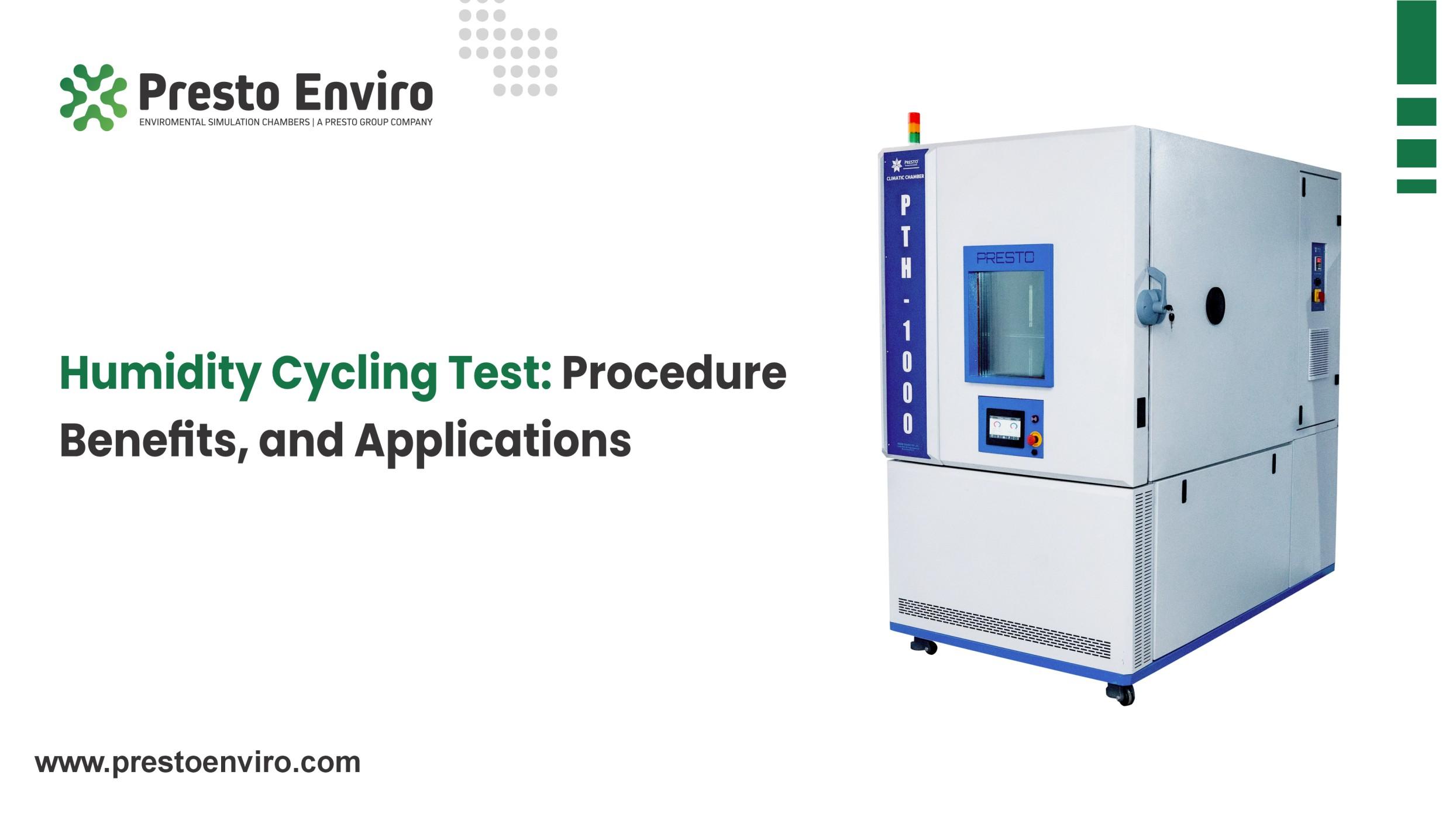
Benefits of the Presto Enviro Humidity Chamber for cyclic testing include tight environmental control, fast test cycles and reliable data collection. This removes the risk of damaging the sample by shifting the chamber or by significant changes in parameters.
Presto Enviro Humidity Cycling Test offers applications in the following industries:
Cyclic humidity testing is one of the most reliable ways to prove your product can handle harsh real-world conditions. Finding water ingress and corrosion issues in the lab saves millions compared to handling warranty claims after launch. The quality of your lab setup is what determines the accuracy of your test data. Presto Enviro stands out as the best Humidity Chamber manufacturer, building tough, highly reliable chambers that make running complex climate profiles simple.
Elevate your quality assurance process to new heights
Related Blogs

23-Sep-2026
Presto Enviro
Products are expected to work reliably for months or years, but manufacturers cannot always wait that long to find out how they will perform. Accelerated aging testing solves this problem by exposing products to controlled environmental conditions that speed up certain aging effects.