© Copyright 2025. All Rights Reserved by Presto Stantest Pvt. Ltd.
24-Aug-2026
Presto Enviro
Every product eventually leaves the safety of a lab and enters the real world for a real test. Heat, humidity, dust, vibration, and sudden temperature drops all hit the product whether the team is ready or not. This is one of the main reasons products fail after reaching customers even when everything looked fine during design and testing on paper.
This is where environmental testing steps in to ensure that the product behaves as perfectly as it performed in the laboratory. In this article, you will learn what environmental testing actually means, what kind of risks show up when it gets skipped, and how testing works to reduce those risks in practice. If you want your products to perform as per your expectations, keep reading this article to the end and improve your product’s lifespan.
Environmental testing evaluated products under controlled conditions like heat, cold, and humidity to analyze how the product behaves in specific environmental conditions. This testing usually covers thermal cycling, humidity exposure, altitude simulation, and vibration testing, and which ones matter depends on the product and where it is going to be used.
A simple analogy of a smartphone manufacturer testing its products can be used to comprehend the testing. They test new devices under conditions of desert heat, freezing winter, sudden humidity and rapid temperature changes in a series of chambers. It is done to uncover the weak points at an early stage so that it will be good for a little money rather than at the end when an entire wave of returns or recall will cost a lot.
In the aerospace and defense sector they have been using this type of testing for decades, as a failure there can be dangerous as well as expensive. The idea is the same with consumer electronics, automotive parts, medical devices and even packaging over the years.
Product development carries risk at nearly every step, and most of that risk stays hidden until the product actually fails somewhere out in the field. These risks go from small material issues to full functional breakdowns once real conditions come into play.
A product can work perfectly in a lab kept at a steady 22 degrees, and that tells you almost nothing about how it behaves in a hot warehouse in Rajasthan or a humid coastal town during monsoon. Materials expand and contract with heat and cold. Adhesives lose their grip over time. Electronic parts can short out from condensation nobody accounted for. Plastics turn brittle in the cold and soft in the heat. None of this becomes visible unless someone actually tests for it on purpose.
Batch inconsistency is another problem worth mentioning. A part that passes today might not pass tomorrow if storage or manufacturing conditions shift even slightly. Then there is the compliance side. Several industries have mandatory environmental standards, and skipping these tests can mean the product simply is not allowed into certain markets at all.
Honestly, the biggest risk is reputation. One bad batch reaching customers can undo years of trust built slowly. People rarely care why a product failed. They just remember that it did, and they tell others.
Environmental testing reduces risk mainly by catching problems before customers ever get their hands on the product. It swaps out guesswork for actual data about how something performs under real conditions.
When a product fails inside a test chamber, engineers can attempt to make the modifications necessary to make it work without having to invest heavily or wasting significant time. However, if the same defect is detected after mass production, the company is now facing three problems: recalls, spoiled inventory, and disgruntled customers.
Testing also provides consistency which is difficult to achieve otherwise. If all the units are subjected to the same tests, the result is a much more consistent performance throughout the production run. There are not as many shockers appearing when the product actually reaches the people.
There is a compliance aspect to the process also. In several industries, for example, automotive, aerospace, electronics and pharmaceutical, there have to be often documentary proofs that the product complies with a certain environmentally related standard prior to selling it. However, this process can be dangerous and can sometimes violate laws in some countries. The early testing prevents the team from being in a hurry once the product is produced and ready for shipping.
One of the aspects frequently overlooked is confidence. As long as engineers know that their design overcame very high & low temperatures and humidity in controlled conditions, the process and decision-making quicken.
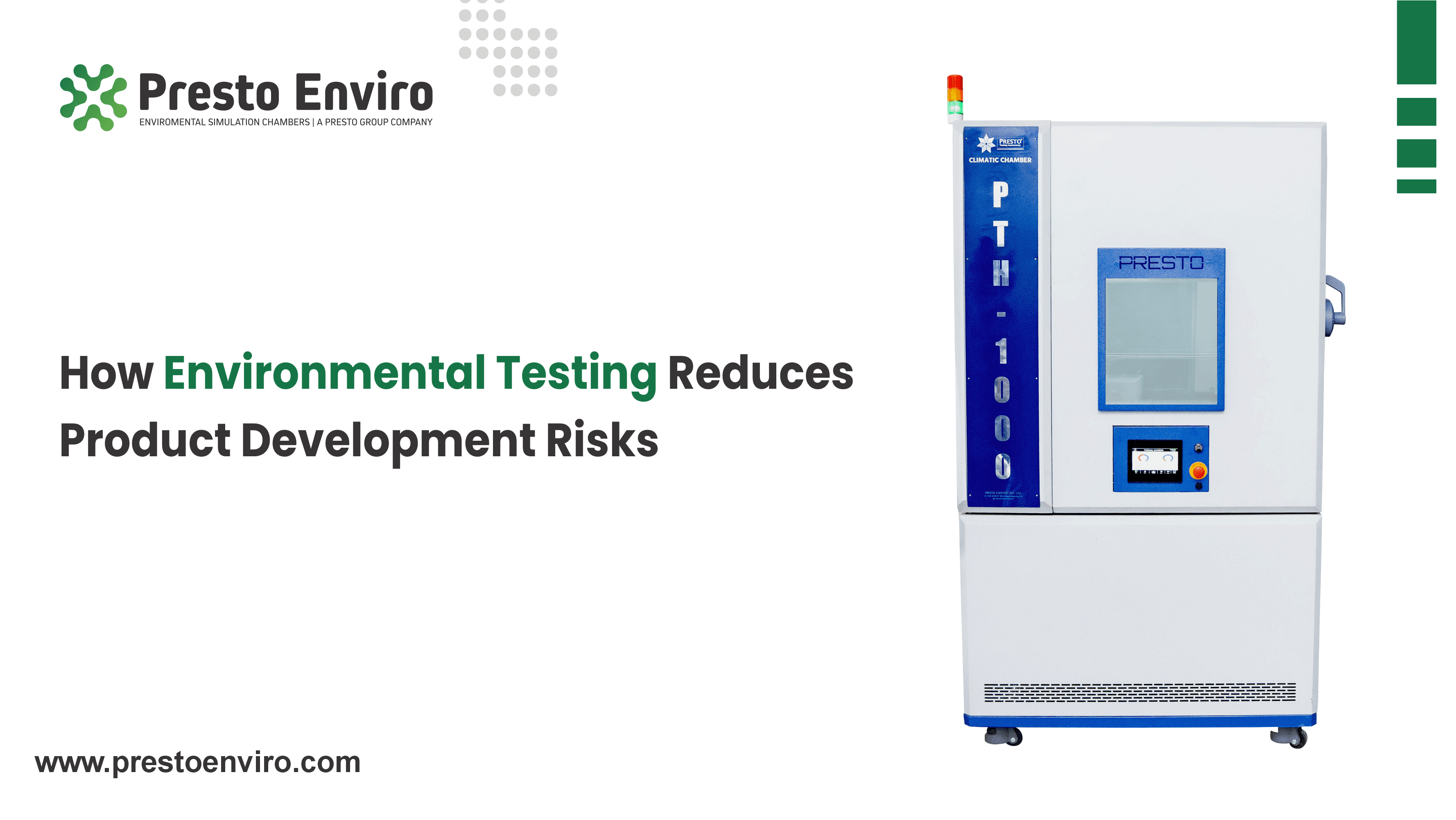
Presto Enviro, recognized as a top environmental test chamber manufacturer in Bangalore, builds specialized chambers to simulate harsh real-world conditions during product development. These units let manufacturers test for heat, cold, humidity, and atmospheric stress before mass production ever starts.
Testing is only as good as the equipment running it, and that is worth pointing out here. A poorly calibrated chamber can give false confidence, and false confidence is arguably worse than skipping the test altogether. Presto Enviro's chambers are built to hold precise and stable conditions, whether that is a specific humidity level or a fast temperature swing cycle. This precision matters because even a small inconsistency during testing can throw off results, and once results are off, the whole point of testing is lost.
Manufacturers in electronics, automotive, packaging, and pharma use these chambers to validate products before scaling up production. The chambers hold up well over long testing cycles too which matters because environmental testing rarely happens just once. Products go through repeated rounds of testing across different design versions, and equipment that stays consistent through all of that saves a lot of rework down the line.
Good quality product development comes down to a handful of consistent habits, and environmental testing sits at the center of most of them. A few practical tips worth following here.
It is to be noted that packaging itself needs to survive environmental stress during shipping and storage too, not just the product sitting inside it. Environmental testing supports all of these habits directly. It gives teams real data to work with instead of relying on assumptions or industry averages that might not even apply to their specific product or market.
Before launching a product in the market, it has to go through the set parameters of testing. Environmental testing is one such critical test where the product is exposed to specific conditions of temperature, pressure, humidity, and others. This helps in catching material failures early to meet compliance requirements and protect brand reputation.
Whether you are a growing business or a large enterprise and want to excel in product developments, Presto Enviro stands out as one of the reliable environmental test chamber manufacturers around. Our chambers are built for precision, consistency, and long-term reliability which makes them a solid pick for manufacturers who want to cut down risk without slowing their development timelines.
Elevate your quality assurance process to new heights
Related Blogs
23-Sep-2026
Presto Enviro
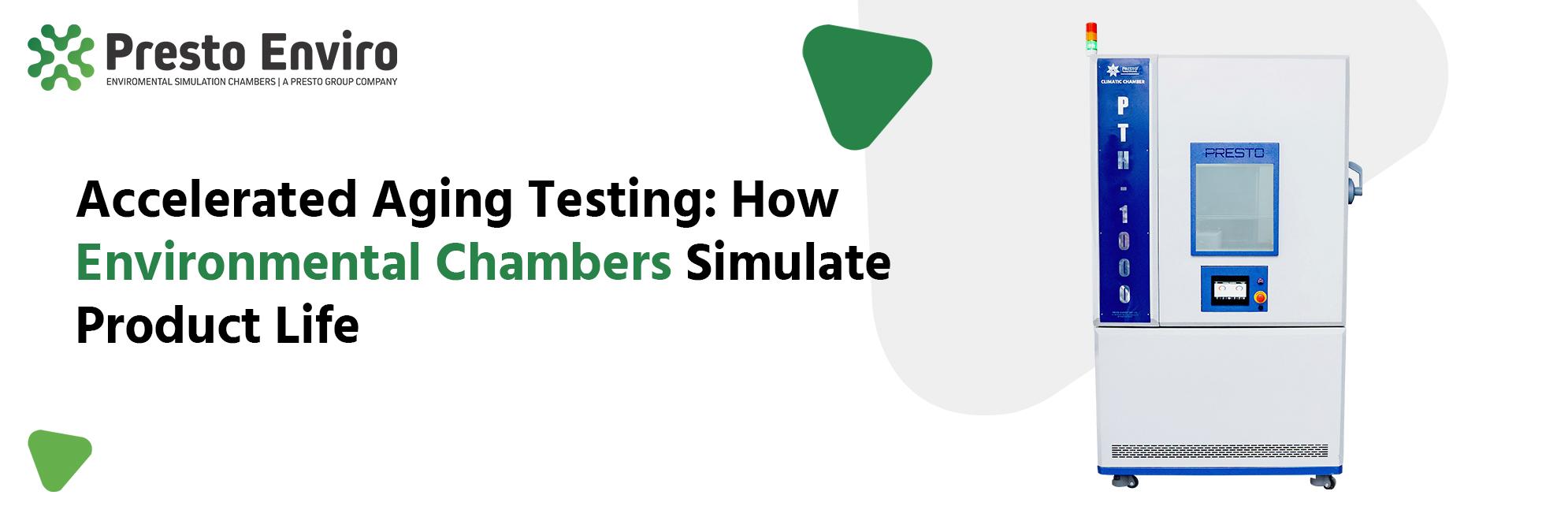
Products are expected to work reliably for months or years, but manufacturers cannot always wait that long to find out how they will perform. Accelerated aging testing solves this problem by exposing products to controlled environmental conditions that speed up certain aging effects.