© Copyright 2025. All Rights Reserved by Presto Stantest Pvt. Ltd.
22-Nov-2025
Presto Enviro
Corrosion represents a major challenge to manufacturers. In addition to how it will affect the long-term viability and destruction of metal parts, coatings, and finishes, an increased emphasis has been placed on determining how susceptible a material is to corrosion. As such, the industry must rely on standardized accelerated tests to determine the resistance of a material to corrosive agents.
ASTM B117 is among the most recognized global testing standards for this purpose, and it is the industry standard for salt spray (fog) tests, which provide an accelerated environment to achieve expedited testing of material resistance to corrosion.
ASTM B117 is a standard method used to test various metals’ and coated metals’ resistance to corrosion with the aid of a salt spray (fog). The amount of corrosion resistance that metal and coated metal experience in a corrosive environment is measured by this standard method.
The ASTM B117 standard is a comprehensive guideline for using the salt spray apparatus, providing precise specifications of the operational procedures, environmental conditions, equipment preparation, cabinet temperature, and an exact concentration of salt and pH level of the fog. The method does not provide an accurate determination of how well metals and coated metals will perform or endure corrosion under actual environmental conditions.
For the ASTM B117 Standard Practice, the scope of the standard describes the ASTM B117 standard guidelines to maintain the product’s integrity and efficiency. The following are the standard practices for ASTM B117:
The ASTM B117 standard is utilized within the industries for standardized, repetitive, and accelerated salt spray testing to evaluate corrosion resistance characteristics in protective coatings and materials. Key reasons why industries rely on ASTM B117:
Standardized and repeatable testing: The standard gives a globally accepted procedure to perform neutral salt spray tests and thus provides a number of benefits related to consistency and comparisons.
Accelerated corrosion testing: It simulates years of natural corrosion in a controlled laboratory setting and provides quick insights into a product's long-term durability and performance.
Quality assurance and compliance: Manufacturers are able to confirm, through use of the standard, that their items meet the industry benchmark for corrosion resistance and are therefore safe and reliable for the end-user.
Cost-effectiveness: Accelerated testing to identify material weaknesses early on can prevent expensive product recalls or failures that may occur in real-world conditions.
Material and coating validation: The test enables the comparison of different protective coatings such as paints and electroplated finishes, thereby aiding in selecting the best materials for a particular application.
The general procedure for performing the test involves several steps, such as specimen preparation, salt solution preparation, chamber setup and calibration, specimen placement, continuous exposure, and post-test evaluation.
All test specimens are thoroughly cleaned of contaminants prior to testing and handled only by the edges whenever possible. The edges of coated specimens may require protection if they are not part of the evaluation.
Using purified water and high-purity pure-grade sodium chloride (NaCl), the pH of the fog solution should be brought to a range between 6.5 and 7.2 using either reagent-grade HCl or NaOH. A 5% NaCl solution will be used as the prepared stock for the collection of the fog solutions.
The chamber and all the measuring instruments have to be calibrated, including thermometers, pH meters, and flow meters. The chamber is first preconditioned at the operating temperature of 35 degrees Celsius, after which it is checked that the fog collection rate and pH are within limits.
The samples are put in the chamber to be exposed to the salt fog uniformly. Specimens will be positioned at a 15- to 30-degree angle relative to the vertical axis during experimentation. It is critical that each specimen remains completely free of contact with any other specimens or the sides of the experimental chamber during experimentation. The dripping of condensate from one specimen onto another adjacent specimen should not occur.
The test is run continuously for the specified duration. Chamber temperature, air pressure, and salt fog collection rates are measured daily.
The specimens are taken out of the test, kept under gently running clean water—not warmer than 38°C—to remove salt deposits, and subsequently dried. They are then visually examined and evaluated for signs of corrosion, for example, red rust, white rust, blistering, pitting, and coating adhesion loss, all based upon the pertinent criteria found in the product specification.
The advantage of doing salt spray tests according to ASTM B117 involves its long history of global acceptance, cost-efficacy, and simplicity, resulting in highly reproducible and repeatable results.
Here are the advantages:
ASTM B117 provides a rapid corrosion testing technique and has been developed as an accelerated test method to expedite the evaluation of corrosion resistance. This testing procedure helps manufacturers to evaluate their designs and products quickly, which reduces the time required for product development and allows manufacturers to make timely decisions regarding product improvements/validation.
The ASTM B117 standard provides precisely defined parameters: temperature, salt concentration, fog density, pH levels, and sample placement. It takes away the laboratories' variability in such a way that test results of corrosion phenomena are constant and reproducible. and comparable worldwide. These consistent conditions mean industries can benchmark products accurately and maintain compliance with quality or certification requirements.
Testing with salt spray under ASTM B117 does not require very specialized equipment or complicated procedures; it is also quite an economical way to assess corrosion. This enables companies to conduct regular quality checks at low operational costs. Early detection of coating defects could also lower warranty claims, failures in production, and maintenance costs over a long period.
The setting up, operation, and monitoring of tests according to ASTM B117 are rather simple. The operating parameters related to the test chamber are well-defined, minimizing operator interference. Clear guidelines enable technicians to operate several tests simultaneously with ease, even in high-volume production conditions. This efficiency enables an organization to maintain consistent quality control without requiring highly technical expertise.
The ASTM B117 specification includes numerous subcategories of materials, including metal, plating, painting, galvanizing, and automotive and marine fasteners. This process is also universal in application in various industries (automotive, aerospace, construction, consumer products, and so on). The test helps in the evaluation of bare materials and surface treatments; hence, it is of universal importance in corrosion studies.
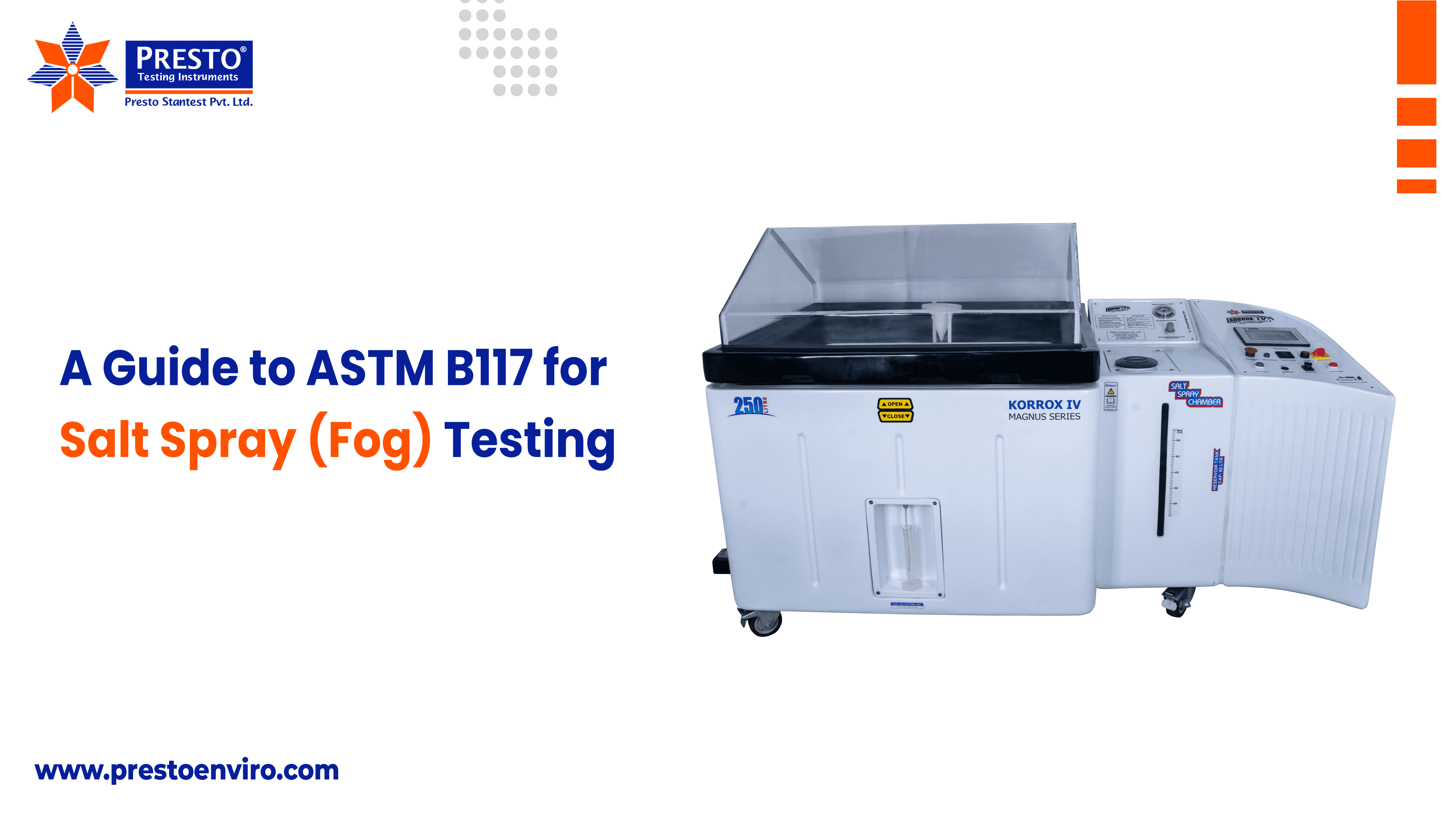
A salt spray test chamber enables manufacturers to determine the corrosion resistance of metals, coatings, and surface treatments. It maintains constant temperature, humidity, and salt concentration levels during the testing process in order to accelerate corrosion development on both product durability and the performance of protective coatings.
Presto Enviro designs and manufactures advanced salt-spray testing chambers for the purpose of providing accurate/repeatable corrosion results. Each piece of equipment meets the ASTM B117 standard with respect to fog distribution, temperature stability, and durability for long-term use. The usability, construction strength, and technical support provided by Presto Enviro allow industries to receive reliable corrosion-resistance results and the assurance of quality every time they use this equipment.
Salt spray (fog) testing per ASTM B117 represents one of the highest standards available for evaluating the performance of coatings against corrosion. The standardized specifications and process developed under this standard create a repeatable process for testing the accelerated corrosive environment experienced by products over time. This assists an organization in validating the long-term usability, quality, and coating performance of their products.
Elevate your quality assurance process to new heights
Related Blogs
15-Oct-2026
Presto Enviro
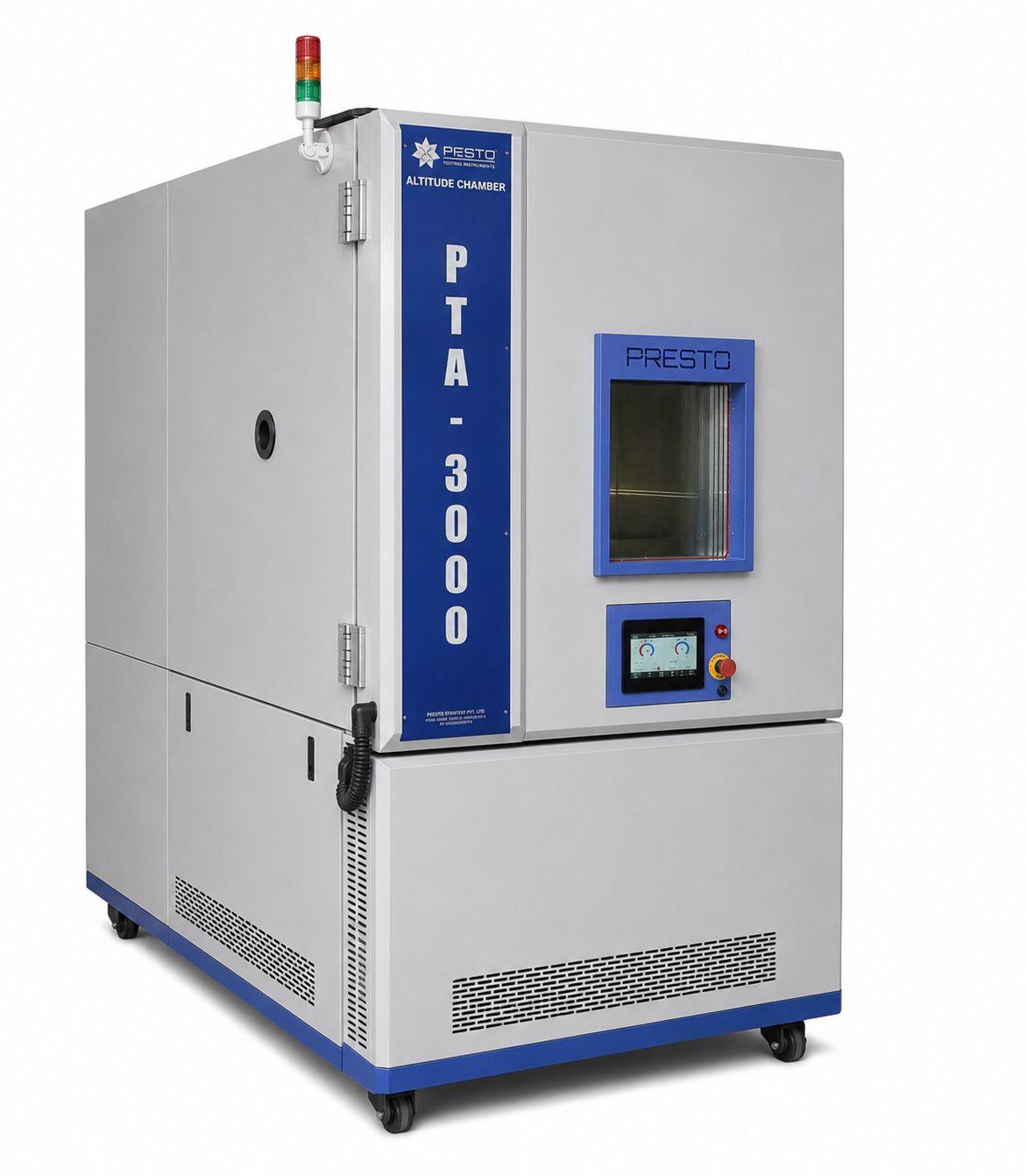
In environmental testing, vacuum chambers are also called altitude test chambers or low-pressure chambers. They lower air pressure inside a sealed chamber to simulate high altitude while controlling temperature and, in some configurations, humidity.
13-Oct-2026
Presto Enviro
An in-house lab can deliver results, give better control over product testing, and reduce testing costs in the long run. To make it work well, the lab space, equipment, utilities, and testing methods must be planned according to your needs.