© Copyright 2025. All Rights Reserved by Presto Stantest Pvt. Ltd.
28-Aug-2026
Presto Enviro
Every day, EV batteries face harsh conditions. On the road, a high-voltage pack may deal with sudden freezing slush, extreme heat buildup during 350kW fast-charging stops, and continuous structural pounding from bad pavement. If a pack fails out in the field, you face rapid range loss, expensive warranty recalls, or severe safety hazards like thermal runaway.
This article breaks down why lab-based environmental testing matters for electric vehicle energy storage, the core testing requirements engineers must satisfy to prevent field failure, and how specialized environmental test chambers simulate these harsh real-world conditions.
Environmental testing involves subjecting a product to simulated weather and atmospheric stresses inside a controlled laboratory setting. It helps engineers identify design flaws, material degradation, and potential component failures before mass production.
Instead of depending on customer warranty claims from colder climates and coastal regions, you replicate the same stress factors in controlled conditions.
For example, an electric delivery truck. During winter, slushy, freezing water is sprayed onto the outside of its battery casing while high voltage electric cells inside heat up due to acceleration. With the help of a test rig environmental chamber, engineers can carry out a hot/cold cycle on an electric vehicle continuously.
Thermal cycling subjects a battery system to constant temperature shifts between extreme heat and cold. This simulates the conditions that occur when a vehicle sits outside on a cold winter's night, then gets plugged into a fast-charging station.
Materials contract in the cold and expand when hot. If you put a full battery tray through repeated cycles from -40°C up to 85°C, those dimensional changes put massive strain on wire bonds, structural adhesives, and cooling plate joints.
The main issue here is mismatched thermal expansion rates. Aluminum cooling lines, copper busbars, and steel housing elements all move at different speeds. If the joints can't flex, solder snaps or coolant leaks directly onto live cells. Thermal shock speeds up this damage by slamming the pack between hot and cold zones in seconds rather than minutes. It proves whether micro-cracks will form in high-stress spots over time.
Endurance testing bakes or freezes a battery pack at fixed temperature limits for hundreds of hours straight. It shows how long-term exposure to desert heat or polar conditions degrades the internal cell chemistry over time.
Heat is the absolute enemy of lithium-ion longevity. Holding a pack at elevated heat like 60°C speeds up unwanted chemical side reactions inside the cells, degrading the liquid electrolyte and driving up internal resistance.
Cold endurance presents different risks. Sub-zero soak times cause the electrolyte to thicken up like cold syrup. This slows ion movement, cuts usable energy, and makes the pack vulnerable to lithium plating on the anode if someone attempts high-current charging without proper pre-heating. Long-duration thermal soaks give validation teams hard numbers on capacity loss, cooling power demands, and BMS logic accuracy over time.
Humidity testing checks if moisture can creep past seals and ruin sensitive electronic boards or high-voltage insulation barriers. Water inside an EV pack causes an immediate electrical disaster.
Air temperature changes inside a battery box lead to internal condensation. Tiny water droplets form on exposed copper tracks, corroding joints and degrading the dielectric strength of protective coatings over time.
Chambers run damp heat cycles at relative humidity levels up to 95% while sweeping temperatures back and forth. This creates internal pressure changes that drag moist air right past outer cover seals. If moisture gets through, current bleeds across isolated circuits. That causes short circuits or trips isolation monitoring faults on the vehicle dashboard.
Vibration testing imitates rough roads, potholes, and other stressors on a vehicle chassis and gives a good impression of real-world fatigue by performing vibrations in a temperature-controlled chamber. EV battery packs are heavy structural units mounted to the frame.
EV battery packs are heavy structural components bolted directly into the frame. As the car hits bumpy roads, the frame twist passes mechanical energy right through the battery casing and internal mounting points.
To run these rigorous stress tests, automotive labs often rely on custom solutions engineered by a top environmental test chamber manufacturer in Pune. Technicians bolt the complete pack onto an electrodynamic shaker table integrated straight through the floor of an environmental chamber The table shakes the pack along three axes while the chamber cycles ambient temperatures around it. Combining mechanical stress with thermal strain reveals loose high-voltage fasteners, cracked mounting tabs, and chafed wire looms that standard bench tests never pick up.
Corrosion testing verifies that structural trays, exposed cooling fittings, and outer mounting hardware survive harsh road salt and coastal ocean air. Metallic parts rust quickly when exposed to aggressive road spray.
Winter roads get treated with heavy concentrations of liquid brine and rock salt. In salt fog testing, atomized salt mist sprays continuously over test hardware inside a warm room.
The test goes through weeks of wet spray periods, dry periods and high humidity periods. Engineers look for protective paint flaking off, aluminum cooling lines corroding through, or rust creeping past rubber seal faces into internal compartments. Passing this test means that the outer shell is structurally strong throughout the life of the vehicle.
Altitude testing confirms how battery seals and pressure relief vents act under reduced atmospheric pressure. Pressure drops when driving across high mountain passes or during cargo flight transport.
Air pressure drops at high elevations while internal pack pressure stays high. That pressure gap forces internal air outward against top covers and side walls, stressing structural fasteners and gasket lines.
In a thin mountain atmosphere, the air is less dense which reduces the efficiency of heat transfer in air cooled battery layouts. Vacuum environmental chambers can simulate atmospheric conditions at altitudes of up to tens of thousands of feet. This test confirms that structural seals are tight and emergency pressure valves only open at the correct pressure settings.
Thermal runaway containment testing checks whether a battery enclosure can hold back high-pressure gas and fire if an individual cell suffers internal failure. Overall vehicle occupant safety depends on this test.
Thermal runaway is induced by technicians in a target cell using localized heating pins in a safety-rated explosion chamber. The chamber is designed to safely accommodate rapid gas release, extreme heat flares and pressure spikes during the test event.
Engineers monitor internal heat shields to verify fire doesn't jump to neighboring cells. They also check if internal pressure relief valves vent hot exhaust gases outward safely. Combined with high-pressure water jet spray tests (IPX9K rating), this process confirms the tray blocks outside water while handling internal thermal events cleanly.
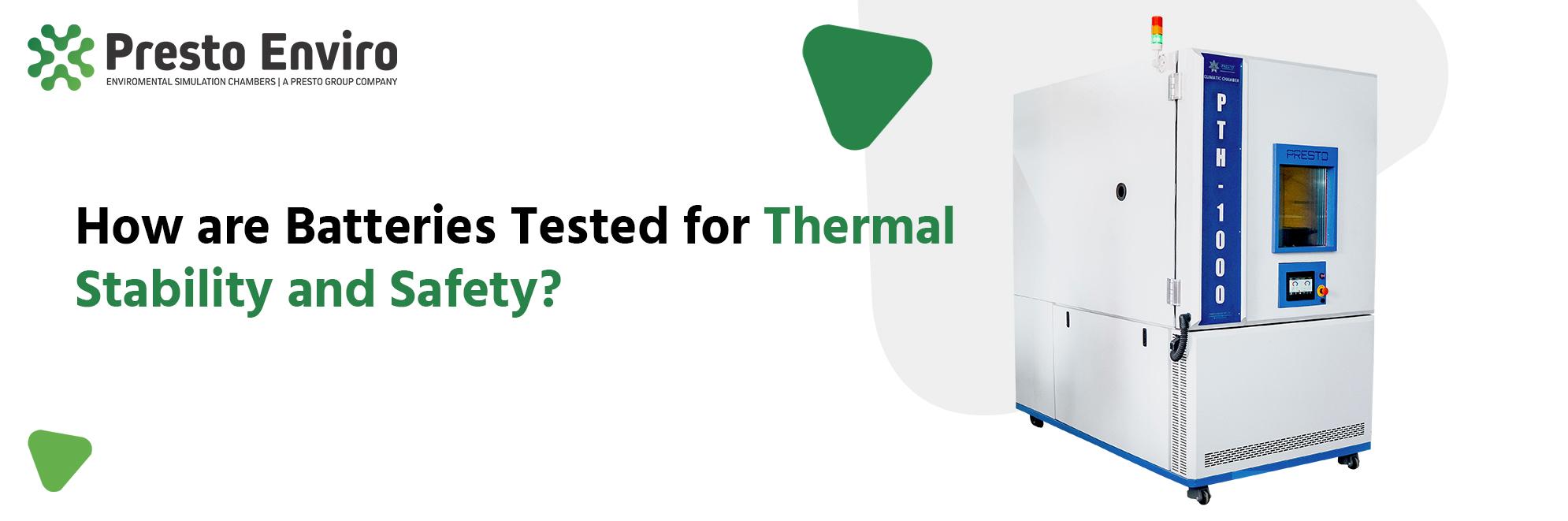
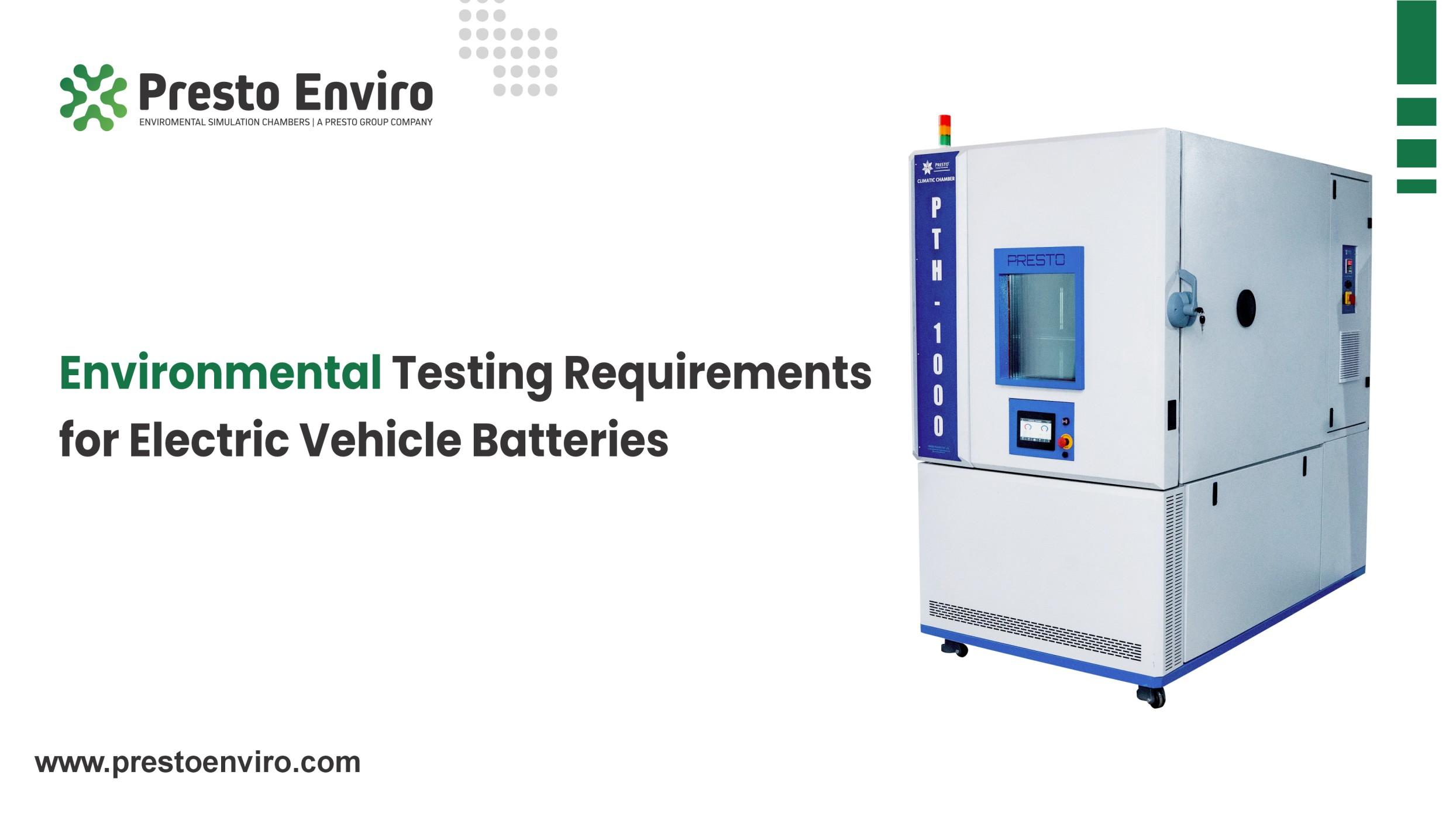
Presto Enviro builds best-quality environmental test chambers designed around the mechanical and thermal demands of EV battery testing. Our test chambers offer wide operating ranges for both temperature and humidity, letting labs run thermal shock, damp heat, and high-temp soaks in a single machine. The test spaces feature heavy-gauge stainless steel interiors and dense mineral wool insulation to keep temperature distributions even across large, heavy battery arrays.
Since testing high-density energy storage carries real operational risks, Presto Enviro builds specific safety hardware directly into their chamber architecture:
Environmental testing forms the bedrock of reliable electric vehicle development. Subjecting cell modules and battery packs to aggressive thermal cycling, heavy humidity, road chatter, and salt spray exposes structural defects long before vehicles reach commercial production. Engineering teams can use high quality lab simulation equipment to discover design flaws earlier and help protect the safety of the drivers and the reputation of the brand.
Presto Enviro is the most trusted manufacturer of environmental test chambers for simulation hardware to validate energy storage. Their custom-engineered testing enclosures help engineering teams deliver the right climate control and reliable safety features they need to meet demanding global automotive standards.
Elevate your quality assurance process to new heights
Related Blogs
23-Sep-2026
Presto Enviro
Products are expected to work reliably for months or years, but manufacturers cannot always wait that long to find out how they will perform. Accelerated aging testing solves this problem by exposing products to controlled environmental conditions that speed up certain aging effects.