© Copyright 2025. All Rights Reserved by Presto Stantest Pvt. Ltd.
04-Apr-2025
Presto Enviro
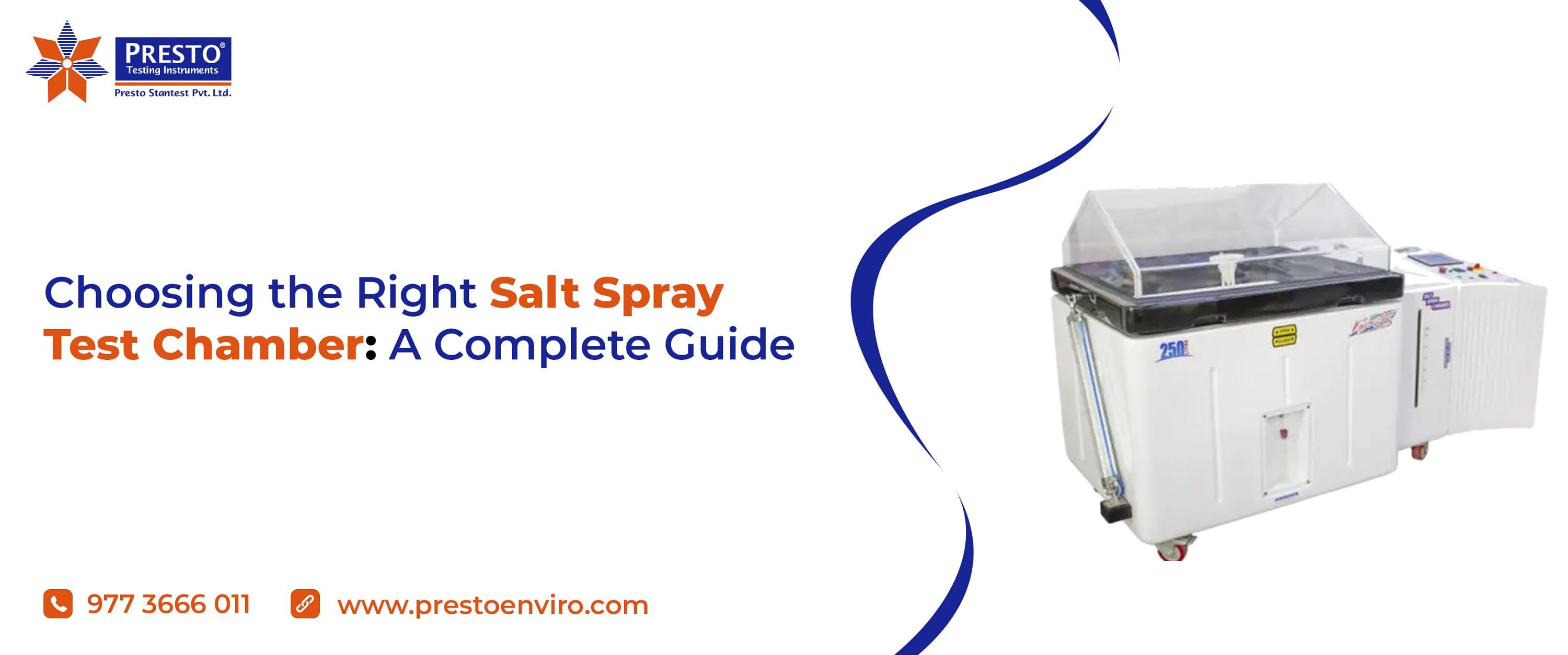
A Salt Spray Test Chamber, also known as a corrosion test chamber, is an advanced testing device that mimics aggressive environments by releasing a gentle mist of saline solution over test samples to evaluate their durability against corrosion. These chambers comprise an enclosed area where a saltwater solution is misted and dispersed onto samples.
The test samples are composed of metals, polymers, or various substances that are utilized in several implementations, such as automobile components, marine devices, and space industry parts. Industries like automotive, aerospace, and marine use it to test the corrosion resistance of components, coatings, and finishes.
Salt spray chambers are utilized to assess the strength and rust resistance of substances and surface coatings in simulated corrosive environments.
When choosing the salt spray chamber, it is very important to evaluate the specific testing needs and ensure that the selected chamber has the correct specifications, features, and size. Here is a detailed explanation of the major points that should be kept in mind while choosing the right salt spray chamber:
ASTM B117 is an internationally acknowledged standard that defines the methods, tools, and conditions for performing Neutral Salt Spray (NSS) tests to assess the durability against corrosion of metals and coatings. It mimics exposure to authentic saltwater or corrosive environments.
Established by ASTM International, this standard provides guidelines for creating a controlled corrosive environment to speed up the formation of rust and corrosion on test samples.
The purpose of ASTM B117 testing for salt spray is to evaluate the corrosion resistance of materials and coatings by simulating salt spray exposure in a controlled environment. This test helps predict material durability, ensures quality control, and determines the long-term performance of materials in harsh environments like marine or coastal settings.
Salt Spray Chambers are necessary for ensuring the durability and performance of automotive components by evaluating their corrosion resistance by industry standards.
Various types of salt spray chambers are available, differing in size, capacity, and features. Cyclic, walk-in, and compact chambers are tailored to meet specific industry requirements.
Cyclic salt spray chambers, also known as cyclic corrosion tester chambers, are high-tech devices constructed to test specimens in regulated environmental parameters. The primary feature of a cyclic salt spray chamber is its capability to switch under different environmental conditions in a cycle. It is an important tool for industries where materials are exposed to fluctuating environmental conditions.
A Walk-In Salt Spray Chamber is a large-scale testing device designed to cater to large or heavy specimens that require corrosion resistance testing under salt spray conditions. Walk-in chambers are spacious enough for the operators to walk inside the chamber to maintain and load larger components.
A compact salt spray chamber is a space-efficient version of the traditional salt spray chamber. It is designed to perform corrosion-resistant testing on tiny components with limited space facilities. Despite its smaller size, it provides the same level of precision and control over environmental conditions.
A neutral salt spray chamber is designed to evaluate the corrosion resistance of materials and coatings when exposed to a salt-laden environment. The term neutral refers to the pH level of the salt solution utilized in the chamber, and it is typically maintained at a neutral level (around pH 6-7).
A Salt Spray Chamber is a necessary piece of equipment in laboratories used to evaluate the corrosion resistance of materials. Whether for research, quality control, or product development, the suitability of a salt spray chamber for laboratory use is determined by several critical factors that meet industry standards. These factors include precision, reliability, ease of use, versatility, and compliance with international testing standards.
With accurate environmental control, compliance with international testing standards, and robust construction, these chambers enable laboratories to carry out effective and consistent corrosion resistance testing. By ensuring reliable results, ease of operation, and safety, a salt spray chamber becomes a necessary tool for manufacturers and researchers across various industries, from automotive to aerospace to electronics.
Elevate your quality assurance process to new heights
Related Blogs

23-Sep-2026
Presto Enviro
Products are expected to work reliably for months or years, but manufacturers cannot always wait that long to find out how they will perform. Accelerated aging testing solves this problem by exposing products to controlled environmental conditions that speed up certain aging effects.
20-Sep-2026
Presto Enviro
Battery safety is not something manufacturers can check only after a battery is ready for use. Temperature, charging conditions and repeated use can change the way a battery behaves. In some cases, excessive heat can cause permanent damage or create serious safety risks.