© Copyright 2025. All Rights Reserved by Presto Stantest Pvt. Ltd.
07-Sep-2026
Presto Enviro
The environmental test chamber plays a critical role in product development, quality control, research and development (R&D), and other areas. Not only that, but an environmental chamber is important to maintain regulatory compliance in the pharmaceutical industry.
Above all, you must understand how to choose an environmental test chamber depending on your product requirements. In this article, you will find the complete details of why your product needs an environmental chamber, what factors you should consider when choosing one, and why Presto Enviro is the best option to consider.
Environmental test chambers simulate real-world conditions like extreme temperatures, high humidity, or rapid climate shifts in a controlled lab setting. They help in identifying potential design flaws before a product reaches mass production.
Different products behave in varying ways when exposed to heat, humidity, or cold for extended periods. Electronic circuit boards may fail to work properly in humid conditions, while plastic housings may suffer damage in low temperatures. If you rely on customer feedback to identify such problems, the cost of recall will be substantial.
Utilizing a climate chamber gives you the opportunity to simulate years of environmental exposure in a matter of a few days. You can get clear information on the limits of materials, the effectiveness of products, and the thermal properties of units. This process guarantees that your machines satisfy the standards of the industry in terms of reliability and endurance.
You need to outline the physical dimensions and environmental limits of your hardware before you start looking at equipment catalogs. Knowing these numbers upfront keeps you from buying a unit that turns out underpowered or too cramped for daily use.
Start by looking closely at the real environments your product will face during its operational life. A device designed for air-conditioned office spaces needs a completely different test profile than an automotive sensor mounted right next to an engine block.
Factor in the internal heat your product generates while powered on and running. Active thermal loads force cooling systems to work much harder to keep temperatures stable. You should also think about sample shape, wire connections, and whether you are testing single chips or fully assembled enclosures.
Selecting a chamber means balancing its internal specs with your testing routines and floor space. Here are seven core factors you should review carefully.
The inside workspace must be spacious to allow sampling sizes and more than enough air circulation. A mini chamber would mean limited airflow that leads to hot spots and uneven heat distribution around your samples.
Make sure to retain a gap of 2-3 inches between the wall and your test samples. It is essential to ensure that air flows freely from all directions in the working space. Overcrowding the machine could lead to inaccurate readings.
Plan for future projects as well. If your design team will produce bigger models next year, you will save yourself from making a second machine purchase by opting for a larger unit now.
Choose a chamber that reaches conditions well beyond your basic operating limits. Having extra range provides a safety margin for aggressive stress tests down the line.
The typical temperature range in standard test chambers is between -40°C and +150°C. If your tests require a temperature range of -70°C, you will need a two-stage cascade refrigeration system.
Regarding humidity, the humidity generator offers a wide range from 10 to 95% RH. It must provide for high humidity levels at relatively high temperatures if your products are used in humid tropical regions.
Ramp rate shows how quickly the chamber can raise or lower the internal temperature per minute. Faster change speeds shorten overall test cycles and let you run thermal shock routines on your parts.
A standard lab chamber changes temperatures at roughly one to two degrees Celsius every minute. However, when it comes to high-performing models like one from Presto Enviro, they can push the temperature change over 10 degrees/minute. This is done by using high-rated compressors or direct liquid nitrogen injection which makes it a more powerful machine.
Similarly, when using faster ramp rates, it requires bigger motors and extra cooling power; however, it increases the overall cost, and that should be kept in mind. Check your industry test standards to see if you actually need rapid temperature swings or if a steady, slower pace works fine.
Today's test devices utilize up-to-date digital equipment, which allows operators to perform multiple test operations, thus gathering data and observing tests remotely. A good user interface helps the operator to avoid unintentional errors during setup processes.
Choose control systems with simple interfaces and user-friendly functionality. Software must automatically gather temperature and humidity data so that the data is easier to export later.
Network features provide easy monitoring of the laboratory. Notifications should be sent to your employees as soon as any accident occurs during night tests.
Balanced air circulation guarantees every part of your sample encounters the exact same temperature and humidity. Poor air movement leaves dead zones in the cabinet that ruin test consistency.
Chambers use internal blowers to move conditioned air through the main workspace continuously. The layout of the air ducts and fan speeds determine how evenly that air sweeps across your samples.
Pay attention to how you position things inside the chamber. Mounting tall circuit boards vertically can block horizontal air streams, giving you false readings on items sitting directly behind them.
The cabinet should be lined with strong stainless steel and thick insulation for improved temperature efficiency. If the walls are not insulated properly, energy is lost and moisture condenses on the outside panels.
The internal walls are composed of first-rate stainless steel that will prevent the possibility of corrosion or rusting and hold off the accumulation of moisture. The joints are welded completely to prevent water from leaking into the insulating material and keep the insulation performance intact.
Outer panels need tough powder-coat finishes to resist daily wear in busy labs. Dense insulation layers keep exterior surfaces safe to touch even when running high-heat testing profiles.
Environmental chambers draw heavy electrical currents and dump a lot of heat into your room. You must verify your lab utilities before signing off on a purchase order.
Large reach-in units frequently need three-phase power hookups along with dedicated water lines for humidity generation or water-cooled condensers. Air-cooled systems throw warm air straight into your room, which can overload standard building air conditioners.
Measure all doorways, hall turns, and floor load weight limits beforehand. Getting a heavy walk-in unit through narrow corridors creates massive headaches if you skip spatial planning.
Presto Enviro manufactures reliable test chambers designed for industrial quality control, delivering solid thermal accuracy and long-term stability. Our systems pair intuitive digital controls with heavy-duty construction to simplify daily lab routines.
This factor also needs to be considered when devices need to be calibrated for years. The use of reliable stainless-steel frameworks and efficient cooling systems is a feature offered by Presto Enviro.
Our touch-screen technology allows laboratory workers to set complex temperature and moisture settings with no difficulty. Presto Enviro products have versatile designs that can accommodate small working spaces and meet international testing requirements regardless of the type of item tested – electronics, plastic, or automotive pieces.
In addition, the local presence of many services and spare components makes repairs quick and effective.
When selecting the right environmental test chamber, the most important factor is understanding your product dimensions, required temperature ranges, and facility limits. Taking time upfront to evaluate capacity, change speeds, and controller features keeps you from making expensive mistakes. Trusted manufacturers like Presto Enviro supply dependable chambers that deliver clean test data and keep your quality assurance process running without hiccups.
Elevate your quality assurance process to new heights
Related Blogs

23-Oct-2026
Presto Enviro
A walk-in climatic test chamber is a room-sized chamber that an operator can enter to load, position, and instrument large products or many samples. A drive-in chamber is a type of chamber. It has a reinforced floor and wide doors. This design lets a vehicle be driven or rolled inside.

21-Oct-2026
Presto Enviro
Temperature chambers are insulated boxes. They keep a product at a specific temperature. They can move it through different temperature levels in a set pattern. This lets people test how the product behaves when it's hot or cold.
15-Oct-2026
Presto Enviro
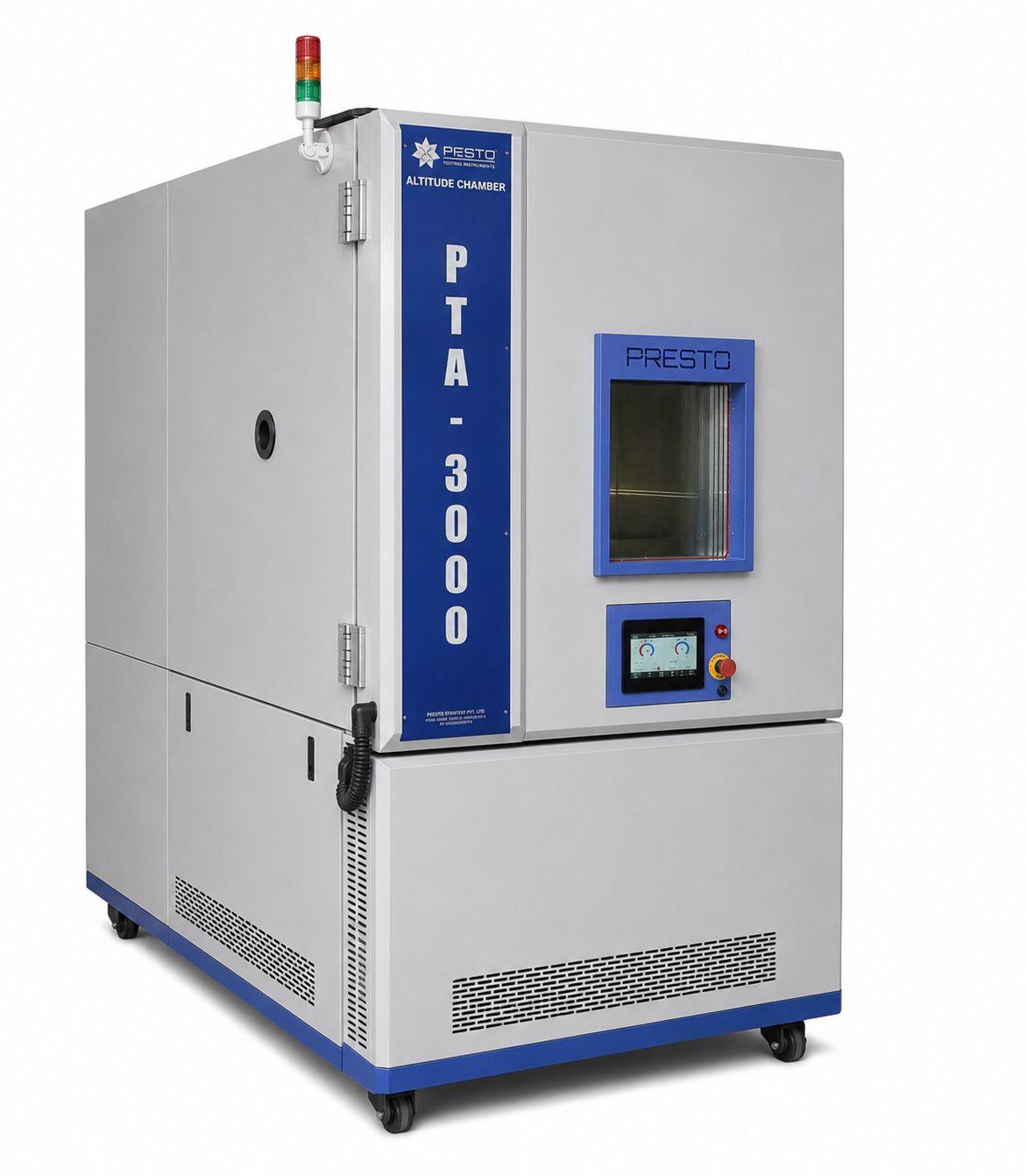
In environmental testing, vacuum chambers are also called altitude test chambers or low-pressure chambers. They lower air pressure inside a sealed chamber to simulate high altitude while controlling temperature and, in some configurations, humidity.