© Copyright 2025. All Rights Reserved by Presto Stantest Pvt. Ltd.
20-Mar-2025
Presto Enviro
Batteries are essential to modern electronic devices, but they also pose significant safety risks, especially under mechanical stress. In cases of accidental impact, compression, or crushing, batteries can experience internal short circuits, leading to overheating, fire, or even explosions.
To address this issue, the Battery Crush Test is conducted to evaluate a battery’s ability to withstand mechanical pressure without catastrophic failure. This test simulates real-world conditions where batteries may be deformed due to mishandling or external force.
In this discussion, we will explore the working, safety standards, and the importance of crush testing in battery safety assessments.
The Battery Crush Test evaluates a battery’s safety by applying pressure or external force to simulate crush or impact. The test ensures that a battery can withstand mechanical stress and extreme pressure without causing fire, explosion, or leakage, making it essential for ensuring safety in various applications.
The main purpose of the battery crush test is to check if a battery stays secure and works properly when it is pressed hard. This test helps find out if the battery gets damaged inside, which could cause dangers like fires or explosions.
A battery crush test setup comprises several vital components including crushing plate, fixture, load cell, etc, developed to apply controlled pressure on a battery to assess its safety. The main components and their respective functions are described below:
Crushing Plate: A strong metal plate that applies pressure to the battery. It is usually flat in shape to replicate different types of pressure scenarios.
Hydraulic or Mechanical Press: A system that produces the required force to crush the battery. Hydraulic presses are commonly used as they provide controlled and precise pressure.
Battery Holder/ Fixture: It is a safe frame that holds the battery in place during testing to avoid unnecessary movement.
Force sensor/Load cell: A device that measures the amount of force being applied to the battery, ensuring accurate testing conditions.
Voltage Monitor Systems: These systems track the battery voltage during the test to identify sudden drops, which could indicate internal short circuits.
Protective Chamber: A safety enclosure that contains any fire, explosion, or hazardous material release in case the battery fails during testing.
Battery crush testing is crucial because it checks how safe and strong a battery is in extreme conditions like accidents. By pressing the battery, manufacturers can find weak points and fix them to make batteries safer. This helps prevent dangerous problems like fires or explosions.
Crush tests simulate real-world scenarios where batteries might be subjected to mechanical stress, such as in vehicle accidents, helping to determine if a battery can withstand such conditions without failing or posing a safety hazard.
These tests can reveal weaknesses in battery design or manufacturing, allowing manufacturers to address potential problems before they lead to safety incidents.
By testing batteries under extreme conditions, manufacturers can ensure that their products are reliable and safe for consumers, building trust and confidence in the technology.
Battery crush tests are often required for compliance with industry standards and regulations, ensuring that batteries meet certain safety requirements.
The battery crush test has been organized to assess a battery’s capability to resist mechanical pressure without causing danger such as fire, leakage, or explosion. The test follows a systematic process to ensure consistent and accurate solutions. Here are the detailed steps explained one by one below:
Battery crush tests follow international safety standards like SAE J2464, SAE J2929, UN 38.3, ISO 12405, GB/T 31467-3, GB/T 31485, GB 38031-2020. These standards ensure batteries can withstand mechanical stress without causing hazards like fire, explosion, etc.
SAE J2464, SAE J2929:
These standards from the Society of Automotive Engineers (SAE) are used for testing batteries and capacitors in electric and hybrid vehicles, focusing on abuse tests.
UN 38.3:
This standard, developed by the United Nations, covers the transportation safety testing of lithium-ion and lithium-metal batteries, ensuring they can be transported safely.
ISO 124095:
This standard provides specific test procedures for lithium-ion battery packs and systems used in road vehicles, focusing on safety and performance requirements.
GB/T 31467-3, GB/T 31485, GB 38031-2020:
These are Chinese national standards that outline safety requirements for lithium-ion batteries, including mechanical and environmental safety.
IEC 62133:
This standard, developed by the International Electrotechnical Commission (IEC), sets out requirements and tests for the safety and performance of lithium-ion batteries in portable electronic devices.
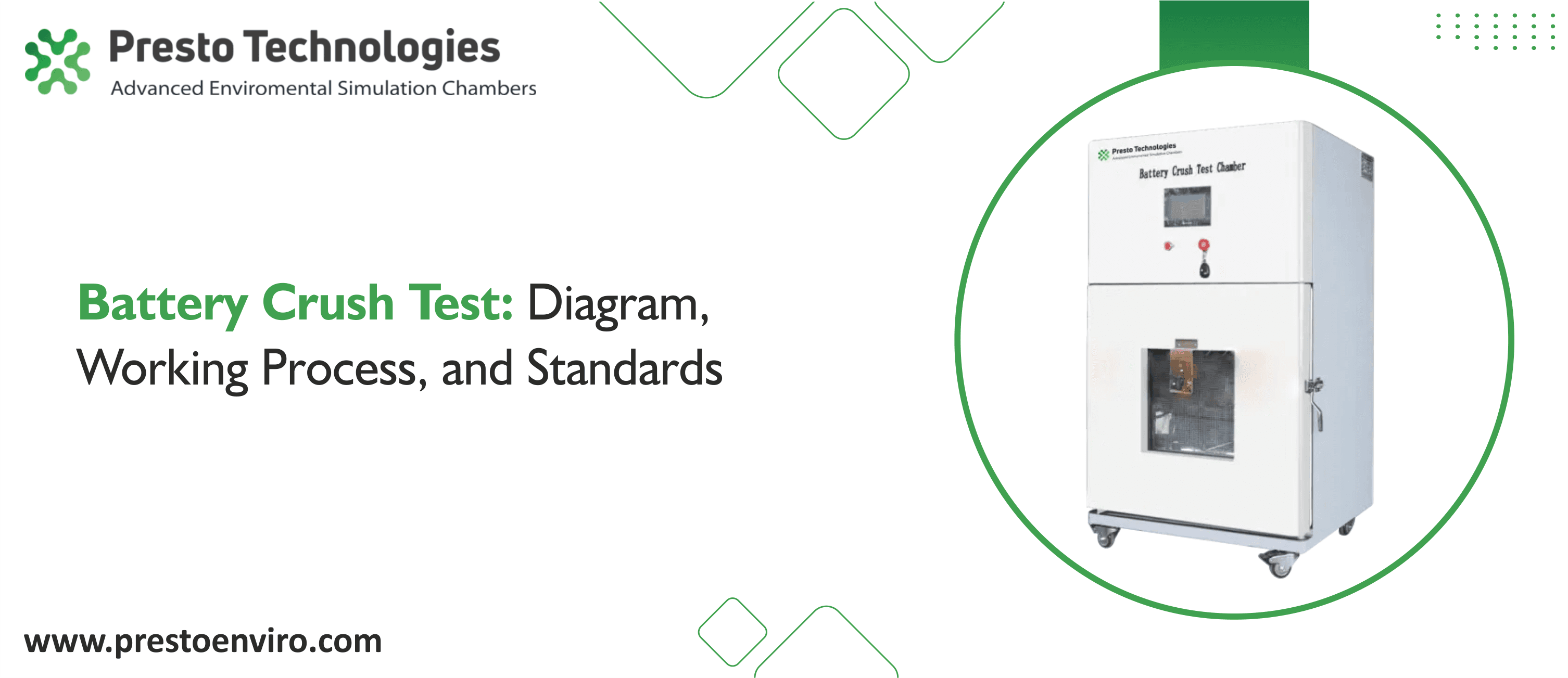
A Battery Crush Test Chamber is a specialized testing machine used to evaluate a battery’s response to mechanical pressure. It helps manufacturers ensure battery safety by simulating real-world crushing scenarios. Below are the step-by-step instructions to conduct a battery crush test:
FAQs
The battery crush test is used to assess how a battery will respond to extreme force, specifically pressure, and to identify potential safety issues like thermal runaway or short circuits.
What is a battery capacity test?
A battery capacity test, also known as a load test or discharge test, determines the actual amount of energy a battery can store and deliver by measuring its capacity to discharge at a specific rate until a predetermined voltage is reached.
What happens if a battery is crushed?
Crushing a battery, can be extremely dangerous and lead to fires, explosions, and the release of harmful substances due to the potential for internal short circuits, overheating, and chemical reactions.
What is a battery crush tester?
A battery crush tester is a specialized piece of equipment used to simulate the mechanical abuse a battery might experience during use, transportation, or storage, specifically focusing on the effects of crushing or impact, to assess its safety and performance.
How to check if the battery is ok?
To check if a battery is okay, use a multimeter to measure its voltage, ensuring it's set to DC voltage and that the red probe is connected to the positive terminal and the black probe to the negative terminal. A healthy battery should read between 12.4 and 12.7 volts.
Elevate your quality assurance process to new heights
Related Blogs

15-Oct-2026
Presto Enviro
In environmental testing, vacuum chambers are also called altitude test chambers or low-pressure chambers. They lower air pressure inside a sealed chamber to simulate high altitude while controlling temperature and, in some configurations, humidity.

13-Oct-2026
Presto Enviro
An in-house lab can deliver results, give better control over product testing, and reduce testing costs in the long run. To make it work well, the lab space, equipment, utilities, and testing methods must be planned according to your needs.