22-Nov-2026
Presto Enviro
Every product data sheet has an IP rating—IP54 for an outdoor sensor, IP65 for an LED fixture, IP67 for a mobile phone, and IP68 for an underwater camera. What everyone knows about IP is that the larger the number, the better. Very few are aware of how the number is awarded.
This tutorial serves as a good IP rating table, explaining both how the system works and what tests need to be carried out.
IP stands for Ingress Protection. The rating is defined in IEC 60529 and has two digits:
Whereas the testing of a particular item has been done with respect to just one kind of protection, the other digit is assigned the value of "X." Thus, IPX4 refers to a water-proofed material without any kind of dust rating.
The second important aspect about which there is often confusion is that the second number is not on a cumulative scale. The fact that a particular product is immersed in water (IPX7) does not make it resistant to water jets (IPX6).
|
Rating |
Dust protection |
Water protection |
Typical test method |
|
IP54 |
Dust-protected (limited ingress allowed, must not affect operation) |
Splashing water from any direction. |
Dust chamber plus oscillating tube or spray nozzle |
|
IP65 |
Dust-tight |
Low-pressure water jets from any direction. |
Dust test plus a 6.3 mm nozzle jet. |
|
IP67 |
Dust-tight |
Temporary immersion up to 1 m |
Dust test plus immersion for 30 minutes. |
|
IP68 |
Dust-tight |
Continuous immersion beyond IPX7 conditions. |
Dust test plus immersion under conditions agreed with the manufacturer. |
Dust (5): The dust chamber is used in conjunction with talcum powder, often under vacuum conditions for a certain amount of time. Some dust will get inside, but there won’t be too much to cause problems.
Water (4): The spraying or drenching takes place in all directions, either using an oscillating hose or spray nozzle, which sprays water at a rate of 10 liters per minute for several minutes.
IP54 is ideal for products that operate in conditions involving dust and splashing but without the threat of direct exposure to jets of water.
Dust (6): The same dust test, but the pass criterion is stricter: no dust ingress at all.
Water (5): A 6.3 mm nozzle sprays water at about 12.5 liters per minute from a distance of roughly 3 meters, aimed at all practical angles for at least 3 minutes.
IP65 is typically used in outdoor lighting, junction boxes, CCTV enclosures, and wherever there is a chance of cleaning with water or heavy rain.
Water (7): The product is then submerged in water in such a way that the lowest point of the product is one meter below the water surface for 30 minutes. At the end of the procedure, the product should not have any water entry inside it and must be operational.
Such ratings are suitable for devices that could end up in water droplets but not for prolonged immersion underwater.
Water (8): The test conditions are more challenging than the IPX7 rating, despite it being unspecified in the IPX7 rating. The depth and duration are decided on an individual basis by the manufacturer and the consumer; therefore, it can be concluded that even the IP68-rated products may have different capacities.
It is always advised to go through the data sheet for the mentioned depth and duration, like "IP68, 2 m for 60 minutes."
The dust and immersion tests require specialized equipment, but a lot of the water protection testing done during product development is done using IPX1-IPX6 ratings on the water scale.
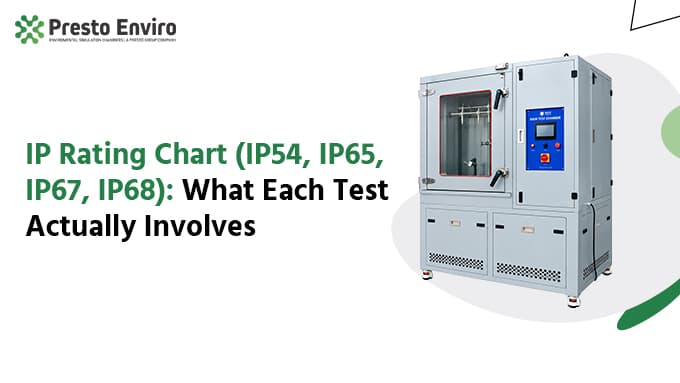
The rain test chamber replicates all the above requirements in a systematic and reproducible manner. The rain test chamber might be capable of replicating:
With a rain test chamber, you will be able to detect whether there is any leakage in the seals, gaskets, cable glands, vent holes, and seams of your product before certification. The chamber also gives you an opportunity to test design modifications, supplier comparison, and quality control of production samples.
Before buying a rain test chamber, consider:
IP rating is a commitment to your customer. A proper IP test, done correctly using the right process, equipment, and documentation, ensures your commitment and reputation.
Presto Enviro manufactures the environmental testing equipment required for IP testing and provides it to manufacturers, research and development labs, and test centers. Give us your product information along with the IP rating you are looking for, and we will help you with the right setup.
Call: +91 977 3666 011
Email: response@prestoenviro.com
What is contained in an IP rating chart?
It contains the IP codes like IP54, IP65, IP67, and IP68, which are accompanied by their respective degree of protection against dust and water.
What is the distinction between IP65 and IP67?
IP65 is dust-tight and tested using low-pressure water jets, whereas IP67 is dust-tight and tested by temporary immersion of the apparatus in water to a maximum depth of 1 meter for 30 minutes.
Is IP68 superior to IP67?
IP68 implies protection against prolonged submersion in water, but only as defined by the manufacturer’s own criteria. Be sure to check the specific depth and duration figures when making comparisons.
Can a rain test chamber perform IP67/IP68?
Not at all. The rating of immersion requires either an immersion tank or a pressure vessel. The rain test chamber is applicable for the drip, spray, splash, and jet tests ranging from IPX1 to IPX6.
What standard covers IP classifications?
IEC 60529, which also serves as the base for similar national standards.
Elevate your quality assurance process to new heights
Related Blogs
© Copyright 2026. All Rights Reserved by Presto Enviro Pvt. Ltd.