24-Nov-2026
Presto Enviro
Today, drones conduct power-line inspections, map agricultural land, provide medical supplies, and assist in defense and rescue operations. Not many of these applications are performed in a nice, temperate, and wind-free laboratory. These drones are deployed in rain from monsoon storms, desert sandstorms, freezing altitudes, and continuous vibrations from motors. Drones that function perfectly well in the lab can still falter outside if they have never been exposed to these conditions under control.
This is where drone reliability testing becomes important. Through environmental simulation test chambers, flaws in designs can be discovered, and tested components are used to manufacture reliable drones.
The failure of a drone is not just an inconvenience because it results in the loss of the drone, damage to the payload, and disruption of the mission, as well as putting human lives at risk. The reasons for drone failure include
Tests conducted in the laboratory setting allow the engineers to recreate the flaw, solve it, and make sure that the solution is correct without any need for more money.
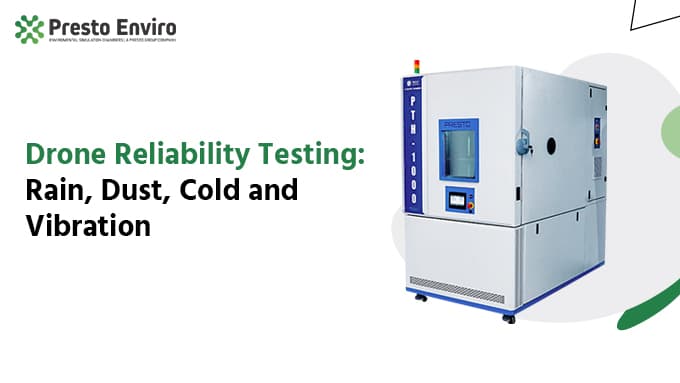
An environmental test chamber for drones is a test enclosure that can create climatic and mechanical stress factors like temperature, humidity, rainfall, dust, and vibrations. This way, you can apply a particular set of environmental conditions to your drone or its parts for some time and evaluate their performance and damage.
Since the conditions are controllable and replicable, comparisons of different models and versions of the product can be made.
Rain is one of the many threats to UAVs that fly outdoors. Rain tests are performed in order to check the ability of rainwater to enter the electrical systems, batteries, motors, and connectors from seams, vents, and entrances of the cables.
In the rain testing procedure, there is usually spraying or dripping of water at certain flow rates, angles, and durations, followed by functionality tests and the presence of any moisture. These results are normally expressed using IP ratings under IEC 60529.
Fine dust is abrasive and can find its way into the bearing area as well as clog up moving parts, sensors, and airflow. Fine dust testing takes place in places where dust is a constant problem—arid areas, agricultural sites, and construction sites.
Dust testing consists of exposing the drone to a certain amount of fine dust for a predetermined period of time and assessing the motors, cooling ability, and visibility of cameras and sensors.
Lower temperatures and higher altitudes affect the performance of lithium batteries, cause thickening of lubricants, and also cause plastic materials to become more brittle. An unmanned aerial vehicle that is launched under normal conditions will have problems taking off in cold weather.
Cold testing in a temperature chamber confirms:
Many programs also include high-temperature and humidity cycling to cover the full operating range.
Continuous vibrations occur due to propellers, motors, and improper handling. After some period, the vibrations lead to the loosening of screws, solder fatigue, and performance degradation of the connections, especially IMUs, gimbals, and cameras.
The vibration test is conducted using frequencies and amplitudes of a standard nature, which resemble the real situation during the flight and transport process. The test enables identifying the points of resonance, mounting problems, and more damped components.
The test plan can usually be based on established standards, which are chosen depending on the intended use of the drone. Standards used include
The right mix depends upon where the drone operates and how it operates, and hence it is advisable to know the mission profile beforehand.
Things rarely proceed in series in real-life situations. To illustrate this, consider a case of an airplane required to lift off in cold air, fly in rain, and land on dusty ground after vibrating for several hours. Testing in a series, such as temperature, vibration, and then water, will allow the revelation of certain modes of failure that would not otherwise be detected separately.
When selecting a chamber for drone reliability testing, consider:
Drones’ reliability tests are all about performance, safety, and gaining customers’ trust. Using the proper environmental simulation test chamber, you will be able to verify your design’s resistance to rain, dust, cold, and vibration without leaving the lab.
Presto Enviro helps manufacturing companies, research and development laboratories, and testing facilities choose and install environmental testing equipment that is best for them. Just tell us about your drone and the environment where it operates, and we will help you choose the right test system.
Call: +91 977 3666 011
Email: response@prestoenviro.com
What is drone reliability testing?
The process of subjecting the drone to various types of stress, like rain, dust, temperature changes, and vibrations to check for reliability of the drone is known as the following.
What environmental testing is necessary for drones?
Rain, water resistance, dust, temperature (low and high), humidity, and vibration are the key tests. The appropriate combination is determined by the intended application and operational region of the drone.
Can we test individual components of the drones without testing the whole aircraft?
Yes. Individual components like batteries, motors, flight control, gimbals, and cases can be tested separately during product development.
Why not just opt for field trials rather than the environmental simulation test chambers?
This type of testing facility provides a controllable and faster environment that allows you to conduct replications and comparisons while collecting data much more quickly and safely than if you were testing outdoors.
What determines my choice of specification for the chamber?
The first thing to consider is the mission profile of the drone, the standard that is being targeted, and the size of the object being tested.
Elevate your quality assurance process to new heights
Related Blogs
© Copyright 2026. All Rights Reserved by Presto Enviro Pvt. Ltd.