© Copyright 2025. All Rights Reserved by Presto Stantest Pvt. Ltd.

16-May-2026
Presto Enviro
Solar panels are a long-term investment and are rapidly becoming a household tradition. But they often face a major problem - Underperformance and inefficiency very soon. That is a real challenge in the solar panel industry right now. With so many manufacturers entering the market, quality has become inconsistent and without proper testing, buyers many times end up with poor products.
In this article, we will discuss how solar panel modules are tested under various conditions. You will also learn why solar module testing actually matters in the real world or practical situations and what the step-by-step process is. Whether you are a manufacturer, a quality engineer or just exploring this field, this article gives you all the details you want to know to improve panel’s performance and productivity.
A solar panel module is a single and autonomous unit that is made up of interconnected photovoltaic cells. These small modules absorb sunlight and convert it into usable electricity by the principle of the photovoltaic effect. They are the basic building blocks of residential, commercial and utility-scale solar energy systems.
Solar cells are usually made of silicon and are sandwiched between protective layers of glass and a polymer backsheet in each module. The frame holds everything together. These modules are commonly designed to last 25 years or more so that they are easily able to endure a lot of weather changes, heat, humidity and mechanical stress over their service period. However, such durability is not a miracle but a result of rigorous testing with solar panel test chambers and other instruments discussed.
The solar panel module testing is important to ensure safety, efficiency and performance of the system over the service time. Performance degradation, electrical firing, microcracks, delamination and moisture ingress are some of the most common failures they often face and must be addressed.
None of these is visible to the naked eye at the time of installation. A panel can look perfectly fine and still be operating at 70% of its rated capacity. Testing catches these issues early. It also protects manufacturers from warranty claims and helps buyers trust what they are purchasing. The solar panel industry is massive but it often lacks consistent quality which is addressed by rigorous testing.
Before initiating the testing procedure, the very first step is to visually inspect the modules carefully. The initial visual inspection filters out if there are any cracks in the glass, bubbles in the encasing material, cell misalignment and any other visible delamination.
This step is quick and straightforward to perform but should not be skipped. You may find some defects that can be easily fixed and you may never need to go further in the testing process.
The solar panel modules are tested under Standard Test Conditions. It means a controlled environment with an irradiance of 1000 W/m², a cell temperature of 25°C, and an air mass of 1.5 is required to proceed further. A solar simulator is also used that replicates these conditions and measures the output of the panel accurately.
At this point, the open-circuit voltage, short-circuit current and fill factor are some important parameters checked. This is done to validate what the panel claims. For example, if a panel displays that it can handle 400W, it should handle that exact amount. This sounds simple but it actually requires thorough testing to follow these standards and parameters.
The next important step is the thermal cycling test in which panels go through repeated cycles of extreme cold and extreme heat, similar to a hot and cold chamber. The temperature usually varies from -40°C to +85°C. Here you will find how the product will perform after years under these significant temperature fluctuations and a specific time period.
The objective of thermal cycling test for solar panel modules is to find any mechanical failures due to heat expansion and contraction that might occur over time.
One important step in solar panel testing is the damp heat test in which modules are placed in a climate-controlled chamber at 85°C and 85% relative humidity for 1000 hours. After this test, manufacturers are able to determine the survival of materials in extreme tropical conditions.
It is worth noting that moisture is a serious enemy of solar panels and can corrode internal connections while also degrading the protective coating to safe materials in various conditions. The damp heat test reveals if a module will hold up to long and humid conditions. This is crucial, especially when the installations are performed near coastline areas or tropical climates, as we discussed above.
Now, to check the material weakness against degradation due to intense ultraviolet radiation exposure, it is very important to run a UV exposure test. This test breaks down the polymer over time and accelerates the process of degradation under a specific time period to see how the modules behave in such simulated conditions.
During the test or after it, you can see the yellowing of the encapsulant or cracks in backsheets if the material is unable to withstand these specific conditions. Manufacturers or solar panel experts generally reject these materials as the real-life conditions can be harsher due to other environmental factors.
Mechanical load testing is among the most requisite tests that matter most during the handling of the panels. This test simulates physical stress like snow load, wind pressure, and even hail impact. During the test, panels are subjected to both static and dynamic loads.
A module might pass every electrical test and still fail mechanically. Frame deformation or glass breakage under load is dangerous, especially in rooftop applications.
After the stress tests, EL imaging is used to detect microcracks, broken cells, or inactive cell areas that are invisible to the eye. A current is passed through the module and the resulting light emission is captured by a camera.
This part matters a lot. Many panels that pass visual inspection and even electrical testing have hidden cracks that only EL imaging reveals.
Testing without a reference standard is testing in the dark. The most widely followed standard globally is IEC 61215 for crystalline silicon modules and IEC 61646 for thin-film modules. These cover most of the tests described above.
IEC 61730 focuses on safety qualification, making sure the module does not pose electrical or fire hazards. In some markets, additional certifications like UL 1703 in the United States or BIS in India are also required.
Manufacturers across the solar industry heavily depend on the solar panel test chambers that must comply with various standards. For such requirements, Presto Enviro is a reputable solar panel test chamber manufacturer for precise measurement and efficient production. Our solar panel testing instruments are built to handle damp heat, thermal cycling and UV exposure testing with accuracy while fulfilling the demands of specific standards. Our products are the perfect choice for laboratories that want to ensure compliance and work in photovoltaic testing environments.
Testing solar panel modules is an important step that is becoming mandatory for solar industries to ensure the durability and performance of the panels throughout the years. As we have discussed in this article, the process covers everything from basic visual checks, electrical performance testing, mechanical load testing, and more.
These tests are carefully designed based on real-world environmental conditions that include temerature variations, weather conditions and practical loads.
For manufacturers and testing labs looking to build a reliable testing setup, investing in the right equipment matters as much as following the right procedures. Presto Enviro offers a range of environmental test chambers specifically designed for solar panel testing that meet international standards and handle high-volume testing demands. If you are setting up or upgrading a solar testing lab, their team is worth contacting.
Get in touch with Presto Enviro to find the right solar panel test chamber for your quality assurance needs.
Elevate your quality assurance process to new heights
Related Blogs

23-Sep-2026
Presto Enviro
Products are expected to work reliably for months or years, but manufacturers cannot always wait that long to find out how they will perform. Accelerated aging testing solves this problem by exposing products to controlled environmental conditions that speed up certain aging effects.
20-Sep-2026
Presto Enviro
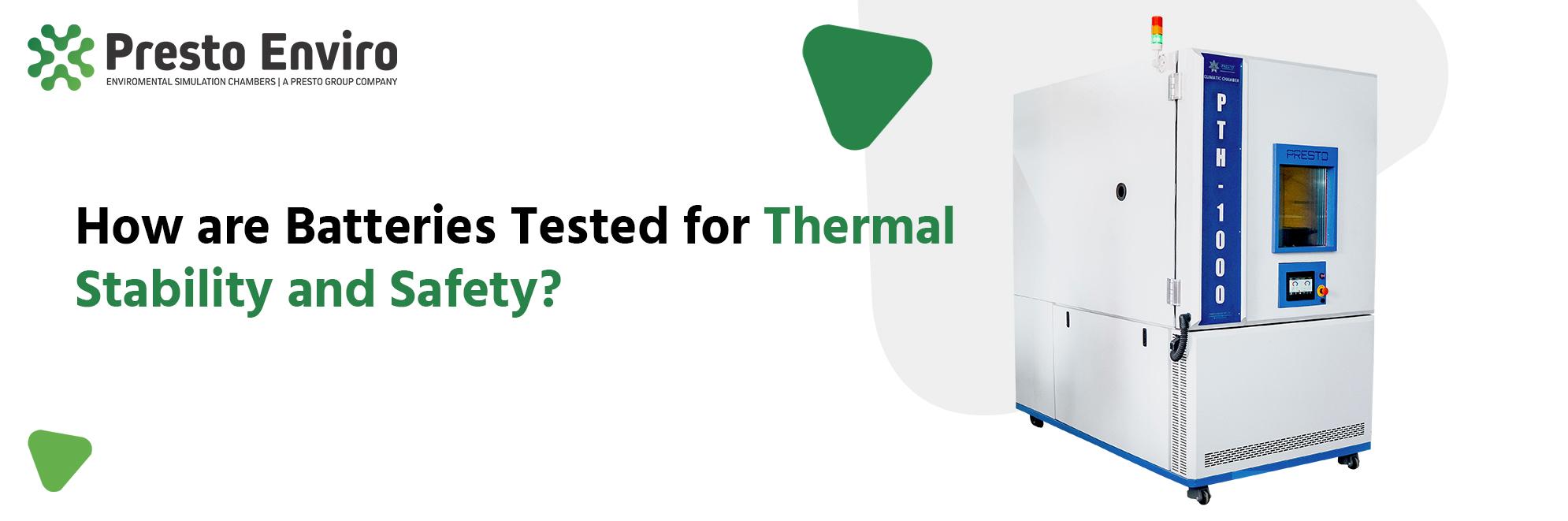
Battery safety is not something manufacturers can check only after a battery is ready for use. Temperature, charging conditions and repeated use can change the way a battery behaves. In some cases, excessive heat can cause permanent damage or create serious safety risks.