© Copyright 2025. All Rights Reserved by Presto Stantest Pvt. Ltd.
12-Jun-2026
Presto Enviro
Most environmental chambers are built for components. These chambers are small enclosures that provide controlled conditions for testing one or a few specimens at a time. That setup works until the product being tested does not fit inside a cabinet. A fully assembled vehicle, a large industrial unit, or a complete system-level assembly cannot be broken down and tested in pieces and still produce meaningful results.
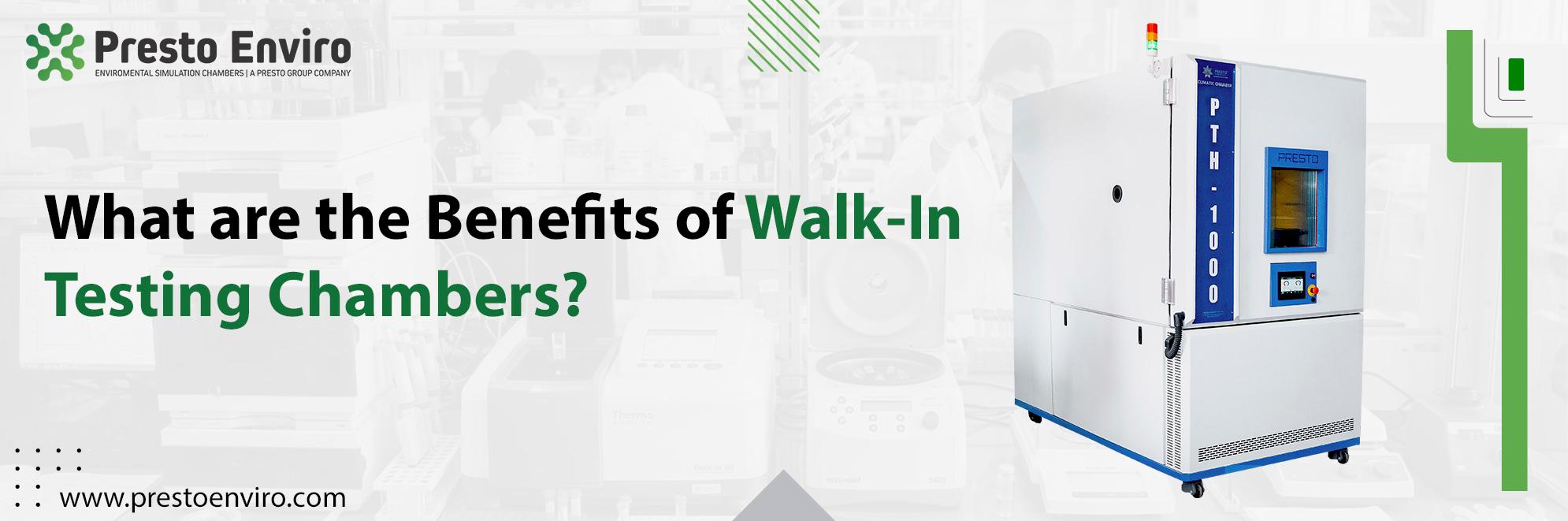
Walk-in testing chambers are capable of bridging the existing "temperature & humidity" control gap that exists between normal or typical products, areas of testing or quality assurance, and the actual environment in which a product will be used. This article provides descriptions of what a walk-in chamber is, how a walk-in chamber is manufactured, how a walk-in chamber operates, and what benefits a walk-in chamber can provide compared to standard chambers.
A walk-in testing chamber is a large environmental enclosure designed to simulate controlled temperature and humidity conditions across a space large enough for operators to physically enter. Products are tested as complete assemblies, not broken down into parts.
Size is what sets them apart. A standard cabinet chamber might offer a few hundred liters of test volume. Walk-in chambers start where those leave off and scale up to hundreds of cubic meters depending on what needs to be tested inside. Automotive manufacturers run full vehicles through temperature and humidity cycles.
Aerospace and defense sectors test large structural assemblies and complete system configurations. Pharmaceutical facilities run large batch stability studies where testing individual units separately would take months. The common thread across all of these is that the product needs to be tested at actual scale to get data that reflects actual performance. Walk-in chambers make that possible.
A walk-in testing chamber diagram consists of several integrated systems, each handling a specific function within the overall enclosure.
Walk-in test chamber working principle operates by maintaining its test environment through continuous coordination between its heating, cooling, and humidity systems. These processes are managed by the controller, reading live sensor data from inside the enclosure.
When conditions drift from the setpoint, the system corrects automatically. A temperature drop triggers heater output. A rise activates the refrigeration circuit. Humidity is managed the same way, with the generation or removal system responding to whatever the sensors report. The result is a stable interior environment that holds its programmed condition regardless of what is happening outside the chamber walls.
Working procedure of walk-in testing chamber: The operator programs a test profile into the controller before the cycle begins. That profile defines starting conditions, ramp rates between setpoints, hold durations at each condition, and the full sequence of environmental transitions the test requires.
Once started, the chamber moves through each phase on its own. Sensors distributed across the test volume feed data back continuously. If any zone drifts, correction happens in real time without operator intervention. For tests that require human entry during the cycle, door sealing systems and safety interlocks maintain interior conditions during access.
When the cycle ends, the controller has logged the complete temperature and humidity history for the entire run. That log feeds directly into test reports and compliance documentation without needing to be reconstructed from memory or notes.
The advantages of walk-in chambers over standard formats are not just about size. They change what kind of testing is actually possible.
Complete products can be tested without disassembly. A vehicle goes in as a functioning system. A large industrial unit gets evaluated under thermal stress with all its components in their actual configuration. This produces results that reflect how the product behaves in the field, not how isolated parts behave in a lab.
Smaller products can be loaded in large quantities and tested simultaneously in a single cycle. For pharmaceutical stability or packaged goods testing, this cuts the time and cost per unit considerably compared to running multiple smaller chamber loads back to back.
Shelving, vehicle ramps, fixtures, and mounting points can be arranged to match whatever is being tested. Presto Enviro builds walk-in chambers with configurable interiors so the test setup matches the product requirement rather than the other way around.
A well-engineered walk-in chamber with proper airflow distribution holds tight uniformity across its full test volume. Every specimen in the chamber experiences the same conditions. That consistency is what makes multi-specimen test results comparable and defensible.
Walk-in chambers are built for industrial-grade continuous use. Accelerated aging programs, multi-day environmental exposure cycles, and long-term stability studies all run without operational interruptions.
Unlike sealed cabinet chambers, a walk-in design allows entry during the test for observation, intermediate measurements, or specimen adjustments without terminating the cycle entirely.
When standard chambers cannot accommodate the product, walk-in testing chambers are not an upgrade. They are the only practical option. Presto Enviro is a trusted walk-in testing chamber manufacturer and supplier in India, building chambers across a wide range of sizes and specifications for industrial and laboratory applications. If you are considering walk-in chamber options for your facility, contact Presto Enviro through our official website to discuss dimensions, temperature and humidity range requirements, and the best configuration for your testing needs.
Elevate your quality assurance process to new heights
Related Blogs
15-Sep-2026
Presto Enviro
Corrosion is one of those problems that may appear mild at first and later turn costly. A metal part may leave the manufacturing facility appearing undamaged, yet suffer corrosion, stain formation or coating failure as a result of its contact with moisture, salts and changing weather conditions.
11-Sep-2026
Presto Enviro
Metal parts exposed to environmental elements like rain, high humidity and saline air are subjected to quick degradation. Manufacturers don’t have years to wait to see long-term real-world durability with immediate shipping deadlines.